
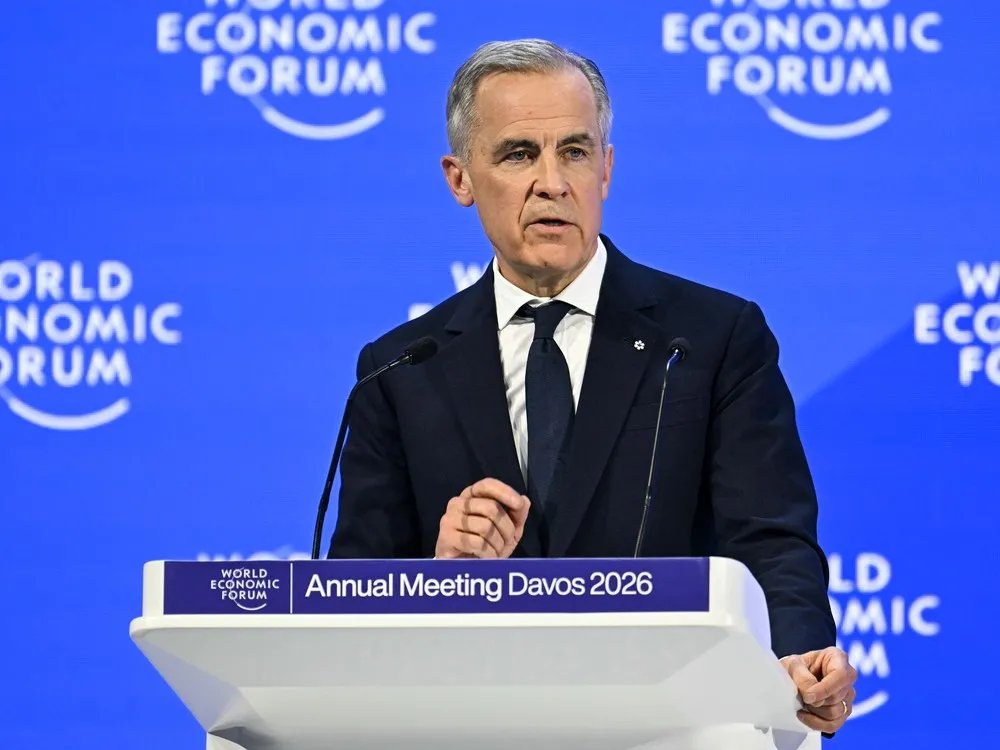
WASHINGTON, D.C. — U.S. Secretary of State Marco Rubio offered a surprisingly conciliatory speech at the Munich Security Conference, and European leaders gave addresses that responded to Prime Minister Mark Carney’s powerful Davos speech and the need for a stronger, more independent Europe.
To cut through the messaging and diplomatic fog, the National Post spoke with former CIA deputy director and acting director John McLaughlin — who was in Munich — for his inside take on allied perceptions of America’s global role, U.S.-Canada ties, and intel-sharing risks and opportunities. Today, McLaughlin is a professor of practice at the Johns Hopkins School of Advanced International Studies.
This interview has been edited for length and clarity.
Q: At the CIA, you oversaw intelligence assessments after 9/11 that included monitoring threats to North America that relied on U.S.-Canadian security ties and information sharing. Are you worried about the prospects for future cooperation between the two countries in an era when 31 per cent of Canadians believe the U.S. could one day invade Canada? How important are strong U.S.-Canada ties and Canadian intelligence cooperation for North American security?
U.S.-Canadian ties are, I think, at the heart of American security but they are strained diplomatically at this time, which is not good. Canada is a member, as is the United States, of the Five Eyes grouping, which includes the United States and Commonwealth countries. In that sense, it’s a key member of a security grouping that’s vital to the United States. That, to me, is the core of American security, and particularly the core of American intelligence cooperation.
Based on my experience in working with intelligence services, I would say that even when international relationships are strained at the diplomatic or political level, intelligence cooperation among allies tends to go forward without significant friction or interruption. I would suspect that will be the case between Canada and the United States, even if this period of political tension persists. This is one of the benefits that comes from intelligence liaison relationships — that they occur below the level of public controversy and scrutiny, and they tend to keep things on a fairly even keel in national security matters.
I saw this during the Iraq war, for example, when many European countries were adamantly opposed to what the United States was doing, but they continued to work with the U.S. intelligence community on issues of common concern, particularly terrorism. So I would like to think that the intelligence ties between Canada and the United States will remain a lifeline that keeps things close on national security, even if political tensions and diplomatic tensions persist for understandable reasons.
Q: Have the U.S. moves in Venezuela and threats against Greenland damaged Allied trust, and do you take Trump’s 51st state threats seriously?
I do not take the threat of a U.S. attack on Canada, or some effort forcibly to integrate Canada into the United States, seriously. I suspect President Trump means it at some level, but I can’t imagine that actually happening.
With regard to Greenland, I take seriously that President Trump and a good part of his administration strongly desire, at minimum, increased influence and, at maximum, actual possession of Greenland. In other words, I’m saying I think they were advancing the idea seriously. However, I don’t think they will get what they’re looking for.
Everyone knows that most of what they concretely desire can be obtained through negotiation and willing provision by the Danish government, in terms of bases presence and enhanced security. I’m confident the Danes, backed by the European partners, are willing to work to satisfy whatever security concerns we have about Greenland.
Now, about Allied trust, one thing I sensed while at the Munich Security Conference was the increased confidence one feels in Europe about their ability to navigate with greater independence from the United States, while also hoping and wishing the United States remains engaged with them and with NATO. There is an increased confidence to stand up and say, ‘we are going to pull ourselves together and take care of ourselves.’ I think a good deal of that came from the dust-up over Greenland and their success in walking the president back from that idea through a mixture of firmness and careful diplomacy.
The head of NATO, Mark Rutte, I think has developed a personal relationship with Trump that, I’m guessing, allows him to speak to him in a manner that combines friendliness with candour. And I think a combination of that with the kind of firmness that they displayed in saying no and in deploying some of their own forces to Greenland, took that issue off the hot burner.
Q: Compared to JD Vance’s 2025 Munich speech, how should allies like Canada interpret Rubio’s softer tone while he was still dismissing the rules-based global order as a “dangerous delusion” — particularly when it comes to U.S. reliability on Ukraine aid, China deterrence, and future trade-security ties under USMCA?
I think Rubio’s speech was very cleverly constructed — and that one can find in it whatever one wants to find in it. If you were looking for reassurance, it was there. His use of phrases like “We are all children of Europe” and his identification with North America’s cultural heritage from Europe — all of that was reassuring.
The tone was reassuring. Tone does matter.
I witnessed the speech and what I saw was a kind of openness and transparency, without anything that was overtly insulting or demeaning, that conveyed a tone of, “We’re in this together now.”
If you want to be less assured, then you can look at the parts of it that echo the underlying themes of what Vance said last year at the same conference. Those underlying themes were a skepticism about energy policies that Rubio referred to as serving the so-called climate cult, his reference to immigration as something that is a threat to create civilizational erasure, and religion. Introducing religion into a speech like that is always controversial.
You could find evidence in the speech that there are still major policy and cultural differences between the U.S. and Europe. From the European point of view, they are committed to climate change, their democracies are strong, and they look at the United States and question whether Washington is adhering as faithfully as it should to the rule of law and such. It’s very irritating to them when Americans come over and lecture them about these things. Now, Rubio did not lecture, but you had a sense that he was not that far off from where Vance was, despite the much more welcoming and unifying tone.
So it was a cleverly constructed speech that won a spontaneous standing ovation. I suspect that as people absorbed what actually had been said and looked at the text in black and white, they might not have all stood quite as reflexively as they did. But, bottom line, it was an improvement over last year.
Q: At Davos, Prime Minister Mark Carney made headlines by referring to a “rupture” in the rules-based global order. Do you agree with Carney’s assessment? How did Rubio and European leaders respond to Carney’s speech in their own addresses at Munich?
I think Prime Minister Carney did a real service in stating things in an eloquent and, simultaneously, stark way. I met Vaclav Havel when I was working on East European politics as the Cold War ended, and I have read a lot of his work, so I got what Carney was talking about when he referred to Havel as a kind of herald of what’s going on today.
The use of a term like rupture, of course, got everyone’s attention. Sometimes it takes that kind of stark statement to jolt everyone enough to actually make them think. A lot of the themes in the speeches by (European Commission President) Ursula Von der Leyen, U.K. Prime Minister Keir Starmer, and German Chancellor Friedrich Merz echoed some of the same themes but stopped short of the notion of rupture. The only one who used the term was Starmer, and he said that instead of rupture, let’s make this a moment of creativity, or radical renewal, let’s not think of U.S. withdrawal, but more of burden-sharing.
So I think Prime Minister Carney’s point registered. I don’t think they were disputing what he had to say. They were taking on board his broader point that everything has changed. This came out explicitly in most of what they had to say about having to work for our independence in everything from defence preparation to defence industry. But they still hope that the United States will still be with them in the crunch.
I think what they’re saying is, along with Carney, we have crossed some sort of bridge here. We are in a different world. We must be more independent in all respects, but, bottom line, we want to keep the U.S. involved because we don’t have the sense that we can do everything by ourselves.
I saw Carney’s speech as a wake-up call to everyone. And I think he got everyone’s attention with that phrase about rupture. It doesn’t mean everyone has to agree with, but I saw no evidence that they were turning their back on his broader point.
Q: Europe has been encouraged to boost its defences for years. In Munich, von der Leyen said Europe must be independent, but is that really possible — can Europe go it alone? Could Canadian involvement in SAFE complicate NORAD/Five Eyes trust with the U.S.?
Well, I think it could complicate Canada’s relationship with the U.S. and NORAD. On the other hand, this is ultimately a choice Canada has to make. Canada’s involvement in Europe’s effort to achieve a greater measure of independence would, in fact, be important to Europe’s success in that endeavour. Canada’s defence posture, its experience, and its closeness to the United States would allow it to play an important advisory and insightful role in working with Europe.
That said, I’m sure it will complicate Canada’s relationship with the U.S. But when I came away from those discussions, what struck me as truly novel about Europe’s current push for independence is the emphasis on developing its own defence industry. Ursula von der Leyen gave what I thought was probably the most comprehensive and thoughtful speech on that point. The key message I took away from it was: we can desire to be independent, but we can’t be independent without capability.
Her focus was really on building a European defence industry capable of producing the equipment needed to be an independent defence power — everything from manufacturing weapons at scale to ensuring interoperability among European forces and integration with NATO. Of course, there’s still the traditional tension between what the EU wants to do and what NATO wants to do. Even though their memberships overlap, the governance structures differ, and the membership isn’t perfectly aligned.
So, to summarize, two things can be true at once. On one hand, Canada working more closely with the Europeans on defence will help Europe get its act together, since Canada brings experience and valuable insight into how to integrate efforts with the United States. On the other hand, Canada’s participation in efforts aimed at building a more independent European defence posture will likely complicate its relationship with Washington.
But an important qualifier here: If the United States truly believes that Europe should take more responsibility for its own defence — essentially managing conventional defence while the U.S. continues to provide the nuclear umbrella — then Washington shouldn’t object to Canada helping Europe build that capability.
Q: Carney’s new defence strategy came out this week, and it aims to divert 70 per cent of procurement away from American firms. Is such diversification a good thing for Canada? What risks are involved, and what if Canada decides not to purchase the rest of the Lockheed Martin F-35s it pledged to buy in 2022, opting instead for the Swedish Gripen? How would Trump likely react and could this compromise NORAD interoperability or Arctic defence?
When it comes to things like defence procurement, I think of it a little bit like the way I think about intelligence. My feeling is always that it’s important to insulate intelligence cooperation and sharing from whatever political, geopolitical, or diplomatic tensions exist between countries. And I lean the same way when it comes to defence procurement and defence cooperation.
My own view — but this is for Canada to decide — is that the decision for procuring equipment and weapons purchases should be made on a purely professional basis. I know from what I’ve read that the Canadian Air Force leans toward the F-35, and if I were making the decision, I would go with the Canadian Air Force recommendation because they’re the ones that Canada will have to rely on for its defence.
At the end of the day, when we tried to establish our priorities in the intelligence world and were unable to do everything, the top priority was always on protecting the lives of Americans and our allies. So we can have all the political fights and diplomatic battles that we need to have, but in making those decisions, make them based on what best protects the lives of Canadians. And if that means the F-35, I would go with the F-35.
Now there are cost issues involved, I know. And the Gripen is a very fine aircraft. But from what I’ve read, in Canada’s own evaluation of capabilities, the F-35 continues to come out on top. From what I know, it is indeed the best combat aircraft in the world. Go for the best, is what I would say.
I suppose on the other side of that, one could say, well, that makes you more dependent on the United States. But again, I tend to insulate defence and intelligence decisions from politics to the extent possible.
Regarding Trump’s reaction, I gave up trying to guess his reactions to things long ago. Given everything he’s said, one would expect him to react badly to a decision to go with the Gripen. That should not be the governing factor in Canada’s decision, though.
Canada has to look at this with very cold eyes and very objectively.
I’m not an expert on this, but it just seems logical to me that having a different aircraft would affect the interoperability of NORAD operations in monitoring and protecting the North. When I say interoperability, does that mean they would not be effective? No, not really. I’m just saying it would make it more difficult. Military people are very professional, and they will figure out how to operate these two air forces, whatever the aircraft.
Q: What divergences did you observe within NATO at Munich on U.S. reliability for Ukraine aid?
I would make two major points. The first is that the Europeans feel the threat from a defeated Ukraine much more intensely than most Americans do – and their governments feel this more intensely than the American government. Personally, I think Ukraine is the most important international issue we are dealing with and that allowing Putin to prevail would have long-range disastrous consequences. It’s not that the average American does not want Ukraine to have a prosperous, independent future. It’s that the Europeans feel the threat from a defeated Ukraine more personally and immediately and urgently than we do because, well, because they’re there, literally right up against it.
Secondly, they desperately want the United States to remain involved as the backstop and the reliable partner, particularly. If they end up having responsibility for providing security guarantees to Ukraine once, and if ever, an agreement is agreed to, they hope the United States will be there in a backup role because they do not yet have confidence that they can do that on their own, dealing with the Russian threat.
So they hope, but you come away with a sense that they’re not 100 per cent confident they got that. Someone in the United States might say, “Oh, we’re going to be there.
We’re fine. Don’t worry about us.” But Europeans don’t give the sense of being convinced of that yet, and that spurs their drive to prepare for the possibility, however you want to gauge it, that they might, in the end, be on their own.
Q: The U.S. has been pushing Canada to ramp up its defence spending for years. We’re finally seeing movement, with Carney getting to the 2 per cent of GDP this year. Are there specific Arctic or cyber intelligence gaps that Ottawa needs to fix to counter any American doubts on Canada’s NORAD capability and credibility?
Well, I actually don’t know — as I’m no longer in the U.S. government. But just logically, to me it seems that the thing that Canada could be most helpful on would be Arctic issues.
The U.S. is coming kind of late to the Arctic party, if you will, in terms of capability. Everyone looks at our shortfall in simple things like icebreakers, but it’s more than that. I think Canada, as an Arctic nation, has a depth of knowledge, expertise, and experience that the United States simply doesn’t have.
And yet, clearly the Arctic is going to be — looking down the road another 20, 30 years, even today — but looking down the road, Arctic issues in terms of transportation, trade, resource exploitation will be one of the truly strategic parts of the world, strategically important parts of the world.
So just as an ally like Australia brings value to the alliance through its deeper expertise on the South Pacific and Southeast Asia, so Canada can bring value to the alliance — and value to its own membership — by contributing the expertise, presence, and experience it has in the Arctic.
Q: Finally, what advice might you share with Prime Minister Carney for his dealings with the White House on defence or trade matters amid today’s tensions?
My own experience is that if you don’t live and work in the White House, if you’re not in and out of there every day dealing with the National Security Council and other officials — and I am currently not any of those things — you’re really not in a position to advise wisely about how to deal with any White House.
Given that, I think Canada’s best posture in these negotiations is one that emphasizes candour in a calm and deliberate way, and without rancour, and also emphasizes Canada’s fidelity to the alliance and to our mutual defence and security. Keep trying to heal the breaches that have opened up between the United States and Canada, while at the same time, underlining Canada’s independence and contribution to the alliance. And hope that this is a sufficiently professional way to have a sensible negotiation and an outcome good for both sides.
National Post
Our website is the place for the latest breaking news, exclusive scoops, longreads and provocative commentary. Please bookmark nationalpost.com and sign up for our newsletters here.
