
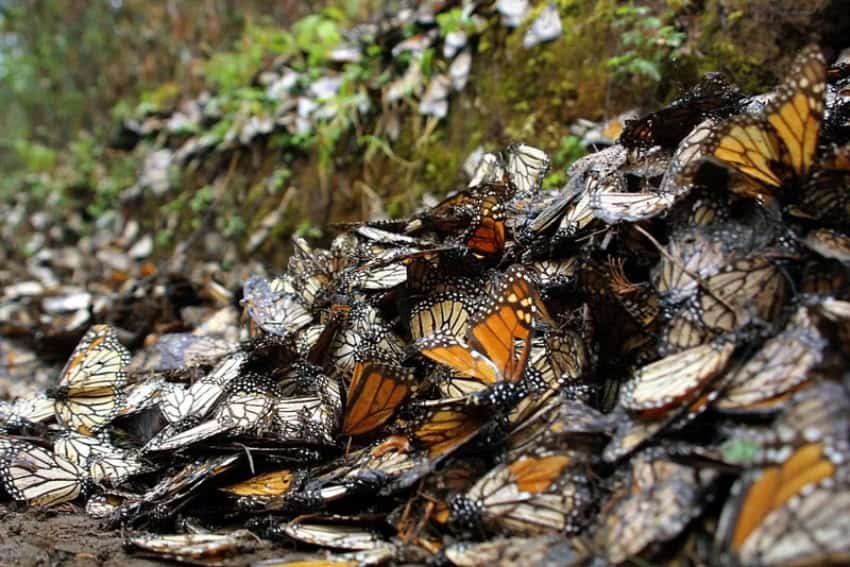
The monarch butterfly weighs roughly one gram — about the same as a raisin. It navigates thousands of miles on instinct, chasing the same high-elevation oyamel fir and pine-oak forests in which every monarch butterfly before it has found refuge. Like the thousands of Americans and Canadians flooding Florida’s coasts each winter, monarchs are snowbirds. But unlike their human counterparts, the world is not their oyster. The forests of Michoacán and Estado de México — cool, humid and dense — are the only place on earth where the eastern monarch migration ends. There is no Plan B.
But something is burning through these forests. And it isn’t fire.
The cartel economy beyond drugs
The cartels operating across Michoacán and Estado de México, two of Mexico’s poorest and most conflict-ridden states, have built a thriving economy most people never consider – assuming it’s a drug-only network. The reality is far broader: timber, land conversion, extortion, water and avocado. When the revenue from one market softens, as it did in the 2010s when U.S. demand for heroin and marijuana nosedived, cartels simply readapt. Organized crime groups move swiftly into regions rich in natural resources that yield heavy profits. Right now, that includes one of the most important ecological corridors in the western hemisphere.
The monarch butterfly, it turns out, winters in cartel territory.
Illegal logging and the monarch butterfly reserve
The Monarch Butterfly Biosphere Reserve (MBBR) is a UNESCO-protected territory that spans across southern Estado de México and northern Michoacán. It covers just over 56,000 hectares across three core zones, where logging is prohibited so monarchs can spend the winter. Two buffer zones of about 42,000 hectares extend in a ring-like fashion from the MBBR; here, farming, logging, and tourism activities are permitted within a controlled program. It is also home to Indigenous and ejido communities who use that land to make their living, and the organized crime cartels that control them.
When the drug market shifted, cartels diversified their portfolios, expanding into logging in Mexican forests that often overlapped with butterfly territory. Traffickers personally threatened or co‑opted ejidos (communal rural land) and private loggers, taking control of community permits that define volume limits and authorized areas. Many forcibly demanded fixed cuts of profits in exchange for “protection.” Others brought in their own felling crews; locals who refused to join were often left with no choice but to abandon the area.
The model proved profitable, and traffickers started using forest roads to move timber and drugs under the cover of legal activity, then setting up clandestine labs to process narcotics deeper in the mountains. To run these operations, they altered natural river flows for water, clearing more forest to open access and feed their labs’ demand. The more forests they cleared, the more springs dried up, stripping monarchs of the shelter, water and cool, humid microclimate required to survive the winter. Some locals tried to stop the destruction, leading to their own.

Murder in the sanctuary
On Jan. 13, 2020, Homero Gómez González attended a local fair in his town and was never seen alive again. Two weeks later, his body was found in a retention pond with blunt head trauma.

González had been a logger before becoming a conservation leader upon seeing the effects of deforestation. By enlisting community leaders, he built El Rosario into one of Mexico’s most visited monarch sanctuaries, organized reforestation projects and anti-logging patrols, and negotiated compensation for communities willing to stop cutting their forests. This involved disrupting the illegal logging operations of groups that did not appreciate his efforts.
Just days after his body was recovered, Raúl Hernández Romero, a conservation guide working in the same region, was found dead by stabbing inside the El Campanario sanctuary. Authorities have not publicly resolved either murder. International condemnation followed, and the Mexican government’s response did little to protect the activists — or the butterfly sanctuaries they had given their lives to defend.
Green gold, dead forests
The avocado boom in Michoacán began in the 1990s and to date, has never slowed. The cultivation area in the state has nearly tripled to roughly 400,000 acres, and as existing farmland filled up, growers pushed into the forests. By 2018, nearly 2,400 acres inside the reserve itself had already been converted to avocado orchards. According to researcher Alfonso De la Vega-Rivera, this has happened despite “not one single legal authorization for forest clearing” being issued in the state — a clear indicator that the majority of avocado orchards established in recent years are illegal.
Drug cartels use the avocado to launder profits and dominate the market through extortion of farmers and bribery of government officials. The pattern is the same one playing out in the logging sector: threaten, co-opt, extract.
Clearing trees isn’t the only problem here. Avocado orchards require at least 75,000 gallons of water per acre during a typical dry season, with farmers drawing from local springs, wells and streams — leaving many local rivers running dry. For a butterfly that depends on moisture to survive the winter, a drying watershed is as damaging as a chainsaw.
What the butterfly pays
In the winter of 1996–1997, the overwintering colony covered 18.19 hectares of forest. This past December, it measured 1.79 hectares — up from a record low of 0.9 hectares the winter before, but still well below the long-term average.
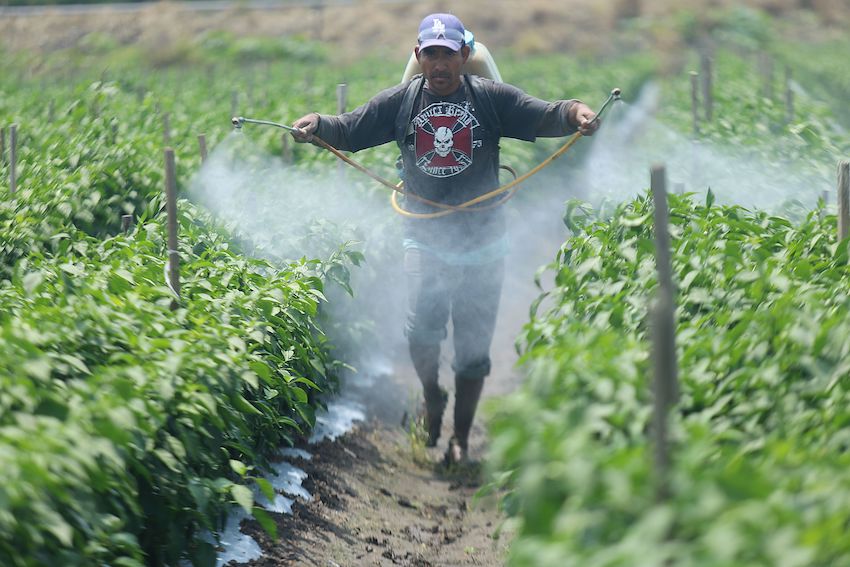
Climate change, pesticides and milkweed loss on breeding grounds all play a role in that decline, and it would be reductive to blame cartel activity entirely. But if the overwintering forests fall, nothing else matters.
The relationship between cartel economics and ecological collapse is not a simple one. Deforestation has many drivers, monarch decline has many causes and some Indigenous communities are actively holding the line against both. What’s clear is that organized crime has made an already fragile situation significantly harder to reverse — by turning forest defense into a life-threatening act, and the forests themselves into a revenue stream. The butterfly has no margin for error. The cartels have plenty.
Bethany Platanella is a travel planner and lifestyle writer based in Mexico City. She lives for the dopamine hit that comes directly after booking a plane ticket, exploring local markets, practicing yoga and munching on fresh tortillas. Sign up to receive her Sunday Love Letters to your inbox, peruse her blog or follow her on Instagram.
