
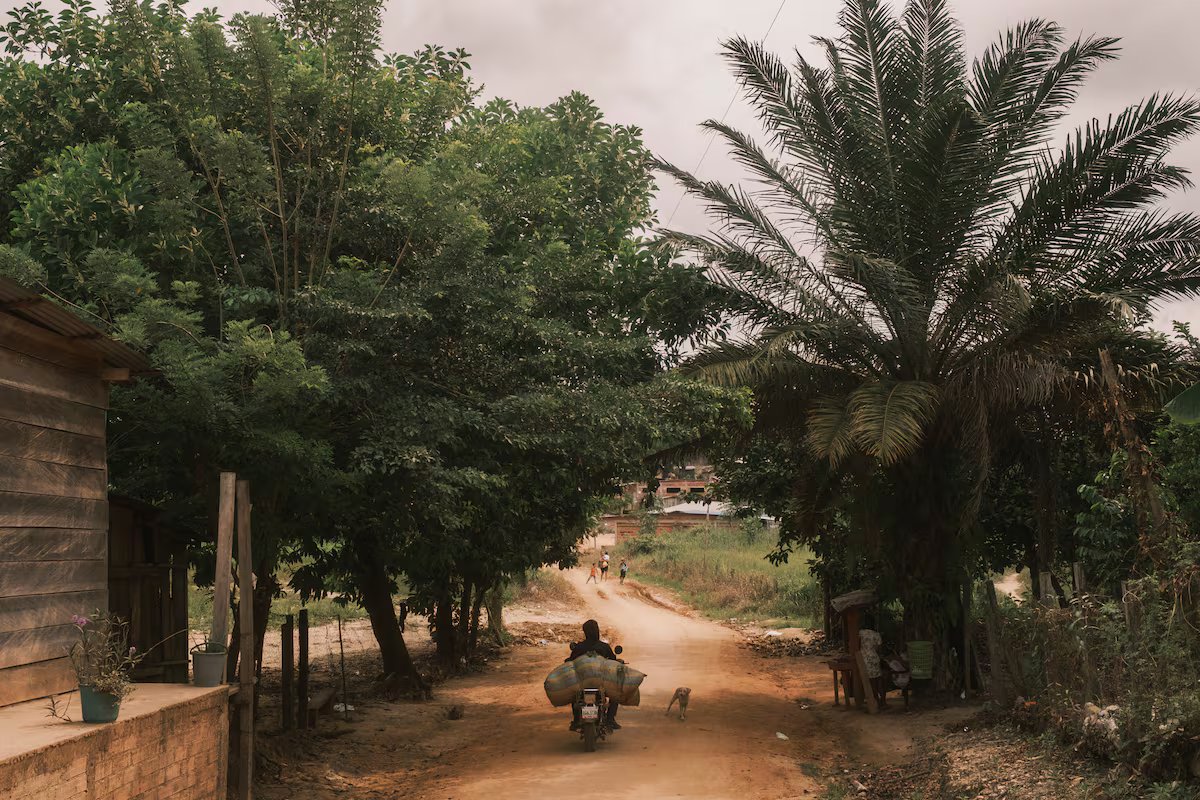
The bus had been bumping along a broken road for almost five hours, bouncing from pothole to pothole. Inside, the heat was building and the dust clung to their skin. Suddenly, the vehicle screeched to a halt at the gates of Tibú, the capital of the Catatumbo region in northern Colombia. Anywhere else it would have been just that: a stop. Not in Catatumbo.
A guerrilla fighter in civilian clothes, with an old rifle slung over his shoulder, climbed into the vehicle. He introduced himself as a member of the National Liberation Army (ELN), one of Colombia’s armed groups that brings death wherever it plants its flag.
“What are you doing here? Foreigners?” he asked, noticing some blond and red hair.
“Humanitarian delegation?” he insisted, frowning at the response.
And he got off the dilapidated coach.
At the same time, a young man on a motorcycle confronted the convoy’s only armored truck. He brandished his silver revolver with a cup of mango ice cream dangling from his mouth.
“Roll down the windows! Put your hands up!” he shouted, the ice cream already splattered on the floor.
But the windows of the armored vehicle don’t roll down.
The tension eased with no explanation other than a soldier approaching to within 30 meters. How could they be so close? The question began to circulate among those who witnessed the scene, until a new fear took hold on the bus — and in the 20 or so trucks that followed it: being caught in the crossfire.
In the end, no shots were fired. The incident remained just an anecdote, but in Catatumbo, this is everyday life. The routine of a territory where no one enters or leaves without permission, where no one is free to do or say whatever they want. For over 15 months, leaving home — and even staying in it — has meant risking being caught in the middle of a shootout.
This is also a war of movement: of roads that cannot be taken, of towns that cannot be left, and of families resigned to staying put.
Catatumbo, one of Colombia’s largest coca-growing regions, is embroiled in a conflict that doesn’t garner much international attention. For the residents of this border region with Venezuela, violence is nothing new, but since January 16, 2025, it has escalated to levels not seen in decades. On that day, a funeral director from Tibú, his wife, and their infant son were murdered.
Theories continue to circulate as to why they were killed in the same hearse, but after that massacre, a bloody dispute began between the ELN and the 33rd Front, a faction of the dissidents of the now-defunct FARC, guerrillas who did not sign the peace agreement in 2016. And the most serious humanitarian crisis that Colombia has suffered in 20 years was unleashed.
Since then, 99,000 residents, the vast majority farmers, have had to abandon their homes and crops, according to the NGO Vivamos Humanos. There have also been more than 4,000 emergency evacuations, over 170 civilian homicides, and at least 262 violent incidents in 2025, making Catatumbo the country’s most volatile region.
Trade has ground to a halt, and people remain afraid to go to work or even to tend their own land. Staying safe is becoming increasingly difficult. In places where the internet is only available via satellite and there isn’t a single doctor for miles around, the war, in turn, has brought its own innovations: mines in the roads, drones carrying explosives in the sky. “This is a factory of victims,” laments César Ruiz, a community leader who represents more than 12,000 residents.
There’s not much ideology in this battle. They’re killing each other to conquer a territory rich in oil, coal, and coca crops, and to control a corridor to Venezuela, key for drug trafficking and the movement of armed groups. It’s a fratricidal war: many of those shooting at each other have known each other forever. They’re relatives, friends, or acquaintances who ended up on opposing sides. And their victims, besides the guerrillas, are the residents. Displaced. Dead. Mutilated. Spied on. Terrified. Desperate to leave.
The treacherous roads of Catatumbo wind through ghost towns. The bus slowly passes between boarded-up facades, “For Sale” signs, and gates bearing a warning: “Beware, landmines.” On the way to Kilometer 25, one of the three towns visited by EL PAÍS, the bar Las Reinas del Norte has lost every last bottle, and dust has settled on the pool tables on the porches. No one plays anymore. No one stops. Graffiti bearing the guerrillas’ acronyms marks the empty houses and the school — that supposed shield against attacks — is dead.
Beyond the zinc roofs lies the jungle and the mountains, the habitat where the guerrillas and their businesses hide.
But not everyone can leave. Or they don’t know where to go. They ask for help from the government, which doesn’t always arrive. Lucía, a 40-year-old farmer, registered as displaced four days after the war broke out and has been waiting ever since. Throughout Norte de Santander, the department where the Catatumbo region is located, 421,607 people are registered as victims, mainly due to homicide, threats, and forced displacement. “It’s been so incredibly slow… There’s no aid, no income. And in the village, there’s nothing to live on,” she laments, on the condition of anonymity. She hasn’t slept on her farm in over a year.
Kilometer 25 greets visitors with the red-and-black flag of the ELN, once a guerrilla group that combined Marxist-Leninist doctrine with liberation theology. Today, its beliefs are unclear. Children with platinum blonde hair stand out in this town of mestizos and Indigenous people. They are the legacy of oil, which in the 1920s brought American companies, wells, foreign currency, settlers, and the attempted extermination of the Barí Indigenous people. Here, people live in open-air cages. They don’t even leave to give birth. There are babies who have reached three months old without their parents having registered them. To do so, you have to go out onto the highway.
More than 30,000 people have lived in confinement at some point during this crisis, and more than 600 were still in that situation when EL PAÍS toured the area.
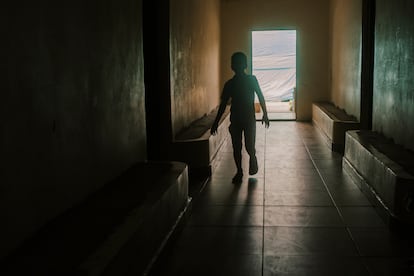
Even so, there are those who choose not to leave. Not because they aren’t afraid, but because leaving also means losing everything. Some stay out of conviction, as a form of resistance. Roberto, a 30-year-old community leader and father of two young children, says that leaving would mean abandoning everything they have built over the years. “It’s not easy to leave things behind: the farms, the animals, what you’ve achieved with so much effort,” he says on condition of anonymity.
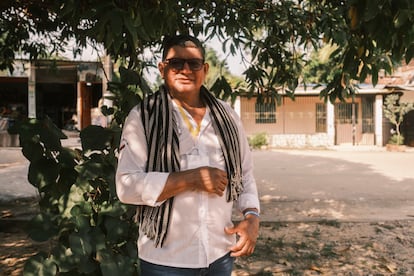
Elkin Robles, another of the leaders resisting in the territory, hasn’t seen his mother and brother for eight months, even though they live relatively close. There’s no explicit prohibition, but he’s afraid. “It’s not that I don’t want to go, but there’s a constant feeling of risk,” he explains. “There are towns that look like they belong in another country… like Iraq, all destroyed, but it’s Colombia, and it’s my Catatumbo,” laments Robles, 38. “Even so, I’m not going to leave,” he asserts. “Staying is the true revolution.”
The problem, Robles says, is that it’s not just the war. “What’s needed here is social investment. We’ve always been neglected.”
“They listened to us, yes, but what have they done since?” asks Paulo Téllez, speaking to his neighbors in a camp where 180 displaced people live — including nearly 60 children. Their makeshift homes, built with tarpaulins and wooden planks on the banks of a tributary of the Tibú River, are beginning to look permanent.
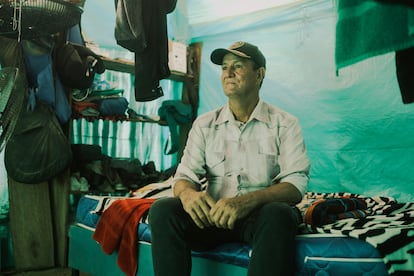
The complete absence of the state begins with the roads, which haven’t been repaired since they were built. There’s no drinking water, and in many places, people flush the toilet with a bucket of water. Children don’t even receive their first vaccinations. There are more police officers than doctors. The new generation studies as best they can, but their elders consider them lost. “What are they going to do here, no matter how many degrees they have?” they ask.
The 20 trucks of the humanitarian convoy, led by Vivamos Humanos, arrived in a line with white flags waving from the windows, and within minutes a queue had formed. Mothers with babies in their arms, farmers with crumpled papers, fathers asking in hushed tones what they had to do to prevent their children from being recruited.
More than 20 institutions, from the Presidency to the Ministry of Health, were trying to make up for the months — the years — of absence. Here, the state appears suddenly and for a few hours.
Among those waiting is a family in a hurry. They’ve given themselves 10 days to leave. The ELN has tried to take their 17-year-old son too many times. First, they offered him a salary. Then, a female guerrilla fighter charmed him, tried to convince him. Next, they say, it will be by force. They don’t want to wait to find out.
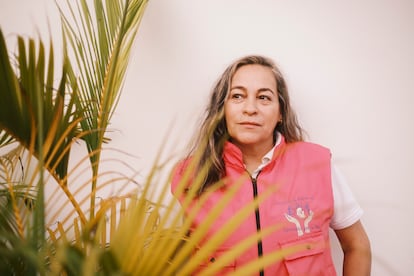
“The biggest concern is that children shouldn’t be caught in the middle of this conflict,” says María Alejandra Quintero, one of the leaders of Madres del Catatumbo (Mothers of Catatumbo). Recruitment operates beyond physical force. “They work on their emotions to manipulate them and ensure their loyalty.” Since the war began, they have seen this strategy repeated, with 70 children recruited in the last year alone. “They need to bring in more people… minors, adults, vulnerable people…”
In Catatumbo, the motto of this organization of threatened women is a reminder in a lawless place: “We do not give birth to children for war.”
At dusk last Wednesday in Tibú, a loud explosion rang out. All the birds in the town took flight. Then another. They were mortar shells launched by an army battalion, attempting to halt a column of guerrillas. The same shells that have fallen on the farms of several farmers, destroying everything.
For a few seconds, only the cries of fleeing birds could be heard. The town, with some 70,000 inhabitants scattered between the city and the rural areas, fell silent.
Before leaving Catatumbo, four days after that checkpoint, someone called to ask how we were getting back home.
— By land or by plane?
The warning came without listening to the response.
— Don’t go by land. They’re shooting at each other.
Sign up for our weekly newsletter to get more English-language news coverage from EL PAÍS USA Edition
