
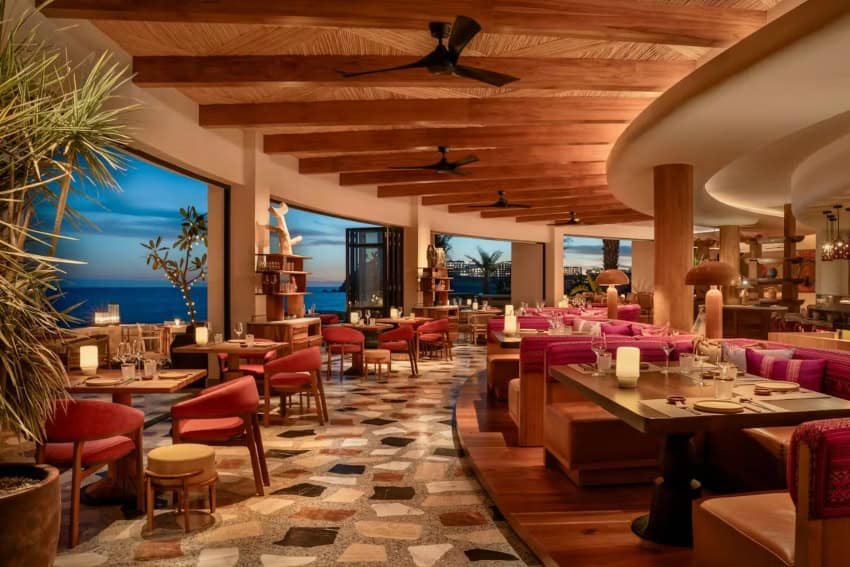
There are things to complain about in Los Cabos. But the quality of food is not one of them, as over the past 30 years, the area has evolved from comfort food and “you-hook-it-we-cook-it” seafood offerings to a world-class culinary capital, attracting some of the world’s top chefs along the way.
The latest example of this is Cayao, the Richard Sandoval restaurant at the Four Seasons Resort and Residences Cabo San Lucas at Cabo del Sol. As the name — a stylized version of Callao, the Peruvian city — suggests, Cayao specializes in Nikkei cuisine, the fusion of Japanese and Peruvian techniques, ingredients and flavors that has proven increasingly popular in recent years.
A new destination dining restaurant in Los Cabos
It’s not just tiraditos and ceviches, Nikkei favorites, that distinguish Cayao, which opened at the Four Seasons resort five months after the property premiered in May 2024. Its coastal setting overlooking the Sea of Cortés (as the Gulf of California is always called in Los Cabos) and Punta Ballena, the evocatively whale-shaped headland that is a staple of views at Cabo del Sol, is exceedingly picturesque, particularly at sunset. Downright beautiful, in fact.
The service, first-class but with the informality characteristic of laid-back luxury of Los Cabos, is likewise excellent. But what really sets Cayao apart are the talented chefs involved in creating its dishes. Not just Sandoval, whose conceptual vision and consultations shape Cayao, but also Michoacano Miguel Baltazar, the resort’s executive chef, and Gino Dávila, the Jalisco native who runs the restaurant on a night-to-night basis.
“When I heard about Cayao at Four Seasons Resort and Residences Cabo San Lucas at Cabo del Sol, I knew it was an exciting opportunity,” Dávila said upon taking the job. “Here, we can take inspiration from the richness of Baja’s ingredients and combine them with thoughtful, precise techniques. It’s about creating honest food full of flavor and texture that guests remember.”
The flavors are exceptional, and yes, especially in the ceviches and tiraditos: like the Cayao ceviche made with shrimp, scallops, octopus, sriracha and coconut foam; and the kampachi tiradito with coconut leche de tigre (tiger’s milk), a Peruvian marinade popular with seafood dishes. But creative flavors are present even in more standard menu items like the rib-eye steak, served here with yuzu kosho chimichurri — a Japanese-Argentine fusion — and yakiniku, a Japanese BBQ dipping sauce.
Indeed, Cayao is one of the best restaurants in Los Cabos, and another in an increasingly long line of those embracing Pan-Pacific fusions.
The Pan-Pacific embrace among high-end Los Cabos restaurants
When Enrique Olvera, the acclaimed chef behind the two Michelin stars awarded Pujol in Mexico City, opened Manta at The Cape Hotel in Los Cabos in 2015, he told me: “Baja has a Pacific influence, so that’s why we’re playing around with Peruvian and Japanese flavors; because a sashimi, a tiradito and a Mexican ceviche have a common language.”
Olvera was hardly the first to take a Pan-Pacific culinary approach in Los Cabos. Chefs Ángel Carbajal and Masayuki Niikura had been fusing Japanese techniques with Mexican ingredients at Nick-San in Cabo San Lucas since 1994, and Chef Volker Romeike pioneered “Pacific-Rim” fusions at Pitahayas Restaurant as early as 1995.
But Olvera was part of the culinary shift away from “Baja Med,” the Mediterranean fusion style developed in Baja California cities like Tijuana and Ensenada during the early 2000s — notably, by Chefs Miguel Ángel Guerrero and Javier Plascencia — that had become very influential in Los Cabos, and back towards the Pacific orientation which has always seemed more appropriate for Pacific-facing Los Cabos. As was Sandoval, whose Toro Latin Kitchen and Bar opened in late 2015, pairing Mexican and South American influences with Asian ones. Toro, after all, not only means “bull” in Spanish but also “tuna belly” in Japanese.
Chef Nobu Matsuhisa, whose early Nobu restaurants in Los Angeles and New York helped put Nikkei cuisine on the map, had opened a Nobu Restaurant at the Nobu Hotel in Cabo San Lucas by 2019, furthering the local trend towards Pan-Pacific fusions.
Richard Sandoval’s global influence and Los Cabos legacy
Although Matsuhisa and Sandoval both feature Nikkei cuisine at restaurants in Los Cabos, their approaches are different. Yes, each chef puts a high premium on locally sourced ingredients and sustainability. At Cayao, Sandoval sources almost all of his seafood from the Baja California peninsula — bluefin tuna and oysters from Ensenada, soft-shell crab from La Paz, for instance — with only a few shellfish like shrimp and scallops coming from Sonora.
But the Mexico City-born Sandoval is much more committed to Mexican influences, and it bears noting that he is without equal in taking Mexican cuisine around the globe. To date, he has opened some 60 restaurants across four continents. No other Mexican chef comes close. Olvera, his closest competitor among celebrated Mexican chefs, has opened 14 restaurants in North America and Europe.
Sandoval has also established a significant legacy in Los Cabos, with Cayao being his third restaurant locally, following the aforementioned Toro in 2015 and La Biblioteca de Tequila (since closed) at Breathless Resort in Cabo San Lucas in 2016.
The many attractions of the Four Seasons Resort and Residences Cabo San Lucas at Cabo del Sol
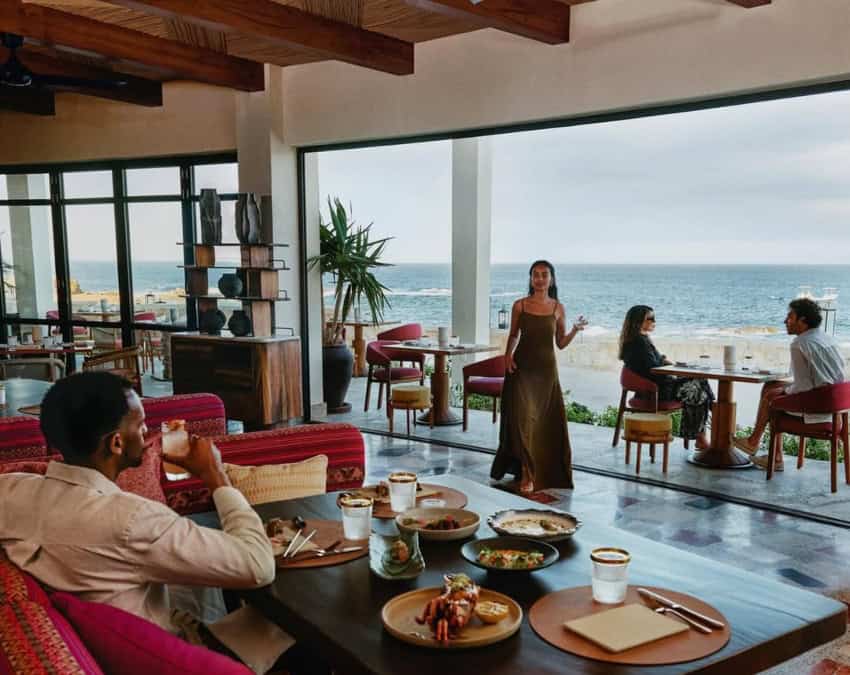
Cayao is a very good reason to visit the Four Seasons Resort and Residences Cabo San Lucas at Cabo del Sol, for guests and locals alike; yes, the latter are welcome at the resort, although reservations are recommended for restaurant dinners.
But there are so many more. For starters, you can arrive early and walk (or take the elevator) up to Sora, the rooftop bar that is a perfect place for a pre-dinner cocktail, wine or beer (try the Piedra Lisa, a Colima IPA). The Mercado near the lobby is also worth visiting, with its selection of wines and artisanal Mexican products, plus fresh coffee, pastries and a superb selection of gelatos. The best time to visit is on Friday nights, when the resort hosts its weekly La Plaza Mágica, with a mariachi band playing in the central plaza and open access to resort features like the Mercado, the mezcal-rich lobby bar and El Taller, the art studio which showcases work from local artists.
The name La Plaza Mágica is inspired by Mexico’s Pueblos Mágicos and there is something magical about it. On my first visit, a mule deer went bounding by on the Uber drive out. It was the largest buck I have ever seen in Los Cabos, and as strikingly magnificent as one would expect at a thousand-dollar-a-night Four Seasons property.
Chris Sands is the former local expert for Cabo San Lucas on the USA Today travel website 10 Best and the writer of Fodor’s Los Cabos travel guidebook. He’s a contributor to numerous websites and publications, including Tasting Table, Marriott Bonvoy Traveler, Forbes Travel Guide, Porthole Cruise, Cabo Living and Mexico News Daily.
