
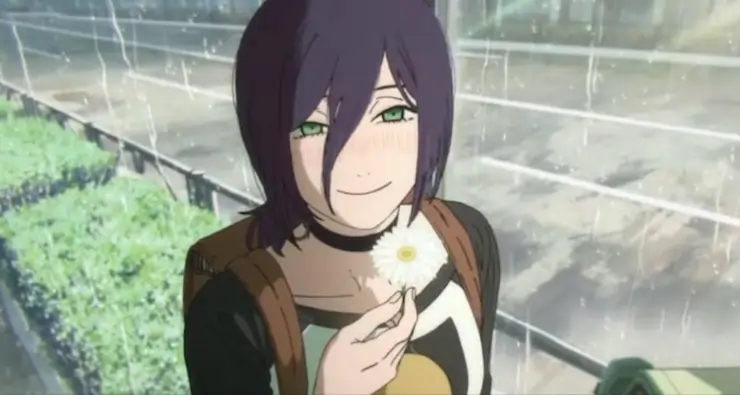
Tatsuki Fujimoto might be one of the strongest mangakas working today, if the adaptations of his work are any indication. Look Back is a monumental piece of emotional storytelling, exploring the idea that there is no point in looking back in anger or dwelling on what-ifs. While Chainsaw Man may not be as emotionally resonant as Look Back, it transcends the typical shonen action anime. As it’s a series that is filled with heart in addition to gripping storytelling, this is perfectly showcased in the theatrical continuation, Chainsaw Man – The Movie: Reze Arc, a masterclass of animation by one of the best animation studios today.
Continuing where the show left off, Denji (Kikunosuke Toya) is working with Public Safety as a devil hunter, and despite turning into a chainsaw to fight devils, he is just trying to live a normal life. He wants to get along with his flatmates and his boss Makima (Tomori Kusunoki), whom he has a massive crush on. One day, though, he meets Reze (Reina Ueda), a young girl who works at a small coffee shop, who seems to be interested in him for more than just his chainsaw heart. He believes he could fall in love with her, but this all changes when Reze asks Denji to run away with her, only to be attacked by the Bomb Devil.
Since the airing of Chainsaw Man’s first season, MAPPA has worked on approximately 15 different anime projects. The studio has long been associated with reports of staff being overworked, a serious issue that has even been trivialised by tasteless jokes from prominent TikTokers. That’s why it’s remarkable to see MAPPA implementing systems aimed at fostering a healthier work-life balance for its animators, especially when Chainsaw Man – The Movie: Reze Arc stands as one of the most visually breathtaking feats of animation this year. In what could be described as MAPPA’s magnum opus, the Reze Arc is a true technical showcase for the studio.
From the stunning dream opening, evocative of an animated manga panel, the film immediately shifts into a new art style when Denji awakens, departing from the show’s divisive yet visually impressive, realistic, live-action-inspired approach. Reze Arc visually aligns more closely with the manga, and a moment when the sky turns blood red is something that likely wouldn’t have appeared in the series. This new style allows the action to become the true visual spectacle. When the Bomb Devil arrives, the tension cranks up to eleven. Every click and explosion is nothing short of breathtaking. Watching the colour drain from the image just before the blast is a masterstroke; it left me gripping my chair, stunned by what was unfolding.
The anime could be viewed as too visually stunning, exemplified by a scene in which Denji imagines several female characters, like Power, Reze, and Makima, in overtly seductive fashion. Love and sex are central thematic elements in Chainsaw Man. Denji’s goal is to live his dream, which is to have a normal life and to experience love. As a result, Denji imagines women he is attracted to dressed in scanty lingerie posing in seductive ways. However, this depiction may make some viewers uncomfortable, particularly when he imagines characters like Power, with whom he shares no romantic relationship.
For the first half, Chainsaw Man – The Movie: Reze Arc feels more like a rom-com than a traditional action shonen anime, focusing on the blossoming relationship between Denji and Reze as well as his complicated feelings towards Makima. The film features moments of genuine hilarity, like when Denji jumps with joy at the prospect of a cinema date with Makima, only to be dragged into a movie marathon where he enjoys just one of the films. When Reze is introduced, Denji’s view on love begins to shift, as his body wants to be with Reze, but his mind wants to be with Makima. On the surface, Reze seems to genuinely want to connect with Denji, teaching him how to swim in one of the most beautiful and heartfelt scenes I’ve seen in an anime film in recent memory.
However, the façade drops when, following a common trend in Chainsaw Man, everyone wants to be close to Denji only to reach his chainsaw heart. Shattering his hope of finding someone who will love Denji’s heart. The film pokes fun at typical rom-com tropes, such as when Reze asks Denji to run away with her. He declines, explaining that while his job might seem strange and violent to onlookers, he’s beginning to get along with his colleagues and enjoys his life, so why would he want to run away from that? This scene highlights the excellence of the voice cast, with Reina Ueda as Reze and Kikunosuke Toya as Denji emerging as the true standouts, both delivering outstanding performances.
Accompanying every action scene, heart-pounding scene of romance, and burst of hysterical comedy is the incredible score by Kensuke Ushio. It’s unlike anything I’ve heard from the composer, whose work is prominently featured in Naoko Yamada’s films such as A Silent Voice and The Colors Within. His score to Chainsaw Man – The Movie: Reze Arc is nothing short of masterful, amplifying the emotional weight of every scene it touches. In key moments, the film would feel entirely different without his score. The opening song, Iris Out by Kenshi Yonezu, is yet another hit for the artist, whose opening theme for the original Chainsaw Man anime is already considered a modern classic.
While its depiction of female characters can at times feel overly provocative. Chainsaw Man – The Movie: Reze Arc is truly a breathtaking piece of animation that pushes the boundaries of the medium, resulting in a work that is a wonder to behold. Accompanied by unexpectedly charming rom-com elements, earth-shattering action, and an immaculate score. Reze Arc stands as a remarkable achievement for studio MAPPA and one of the best animated films of the year
★★★★1/2
Out Now in UK Cinemas / Kikunosuke Toya, Tomori Kusunoki, Reina Ueda, Shôgo Sakata, Ai Fairouz / Dir: Tatsuya Yoshihara / Crunchyroll, Sony Pictures Releasing UK / 15
Related
Discover more from
Subscribe to get the latest posts sent to your email.
