
Kiyoshi Kurosawa has had something of a resurgence recently – in 2024, critics compared Longlegs with his seminal 1997 thriller Cure, leading to reappraisals of that film, and he had an incredibly productive year, releasing The Serpent’s Path (a remake of his own film), the terrifying short feature Chime, and best of all, the thriller Cloud. Eureka’s new boxset pairing Cloud with the beguiling Charisma is an illuminating showcase of the director’s versatility, as well as the recurring elements in his style. Superficially, these are two of the most different films Kurosawa has made, and yet watching them together forms a fascinating and revealing portrait of certain themes and preoccupations that inform the director’s career.
Beginning with Charisma, which remains the director’s strangest and most genre defying films; the story of an existential battle of wills, with different factions all fighting over a mysterious tree named “Charisma”. Kurosawa mainstay Koji Yakusho plays hostage negotiator Haruibe, a more dishevelled, burnt-out version of his detective from Cure (although decidedly more humane). After a hostage negotiation goes disastrously wrong, resulting in the deaths of both hostage and captor, Haruibe is placed on extended leave and retreats into a forest outside the city, where he inadvertently becomes embroiled in an increasingly abstract conflict over the tree.
On paper, it’s a fairly bizarre premise, but Kurosawa plays it with his characteristically dry, restrained style. Scientists, forest rangers, environmental zealots, and commercial interests all converge, some arguing that the tree must be destroyed, others insisting it should be protected, and still others looking to exploit it for profit. The tree itself may possess mystical qualities, or it might simply be a convenient vessel for human projection – Kurosawa largely leaves this ambiguous, although there are moments that hint at something genuinely unnatural at work. Haruibe finds himself in the middle, somehow reliving his job mediating between the opposing sides, and remaining neutral, until the very end, where he finally takes a side.
The film unfolds as a metaphysical allegory, elliptical and cryptic, but with a clear throughline of the balance between what is good for the individual and what is good for the whole. Charisma, we are told, has properties that are killing the rest of the forest. Surely it makes sense to destroy it, for the good of the rest of the wildlife there, but then its very existence is something that should be studied – its existence represents something unprecedented, something that cannot be easily understood or managed. This makes Charisma sound like it’s a completely joyless experience, but it really isn’t. There’s a playfulness to the film, embodied in the jaunty, catchy score that belies the darkness beneath the surface. There are also several moments of deadpan humour, such as Haruibe constantly putting his foot in the mantraps that have been scattered around the tree.
Charisma is a film that invites, and practically demands, in-depth analysis. I can imagine modern audiences getting impatient or frustrated with Kurosawa’s steadfast refusal to offer any clear answers or narrative closure. Some might dismiss it as wilfully obscure or overly dense, but others will be drawn to its rich thematic ambiguity. Theories on the film’s meaning range from the compelling, that it’s a commentary on Japanese societal structures, to the more esoteric, like the idea that it’s a modern retelling of Princess Mononoke (an idea that isn’t as mad as it sounds). One striking image sees a new tree emerge with a visual effect resembling a mushroom cloud, a suggestion of environmental rebirth that is inseparable from apocalyptic threat. The final images too, feel less like a conclusion than a warning – a vision of societal collapse pointing to an uncertain, frightening future.
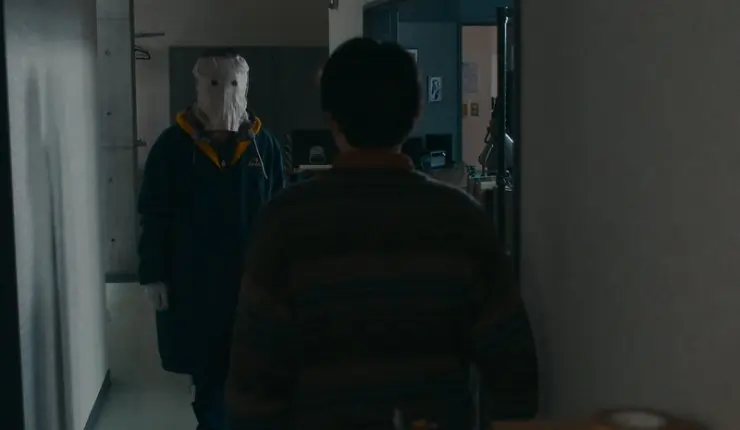
Cloud could not be more different, at least in terms of tone and structure. Where the subtext in Charisma is front and centre, Cloud has a more traditional narrative, and is much more grounded in reality – at least for the first half. It follows Ryusuke (Masaki Suda), an unscrupulous online reseller who exploits small online businesses by bulk-buying products at knockdown prices and flipping for a huge profit online, much to the dismay of those he has effectively ripped off. It’s a smart, contemporary premise, and Kurosawa plays the first half like a slow-burning thriller, as small acts of hostility escalate, from a dead mouse left on his doorstep to dangerous booby traps, indicating a campaign of recrimination against Ryosuke. Eventually, it emerges that the people Ryosuke has cheated have formed an online community, determined to take revenge on him. At this point, Cloud feels like a pointed commentary on the anonymity and moral distancing enabled by online forums and marketplaces; a kind of wish-fulfillment revenge fantasy for internet trolls, brought unsettlingly to life.
Oddly though, this is where Kurosawa abruptly switches gears – at almost precisely the halfway point, the film veers into a warehouse shoot’em up, staged with a cold, static precision that recalls Takeshi Kitano – particularly Violent Cop. It’s well choreographed and shot, but it produces a palpable jolt of tonal whiplash. The creeping tension of the first half largely dissipates, replaced by something stranger and more darkly comic. The would-be avengers are revealed to be largely inept, while Ryosuke’s mild-mannered assistant (Daiken Okudaira) displays a disarming aptitude for violence.
On first viewing, Cloud can feel frustrating and a little disjointed. On a rewatch, however, it reveals itself as carefully constructed, with background characters and seemingly incidental moments gaining new significance – in one especially creepy moment, Ryosuke shows his girlfriend his countryside home on his phone, unaware of an enigmatic figure looking over their shoulders. When Ryosuke finally notices him, the sound completely drops out as he realises his error. It’s a haunting, disquieting moment that captures the lack of anonymity today, where sensitive information can be acquired through the briefest chance encounter.
Despite their apparent differences, Charisma and Cloud are more alike than they initially appear. Both films are open to interpretation, and both are concerned with the actions of the individual affecting the whole. Charisma and Ryosuke are individuals who are negatively affecting the environments they inhabit – one by contaminating a natural ecosystem, the other by his callous, misanthropic behaviour, transgressing and corrupting a marketplace that traditionally relies on fostering good relationships. Despite Kurosawa’s reputation as a horror director, neither film fits comfortably within the genre, though both contain moments of shocking violence and sustained unease. Both films also end on an ominous, almost apocalyptic note, as the protagonists head towards cityscapes looming on the horizon in various states of decay. Both films end on a note of despair, with Haruibe’s superior asking “what have you done?!” while Ryosuke’s ending feels like a figurative (or maybe literal) descent into hell.
Both films originated as something entirely different to the final product – Charisma was conceived as a kind of Indiana Jones adventure, while Cloud was Kurosawa’s attempt at making an action film! The journey from those fairly straightforward starting points to the distinctly Kurosawan films that resulted is illustrative of the director’s unique perspective – something this boxset captures beautifully.
Taken together, Charisma and Cloud serve as a striking reminder of Kurosawa’s extraordinary versatility and his unique approach to filmmaking. It’s an unsettling pairing, but a one that feels strangely apt. The boxset offers a compelling snapshot of a filmmaker still finding new ways to provoke and disturb more than forty years into his career. It may not be the most accessible entry point for newcomers, but for anyone with even a passing familiarity with Kurosawa’s work, this is a must-have.
Special Features
The transfers of both films are well done, although the difference in film quality is pretty noticeable – the print of Charisma is a bit faded compared to the vivid high definition presentation of Cloud. The boxset comes with a modest but interesting selection of extras. Jonathan Wroot, while Charisma also includes a making-of featurette and a video essay by Joe Hickinbottom examining Kurosawa’s wider body of work. The commentaries can be a little repetitive, but they provide valuable insight and context for two films that defy easy interpretation.
★★★★
Charisma and Cloud are out now on Blu-ray / Nikkatsu / Eureka Entertainment / Dir: Kiyoshi Kurosawa / Koji Yakusho, Masaki Suda, Daiken Okudaira / Thriller / 15
Related
Discover more from
Subscribe to get the latest posts sent to your email.
