
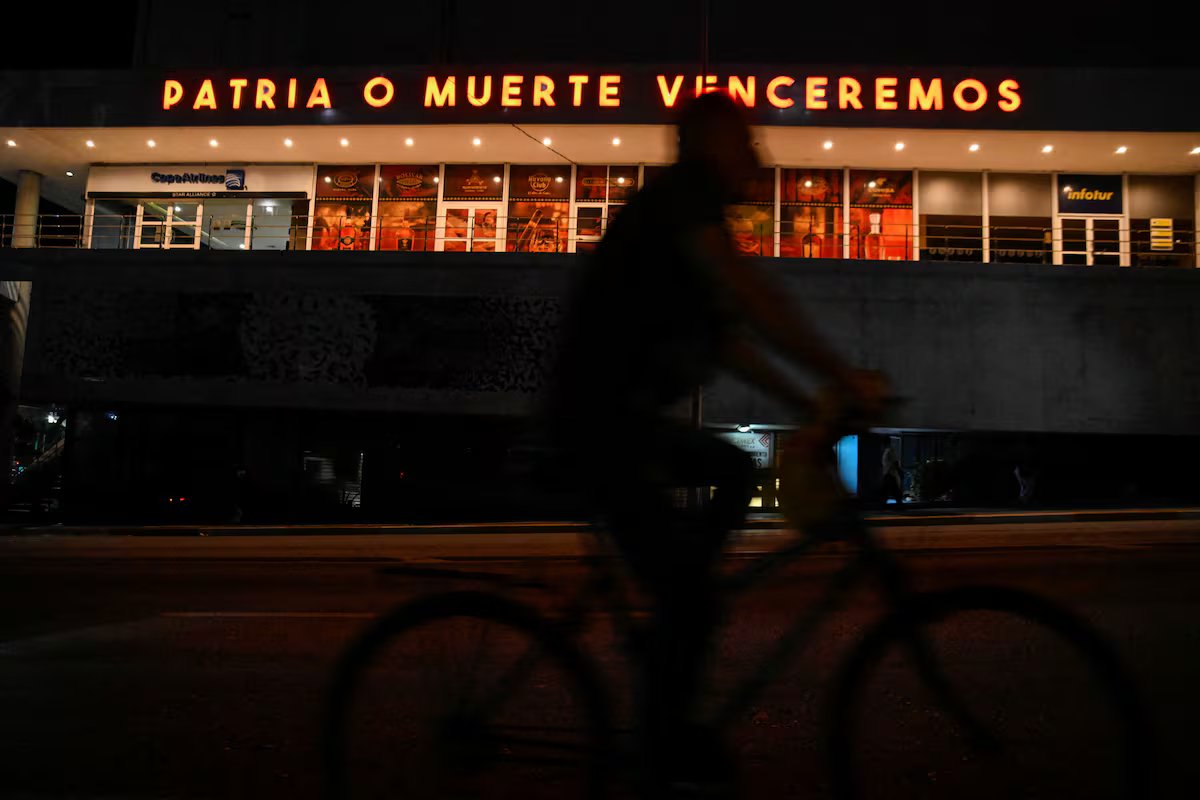
Every time Castroism has been on the ropes, it has always found a way to survive. After the failed U.S. invasion of the Bay of Pigs in the 1960s, it threw itself definitively into the arms of the Soviet Union. And when the Soviet bloc collapsed, it found another lifeline in Venezuela and the governments of the Bolivarian left. But between one lifeline and the next, more than a decade passed. The 1990s were a time of twists and turns in Cuba. With hardly any outside aid, the first signs of economic liberalization appeared, the dollar was decriminalized, and some small private businesses emerged. While the government loosened its grip, it began to thoroughly study other cases of authoritarian regimes that had transitioned toward a certain degree of openness — economic rather than political — thinking about how to survive without ever relinquishing power.
In the late 1990s, a government commission even traveled to China and Vietnam to evaluate the reform packages implemented by both communist regimes to open up to the market. The Mexican experience of the chameleon-like Institutional Revolutionary Party (PRI), which held power for seven decades with a final phase that dismantled much of the state’s role in the economy, was also studied. Reports and recommendations were written, but this didn’t last long. Fidel Castro was never truly convinced that a balance between market forces and the control of the Communist Party was possible. At the beginning of the following decade, Fidel himself closed the door and tightened ranks. That economic commission of experts was dissolved, and a kind of parallel government was created: the Commander-in-Chief’s Coordination and Support Team, with the authority to ensure that the ministers in office didn’t deviate from the established plan.
“Officially, that chapter was never reopened, but academia did take up the mantle,” says Cuban economist Mauricio de Miranda. He, along with other academics, was part of a delegation in the early 2000s, funded by the Swedish International Development Cooperation Agency, that continued to analyze possible models for a Cuban opening. They also visited China and Vietnam, as well as Russia, Hungary, and Denmark. “The idea was to study, on the one hand, governments with strong social democratic leanings and, on the other, the Russian and Hungarian transitions.”
One of the first measures in both China and Vietnam was to open agriculture to the market. This was achieved through a gradual system of private land leases for fixed terms (20, 50, 100 years) that could be transferred to family members. In Cuba, however, “the collectivist spirit of the cooperatives has been maintained, with leases of no more than 10 years,” the economist points out. Currency unification, which in Cuba was implemented in 2021, abruptly eliminating the convertible peso to the dollar in the midst of the pandemic, was implemented in the 1990s by the two Asian countries. They did so gradually and in a controlled manner between the formal and informal markets to avoid runaway inflation, which had become rampant in Cuba’s case.
The so-called Gaige Kaifang, or Reform and Opening Up, was the process undertaken by China under Deng Xiaoping’s leadership starting in 1978. These changes — which anticipated Mikhail Gorbachev’s glasnost and perestroika in the USSR — laid the foundation for the country’s meteoric rise, transforming it from a struggling economy into the world’s second-largest economic power in record time. While after Mao’s death China’s GDP represented 1.75% of the global economy, today it accounts for almost 20%. Life expectancy has increased from 65.8 to 76.4 years. More than 800 million people have been lifted out of poverty.
In Vietnam, the results were similar. Following reunification in 1976 and the start of the Doi Moi reforms a decade later, it began to integrate into markets and attract foreign investment. Its nominal GDP per capita has increased more than eightfold, from less than $500 in 1986 to almost $4,300 in 2023. Extreme poverty has fallen below 2%. Its economy has maintained sustained growth (with the exception of the pandemic) for 25 years, with an average annual growth rate of 6.25%.
In both cases, the state did not withdraw completely. “They have strong controls. For example, the granting of operating licenses is highly discretionary for the authorities, which encourages corruption,” De Miranda points out. In both cases, of course, political power remains with the Communist Party, and international organizations have been denouncing serious human rights violations for decades.
The Party of the Cuban Nation
The Mexican approach even has earlier precedents. In the 1970s, Education Minister Armando Hart urged students to pay close attention to the history of the PRI. “They were interested in the fact that it was a party born out of a revolution, hegemonic but not the only one, with a controlled opposition and the character of a national party,” explains Rafael Rojas, a Cuban historian at the Colegio de México. Then, in the 1990s, during the height of the economic hardships of the Special Period, a change, at least nominally inspired by the Mexican case, came close.
The 1991 Communist Party Congress prepared some changes to the constitution signed in the 1970s, which was heavily influenced by the Soviet paradigm. “There was a debate about changing the name to the Party of the Cuban Nation, softening a rhetoric that looked to the Mexican case,” adds historian Rojas. Despite having the support of influential figures, such as Carlos Aldana, then the party’s number three, this change ultimately did not come to pass.
Turning the focus back to the economy, Cuban economist Omar Everleny Pérez summarizes the current situation in his country: “Cuba today has to import almost 95% of its food needs; agricultural and livestock production is severely deteriorated. Industrial production is at a minimum, and specifically, sugar production is insufficient to export and cover domestic consumption needs.” This precarious situation has been ongoing for years, and the oil embargo imposed by Donald Trump has exacerbated it to unsustainable levels.
The economists consulted believe that opening up entire sectors to private investment is essential. De Miranda points out that “since Fidel Castro, economic policy and reforms have only been implemented when there is no other option, which is why the changes are never profound or structural; one hole is plugged and another one opens.” In the last week, two measures have been announced that seem born of extreme necessity: allowing small businesses to import oil, and the possibility of opening private day hospitals or nursing homes. “These are good news,” says Everleny Pérez, “small businesses are joining together to import. And in the case of the nursing homes, families in exile will be happy to pay $200 or $300 to ensure their parents are well cared for.”
The role of the exile community has also been studied as a comparative case by Cuban economists. In Vietnam, home purchases were incentivized to facilitate return. In China, investment by the exiled community abroad was encouraged, even through political favors. “They were given access to secondary political parties or even membership in the Communist Party,” notes De Miranda. In the Cuban case, there is a hardline sector of the diaspora, including second- or third-generation Republican members of parliament, who believe that any gesture is giving oxygen to Castroism. “But those who shout so loudly are not the ones with the money. There are families who have made a fortune in Florida and are more than willing to invest in Cuba,” maintains Everleny Pérez, who recently participated in an academic conference at the University of Florida.
Economists recall that even during the thaw in relations a decade ago, there were moves to enter the sugar industry during Barack Obama’s last year in office. Even Trump, a real estate mogul before becoming a politician, finalized a development near Havana, on the Salado beaches, during his first term, to build two golf courses and several hotels. The same Trump who said last Friday: “Maybe we’ll have a friendly takeover of Cuba.”
Sign up for our weekly newsletter to get more English-language news coverage from EL PAÍS USA Edition
