
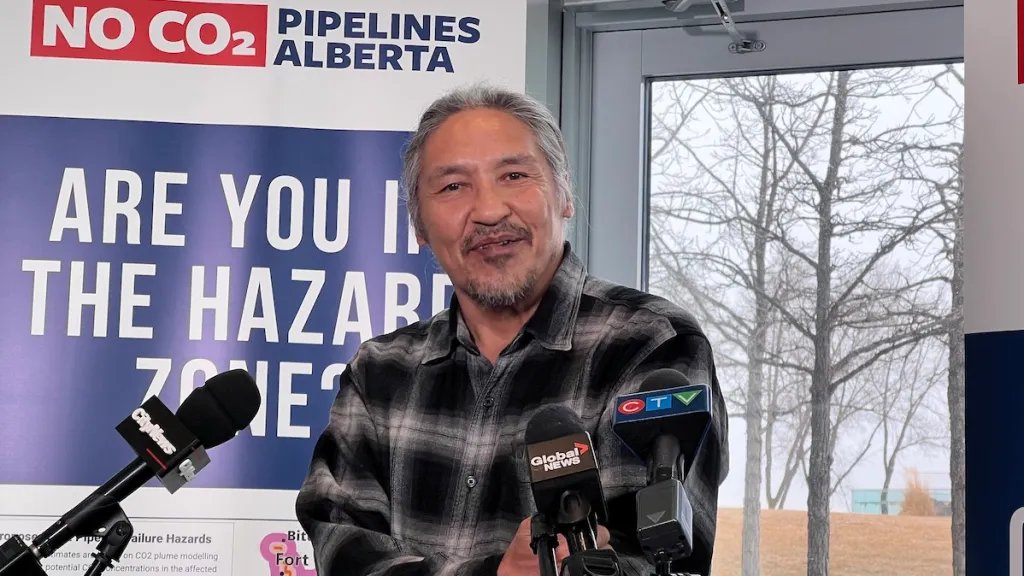
With the deadline for the Alberta-Canada memorandum of understanding on pipelines fast approaching – on April Fool’s Day a week from today – a newly formed coalition of First Nations, farmers and other rural residents is demanding a comprehensive environmental assessment on a proposed pipeline that would carry liquified carbon waste from the oilsands south to the area around Cold Lake and Bonnyville.

In that corner of northeastern Alberta, as part of the $16.5-billion carbon capture utilization and storage project, CO2 from numerous oilsands extraction sites would be pumped into underground formations where – at least in theory – it would safely reside forever and ever, amen.
Of course, as everyone at the NO CO2 Pipelines Alberta Coalition’s news conference yesterday morning in the Alberta Government’s Queen Elizabeth II Building in Edmonton well understood, a comprehensive environmental assessment is the last thing Prime Minister Mark Carney and Alberta Premier Danielle Smith want to see happen.
The two first ministers are hell bent on seeing what the coalition calls “a multi-billion-dollar toxic waste site” and a 600-kilometre pipeline with a kilometre-wide “kill zone” around it built without delay to create social license for a vast expansion of oilsands mining in Alberta in the face of a rapidly heating planet.
Advancing the carbon capture project, as the coalition said in its news release, “is a key element of the proposed Alberta-Canada MoU, setting conditions for the construction of a new bitumen pipeline from Alberta to the West Coast.” In the MoU, the parties agreed to build what they called the world’s largest CCUS project with the objective of rebranding oilsands oil as “low carbon.”
So the stage is set for another David-and-Goliath battle that is likely to end up in the courts.

“We will make sure this project gets a thorough environmental review from the Canadian government,” vowed Chief Allan Adam of the Athabasca Chipewyan First Nation during the news conference, “or else we will launch legal actions against the federal government and the Alberta government for allowing this to happen when it shouldn’t.”
Asked by a reporter what he made of Prime Minister Carney’s view that the pipeline to the coast would be a “grand bargain” for all, Chief Adam chuckled. “Prime Minister Carney is a Conservative Liberal, let’s get that out of the way. … He believes pushing these major projects at a rapid rate is going to be good for the economy, but it’s going to be bad for the environment.”
Another speaker, Amil Shapka of St. Paul, one of the founders of the coalition, said: “I’m not a rabid environmentalist, nor am I anti oil and gas,” but “I do know a bad idea when I see one, and this is a really bad idea!”
“Capturing carbon dioxide out of the emissions of 13 oilsands facilities, compressing it into liquid and then transporting it 600 kilometres under high pressure to be injected deep underground permanently is not just another pipeline,” Dr. Shapka asserted. “CO2 pipelines are uniquely dangerous, as carbon dioxide is both an asphyxiant and toxic. … Breathing in a concentration of 50 per cent for as little as one minute can be fatal. That’s the kill zone we’re worried about.”
“CCS in other jurisdictions has repeatedly failed to deliver its promises,” he added. “If it works perfectly, it will only remove 5 per cent of current emissions. … Combine that with industry plans to double production, and you can see that the ideas of low carbon oil and reaching net zero by 2050 are not grounded in reality.”

Indeed, the Institute for Energy Economics and Financial Analysis reported in 2022 that 10 out of 13 major carbon capture projects had failed to deliver on their targets.
As for the profitable giant corporations of the Oil Sands Alliance that stand to benefit from this project – Canadian Natural Resources Ltd., Cenovus Energy, Imperial Oil and Suncor Energy – they are 73-per-cent foreign owned and 60-per-cent U.S.-owned, several speakers noted.
So how, exactly, is this a nation-building project? Dr. Shapka wondered. “They’re asking for public subsidies worth up to 50 per cent of their operating costs,” he said. “Does it really make sense here to pour billions of valuable tax dollars into a costly, risky and questionable technology that primarily benefits American companies? How is that energy security?”
“I have one question for the prime minister,” said farmer Penny Fox, a resident of St. Paul County and another founder of the coalition. “If you wouldn’t live next to this pipeline, why should we?”
Members of the coalition released a letter to the federal government at the news conference outlining their formal request for comprehensive environmental assessment, which the coalition says has been dropped by both the Alberta and federal governments at the request of the Oil Sands Alliance after three years of lobbying to avoid an impact assessment.
The coalition has scheduled three town halls – in Mallaig on April 26, Lac La Biche on May 6, and Edmonton on May 13 – and expects to hold more later.
