
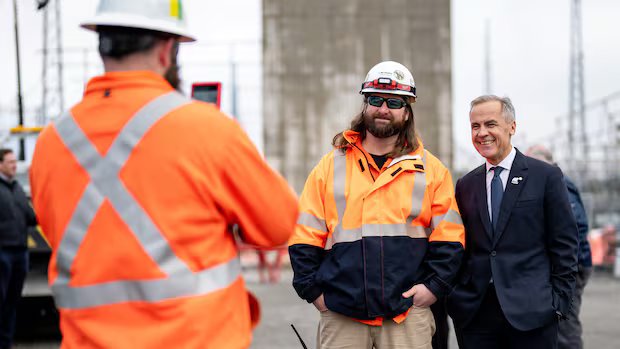
The Carney government’s plan to protect jobs in the energy sector amounts to a list of existing policies that critics say aren’t focused enough on those at risk of losing work.
Previously called the ‘just transition,’ the new federal sustainable jobs action plan offers little in the way of measures tailored for energy workers beyond existing policies.
Natural Resources Canada released the plan in February, quietly fulfilling a Trudeau-era commitment.
“This report in and of itself is not going to help workers,” said Bea Bruske, president of the Canadian Labour Congress, the largest labour organization in Canada.
“The impression that we have at this moment in time is that it’s a compendium of previous announcements and current programs.”
It lands as Canadians face disruptions on several fronts: U.S. President Donald Trump’s tariffs, rapid advances in artificial intelligence, federal budget cuts and an acceleration toward greener manufacturing and clean tech, such as electric vehicles.
Those changes come as workers’ purchasing power has diminished amid higher housing and food prices.
Under pressure from the NDP, the Liberals passed the Canadian Sustainable Jobs Act in 2024, with the aim of supporting workers in sectors that might be sunsetting. It required the government to table its action plan no later than Dec. 31, 2025.
Now that the plan has been released, its longtime backers tell CBC News they were looking for more concrete proposals.
NDP says plan ‘falls short’
A spokesperson for Energy Minister Tim Hodgson said “Canada has an existing comprehensive system of worker supports” which include “income protections, training programs and labour mobility measures.”
“The action plan will continue to evolve as the economy and transition to net-zero continue progress, with additional actions introduced over time,” said Charlotte Power, the press secretary for the minister.
But NDP interim Leader Don Davies says the plan “falls short.”
“Canadian workers need a truly ambitious, sustainable jobs plan. That requires concrete measures such as a jobs guarantee, meaningful upskilling, relocation support where industries are shifting and pensions strong enough to withstand uncertainty,” he said.
After announcing his government would scrap Canada’s electric vehicle mandate on Thursday, Prime Minister Mark Carney was asked whether he still considers himself to be a leader on climate change. Carney said his government is looking to put in place a new electricity strategy and tighten greenhouse gas emissions standards — but is giving industry ‘flexibility’ on how they achieve that.
“I don’t think workers see anything in the report that gives them comfort,” said Sen. Hassan Yussuff, a former national labour leader.
Yussuff previously co-chaired the federal government’s transition task force for Canadian coal power workers as the federal government has mandated the phase out of coal electricity generation plants by 2030.
The task force recommended a fund that provides wage top-ups of up to 90 per cent of previously earned income for two years for affected coal plant workers who have to work in lower-paid jobs, plus a pension-bridging program for workers who have to retire earlier than planned due to the coal phase out.
The task force also called for additional funding to extend private health benefits for affected workers.
Instead, the sustainable jobs action plan cites the Carney government’s existing agenda, accelerating major projects the federal agency launched to build homes, and even investment tax credits, as steps the government is taking to keep energy workers employed.
It does define a sustainable job as one that pays the “prevailing wage” and is “unionized.”
Still, Yussuff said such measures, targeting the economy as a whole, don’t give workers “a whole lot of excitement” to support Canada’s climate agenda.
No targets, timelines or accountability
Any sense of accountability is also missing from the action plan, according to Hadrian Mertins-Kirkwood, a senior researcher at the Canadian Centre for Policy Alternatives, who called the document a “glorified press release.”
“There are no targets, there are no timelines, there is no way to evaluate progress, there is no way to evaluate whether it’s consistent with the climate agenda and like net-zero,” said Mertins-Kirkwood.

The Paris Agreement, the landmark international climate treaty adopted a decade ago, called on nations to consider “the imperatives of a just transition of the workforce and the creation of decent work and quality jobs.”
The International Labour Organization (ILO) says a just transition would mean “greening the economy in a way that is as fair and inclusive as possible to everyone concerned, creating decent work opportunities and leaving no one behind.”
A just transition plan is seen by some as a way to help oil and gas sector workers adjust to clean energy jobs as global net-zero policies gain momentum and if fossil fuel demand declines. Others, like Alberta Premier Danielle Smith’s government, saw it as a polarizing term that’s shorthand for phasing out the oil and gas sector.
CBC News reached out to the Alberta government for comment on the new federal action plan.
But the concept has taken on greater meaning as communities face structural economic change from the low-carbon energy shift along with automation enabled by artificial intelligence and global trade turmoil.
Those factors are impacting other key Canadian sectors as well: lumber, steel, aluminum and auto manufacturing.
Trump complicates the transition
A Montreal-based think-tank, the Institute for Research on Public Policy, is researching which communities are most vulnerable to both global trade disruptions and the effects of international net-zero policies.
It found many of the industries most impacted by the global transition away from fossil fuels are also most susceptible to Trump’s tariffs.
The institute’s yet-to-be-released profile on Sault Ste. Marie, Ont., shows a community that’s dealing with the weight of steel tariffs and the challenges of the green transition.
Algoma Steel is the city’s largest employer.
The company in the midst of one of the most significant industrial decarbonization projects in Canada, shutting down its blast furnaces and coke oven operations and switching over to cleaner electric-arc furnaces.
That more efficient and greener approach to steel making, though, requires fewer workers. In December, the company laid off roughly 1,000 employees due to the electric arc furnaces.
Those challenges are all the more reason for the government to take the issue seriously, according to Rachel Samson, the vice-president of research at the Institute for Research on Public Policy.
“The biggest criticism that I have of the plan is that it doesn’t have enough emphasis on communities,” Samson said.

McMaster University engineering Prof. Giancarlo Dalle Ave explains how “green” steel is made through direct reduced iron and electric arc furnaces, and why it’s such a big change from traditional methods.
Samson said transitions take a toll not just on workers but on communities themselves, when housing prices suddenly crater overnight and once-bustling resource or manufacturing towns quiet with the loss of their main employer.
“Our research has shown that the biggest gap is in smaller communities that have high concentrations of employment in susceptible sectors that do not have enough support in place,” Samson said.
The federal government, she said, could look to British Columbia, which has a just transition service on the ground in a community within 24 hours of a pulp mill or other major employer closing.
But she said part of the plan should focus on how all levels of government can better diversify local economies rather than making them reliant on a single employer.
