
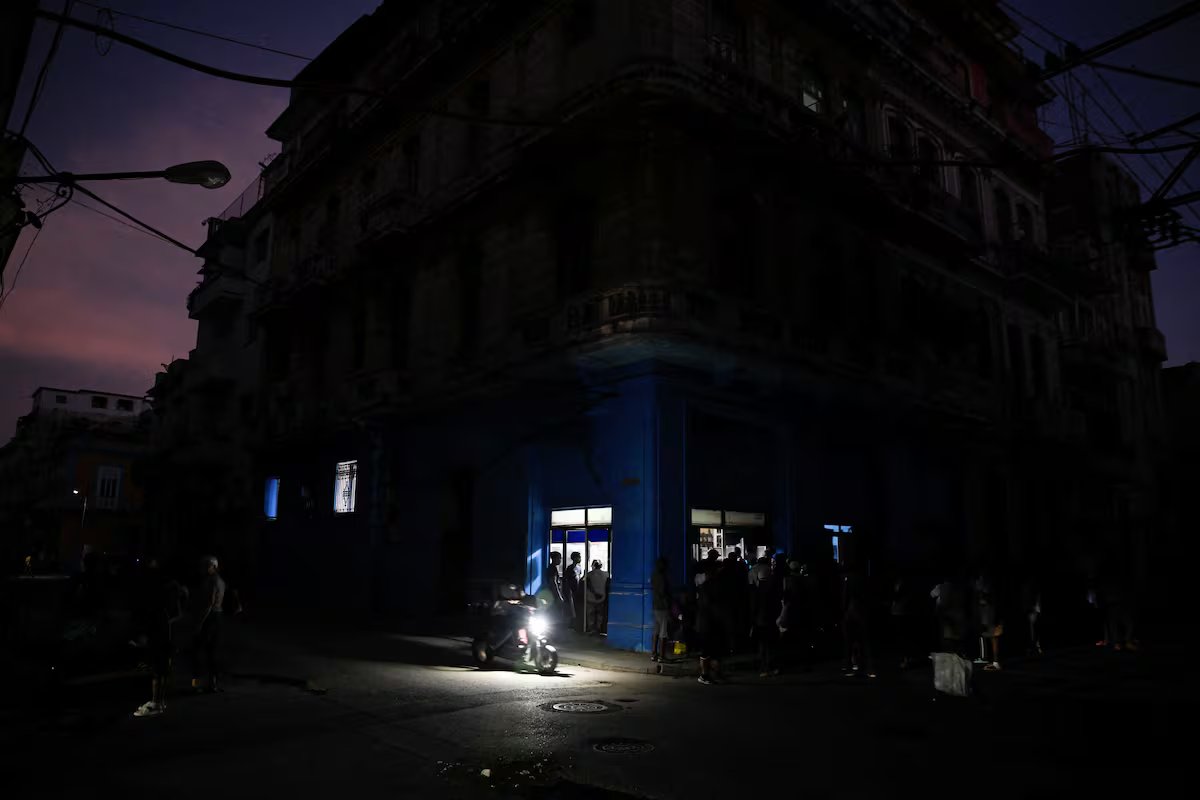
The entire island of Cuba, from one end to the other, has lost power. The state-owned company Unión Eléctrica (UNE) confirmed on Monday that the National Power System (SEN) suffered a “total blackout,” without providing further details on the causes or how long it will take authorities to restore power to the Caribbean nation. This is the sixth total blackout — meaning the entire island is generating zero megawatts — recorded in the past year and a half.
At this time, the Cuban government has not disclosed the causes of this latest widespread power outage, which has left just under 10 million residents without electricity. The Ministry of Energy and Mines has merely stated that “protocols for restoring” the SEN have been activated. According to state television, the incident occurred at 1:40 p.m. local time.
The Cuban power grid operates as a network of separate generation islands. As a result, restarting it from scratch is a complex process that, in the worst-case scenario, could take days. In 2022, after Hurricane Ian passed through, authorities took an entire week to restore electricity. It is also a much more complex process than, when a partial outage occurs, such as the one on March 4, when two-thirds of the country were left without power.
This latest collapse reveals, once again, the fragile state of the Cuban power grid, which relies on oil imports and is built around obsolete, Soviet-made thermal power plants. A nationwide disconnection from the SEN is not the same as the daily blackouts the country endures, which in many areas can last more than 24 hours. The routine outages are scheduled cuts — although the timetable is often not followed because there isn’t enough power generation. For example, for on Monday authorities expected 62% of the country to be without power at peak demand.
A full disconnection, by contrast, is a complete system collapse: the entire grid goes down, the whole country is left in the dark, and a single malfunction can trigger a cascading failure across the network.
Cubans have grown used to SEN collapses. A situation that would be extraordinary in other countries has become normal on the island. Massive blackouts paralyze life in the Caribbean nation, which has already been immersed in a deep crisis since the COVID-19 pandemic. Since then, the country’s gross domestic product (GDP) has fallen by 15%, and up to 20% of the total population — especially young people of working age — has emigrated.
Monday’s outage coincides with an announcement the island’s government will make later today. The administration will officially declare on state television that Cubans living abroad will be allowed to invest in or own businesses. Previously, authorities only permitted this if investors spent more than half of the year living in Cuba. It is another attempt to steer an economy that has been hit by one crisis after another.
It is also an opening gesture amid pressure from Washington, which has tightened sanctions on Havana and cut off Cuba’s main historical source of oil: Venezuela. Last week, Miguel Díaz-Canel’s government acknowledged that the executive branch is in talks with the Trump administration.
Prolonged power outages, shortages of basic goods, a lack of gasoline, and the absence of civil liberties have been the main drivers of discontent on the island. The extreme situation of recent weeks, fueled by Washington’s oil embargo, has erupted into small anti-government protests with pot-banging protests and a sit-in at the University of Havana. The last mass demonstrations took place in July 2021 and resulted in more than 1,000 political prisoners sentenced to up to 30 years in prison.
However, the crisis has also already produced more significant images: this weekend, a group of protesters lit a bonfire in front of the headquarters of the Communist Party of Cuba. Five Cubans have been arrested so far.
Sign up for our weekly newsletter to get more English-language news coverage from EL PAÍS USA Edition
