
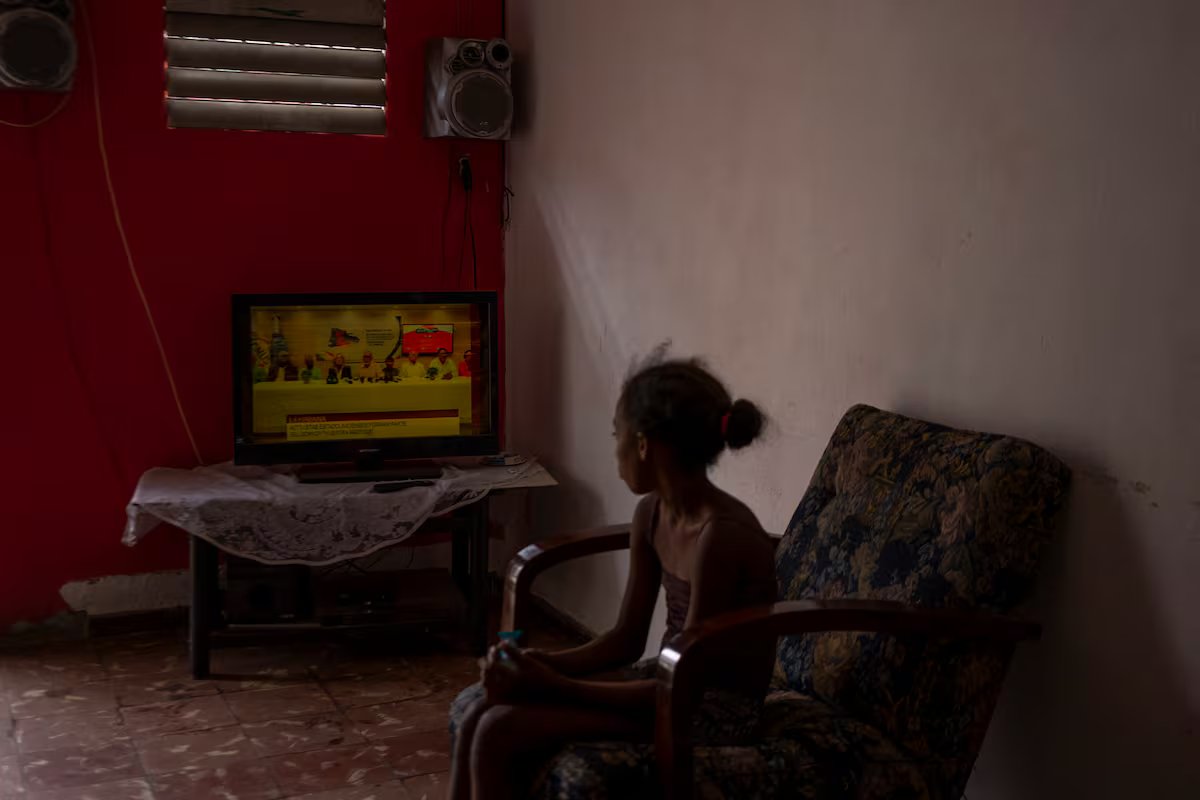
“Friends of solidarity with Cuba shared messages for the Cuban people during a time of heightened threat.” Mariana turns up the volume on the television and listens to the day’s news on Cubavisión. She has been without water for two weeks, and her two-year-old daughter eats only yogurt because there isn’t enough for anything else. On the screen, Michele Curto appears, a member of the Nuestra América Convoy, an international initiative driven by social organizations to bring humanitarian aid to the island. Dressed in a white T-shirt that reads “Let Cuba breathe,” Curto states: “We’re not just doing this for Cuba, but for ourselves. We’re doing it as activists and thinking beings.” Mariana, 30, sighs and implores heaven: “God willing, some of that aid will reach me, because it’s desperately needed.”
Her small home is a makeshift corner of what was once a warehouse in Cerro, a working-class neighborhood in Havana. In the room where she sleeps, sheets hang from the ceiling to collect rainwater that seeps through the gaps in the roof; sometimes she uses them to wash the dishes. In this neighborhood, a couple of days ago, residents blocked the streets with tree trunks and empty buckets in protest, after 19 days without a drop of water. “We took to the streets because this situation is unbearable,” Mariana explains. “We didn’t plan it. One of us went out, and then the other mothers joined spontaneously. We can’t take it anymore.”
Last Sunday, a barrel of water was supposed to arrive to fill the cistern at this tenement where 32 families live. It never arrived. A group of women from the area took to the street with empty buckets and children in their arms until the authorities finally showed up. “We didn’t budge until we reached an agreement. I told them straight up: if they arrested me, at least I’d be able to shower there,” says Xiomara, Mariana’s neighbor, ironically.
On Monday they received the promised barrel, and on Wednesday, three more. “If the commitment is honored, we have no interest in continuing to protest,” they acknowledge. Now, the arrival of the international convoy has them all crossing their fingers, since they say the latest shipments of humanitarian aid from Mexico have only trickled into El Cerro. A few cans of tuna, amaranth, black beans… Something is better than nothing, they insist, resigned.
The Nuestra América Convoy, spearheaded by the Progressive International organization and supported by figures like Swedish activist Greta Thunberg, has spent the week delivering the first five tons of humanitarian aid packed in Europe. Medicines, food, solar panels, and photovoltaic systems arrived during one of the island’s most critical moments.
Cuba is facing a critical situation, given the total blockade imposed by the United States and the cessation of Venezuelan fuel imports. In the last week, Cuban President Miguel Díaz-Canel acknowledged talks with Washington, released 51 political prisoners, and announced measures to open up the economy. During that time, the Caribbean nation experienced its sixth nationwide blackout in a year and a half, saw the Costa Rican embassy staff withdraw from the country, heard U.S. Secretary of State Marco Rubio reiterate that no economic opening was proving sufficient, and even experienced a 5.8 magnitude earthquake in the eastern part of the island. All of this in seven days.
“We want dialogue, not a blockade”
“The United States has absolutely no shame,” said David Adler, one of the organizers of the Nuestra América Convoy, at a press conference. “We are witnessing a government that intends to recolonize the Americas,” he added, clarifying that the group’s ultimate goal is to forge a regional solidarity front.
The main flotilla consists of three ships, each carrying about 50 people, which are expected to dock on Saturday, March 21. Among the passengers are former British Labour Party leader Jeremy Corbyn, former Spanish deputy prime minister and founder of the Podemos political party, Pablo Iglesias, American activist Hasan Piker, and members of the Irish band Kneecap, among other political leaders, trade unionists, and activists from around the world.
Their goal is to help alleviate some of the economic embargo that has strangled Cuba for more than six decades and has intensified in recent months. “I am Cuban-American and, like many in our community, I want dialogue between our countries, not a blockade,” said Danny Valdés, co-founder of Cuban Americans for Cuba, in a statement.
This same flotilla claims to have suffered a siege, in the form of the withholding of aid, threats against its members, and lengthy interrogations at U.S. airports. “We understand that our colleagues are assuming a level of risk similar to that of the flotilla to Gaza, but our children and grandchildren will remember a moment like this,” adds Adler, one of the organizers.
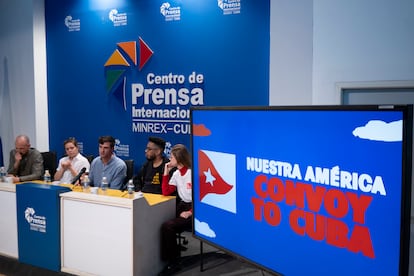
Dr. Fernando Trujillo, director of Hospital Services at the Cuban Ministry of Public Health, was relieved to receive the first delivery of medicines at the Hermanos Ameijeiras Hospital on Wednesday, and explained the titanic effort involved in keeping the country’s 117 medical institutions operational.
“It is very sad for us to see how we lack essential medications to give to our most critical patients,” he lamented. “We are living through an unprecedented time, both because of the difficulty of the situation and because of the dedication of our staff. Many of them walk to the hospital because there is no transportation, and they continue to give 100% to care for and save our fellow citizens.”
Ada Galano, a member of the organization Women Against War, records her words with emotion. The Cuban-Italian activist has been joining any humanitarian aid initiative for her country for years. “I did it during the Covid-19 pandemic, I’m doing it now, and I’ll do it whenever it’s needed. My country is now receiving all the aid it once sowed by sending medical brigades to countries in the Global South, training those who are now winning gold medals, and supporting the left around the world,” she emphasizes. “If the United States enters by force, they will regret it. We will be the resistance that most hinders Donald Trump,” she warns.
Roberto rests for a few minutes sitting on the Malecón, facing the port of Old Havana, where the aid is scheduled arrive on Saturday. He has been working all day at the Eurostars hotel, “emptier than ever,” and admits that the sea somewhat relieves the anxiety he feels thinking about what might happen in his country soon.
“I hope more ships like this convoy and the one Russia is sending arrive soon,” he says, alluding to a Hong Kong-flagged vessel reportedly en route to the island loaded with fuel, something Russia has not officially commented on. He recounts that with the previous Mexican aid ship, he received only a can of tuna and a box of cereal. “So far, my brother has been the only one sending me boxes from Houston,” he notes.
“We’re going to serve the entire island, urban and rural, west and east. But we’re not so naive as to think that the grassroots humanitarian effort will meet all the island’s needs,” Adler concludes. “We are the tool to pressure our governments to do their part: send oil, food, and medicine so that the grandmothers and grandfathers of this country can survive.”
Sign up for our weekly newsletter to get more English-language news coverage from EL PAÍS USA Edition
