
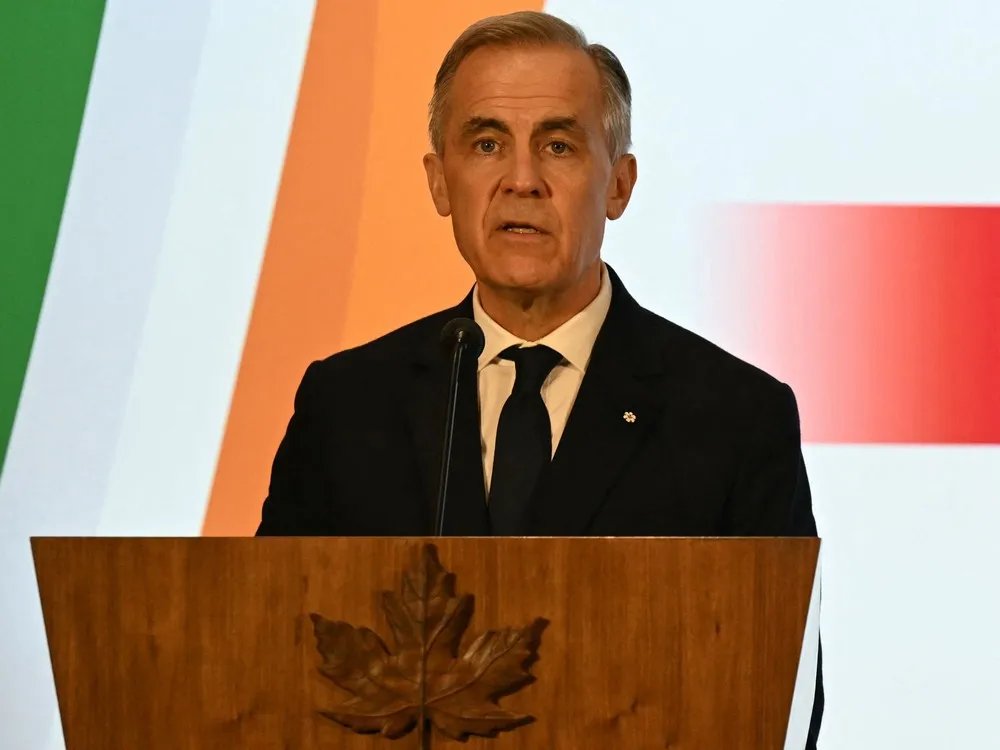
MUMBAI, INDIA — Back on the international stage for the first time since his headline-grabbing speech in Davos, Prime Minister Mark Carney is taking that message on the road, first to India, then likely later to Australia when he addresses its Parliament.
Carney’s rallying cry last month was that middle powers must unite against “hegemons” and he told an audience in India that his words resonated because he said out loud what many of those middle powers are thinking.
While government officials downplayed the question of whether the prime minister on his travels would be delivering a “Davos-type speech” on his first trip since making that address, his words continue to prove a fascination for foreign audiences — and serve as a script for how Carney pitches Canada to the world.
“The main thing I took from that speech,” Carney said to a crowd of roughly 100 business leaders gathered in India’s financial capital Saturday evening, where he participated in a question-and-answer with a CNBC Indian journalist, “I hate to say it — the analogy was right.”
That analogy, which came from an essay by Václav Havel who recounted how totalitarian regimes maintain their power through the compliance of everyday people, told the story of a shopkeeper who placed a pro-Communist sign in his window, despite not believing the message himself.
In his World Economic Forum speech, Carney turned that analogy into a stark diagnosis of where middle power countries find themselves with the world order as they knew it upended by the United States and China, urging them they confront reality as is.
Or, as the prime minister put it in Davos: “Taking the sign out of the window.”
“The analogy is there because in a totalitarian regime, everyone is thinking the same thing,” Carney told the crowd in Mumbai.
“But you don’t necessarily know that everyone’s thinking the same thing. The reaction to that speech was, everyone’s thinking the same thing,” he said to applause.
The prime minister acknowledged the public reaction to the speech but also what he said were the “quality of discussions” with countries “who are all thinking the same thing.”
Carney named India as one of those nations.
Before his question and answer session, the prime minister delivered what could only be described as a Davos-lite speech combined with a list of measures his government has taken in the name of economic sovereignty, to the business leaders gathered as part of the Canada-India Growth and Investment Fund, where he said that both countries were “natural partners” that each stood to benefit from deeper economic ties.
“This is a rupture, not a transition,” Carney told the crowd.
He continued with his diagnosis: The “old comfortable assumptions” that geographic proximity guaranteed security were over, with institutions that have a mandate for collective good like the United Nations “under threat.”
Without naming names, Carney also called out the most powerful nations for using “economic integration as weapons” and “tariffs as leverage.”
He then touted the value of being both “principled and pragmatic,” when it comes to countries forming new partnerships.
“Pragmatic in recognizing that progress is often incremental, that interests of nations can diverge, and that not every partner will share all our values. We are actively taking on the world as it is, not passively waiting for a world we wish to be.”
Carney told the crowd that he believes Canada and India can sign a comprehensive trade agreement, the first rounds of negotiations began back in 2010, by the end of the year, later clarifying he hopes to have the ink dried by the time G20 leaders descend on Miami in mid-December for the annual summit.
He also talked up the ambition Canada has for India to buy more of its energy, such as uranium and for the countries to form closer partnerships when it comes to artificial intelligence and defence, two areas he said stood in contrast to Canada’s renewed interest in China
“This visit marks the end of a challenging period, and more importantly, the beginning of a new, more ambitious partnership between two confident and complementary nations,” Carney said in his speech, which earned applause in the room.
National Post
Our website is the place for the latest breaking news, exclusive scoops, longreads and provocative commentary. Please bookmark nationalpost.com and sign up for our politics newsletter, First Reading, here.
