
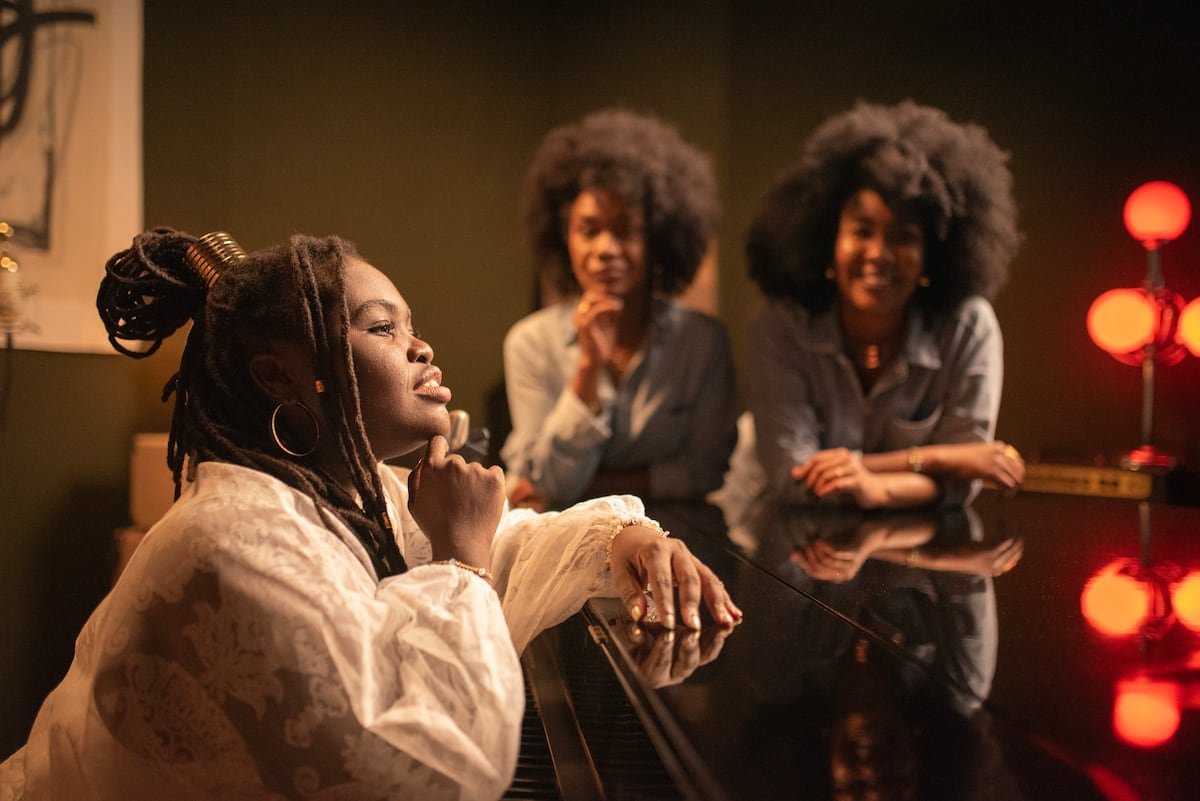
Daymé Arocena, 33, is Cuban. And Black. And these two traits have shaped her life and artistic career. She says that she was born a musician: she didn’t become one. This is because her ancestors shaped her destiny. “I’m an heir to music and dance,” she affirms.
The heritage of African culture is very present in her creations, which are difficult to pigeonhole: the songs that have been released by this 33-year-old artist draw from all genres. She began with jazz, but the evolution of her work has led her toward pop. And she’s also influenced by Latin American music, cha-cha-chá, salsa, bolero… as well as Tchaikovsky, Rachmaninoff and the classical composers she learned about during the strict Russian-style classical education she received in Cuba. Her latest album, Alkemi (2024) – recorded and produced in Puerto Rico with Calle 13’s Eduardo Cabra – also draws on R&B, bossa nova, funk and neo-soul.
Arocena was born in Havana. She left Cuba six years ago, unaware that she wouldn’t be able to return. Political persecution and the fear of imprisonment for her opposition to the Cuban regime keep her away from her beloved homeland. Given her captivating voice and imposing, energetic presence, renowned NPR music critic Félix Contreras once described her as a cross between Aretha Franklin and Celia Cruz… a comparison that both haunts and honors her.
Paradoxically, Arocena didn’t discover “La Guarachera de Cuba” (Celia Cruz’s nickname) until she left the island. “Celia Cruz was – and still is – banned in Cuba. I didn’t grow up listening to her,” she admits.
On September 4, 2025, the singer welcomed EL PAÍS to a hotel in Washington, D.C., before participating in the 38th Annual Hispanic Heritage Awards. At the gala, she performed a song by her compatriot for the first time, coinciding with the centennial of the great Cuban artist’s birth. “I’m no longer disconnected from her. She’s probably the artist who has shone the most light on [Cuban musicians], especially on those of us who have left the island and dream of being able to continue making a living from music outside our city.”
Question. What do you remember and miss the most about Havana?
Answer. I have two beautiful and distinct memories. There’s the memory of the sound of Havana, which is a very noisy city: you walk down the streets and there are people singing and playing rumba music, [some of them doing it] to earn a living. All of a sudden, to sell you flowers, people invent songs and sing them to you. That sound inspires me. One of the things I’ve had the hardest time getting used to is cities with very little noise. You suddenly realize you’re speaking very loudly. On the other hand, I really miss my home and my family. Especially my grandmother, my cousins, my uncles…
Q. When did you make the decision to emigrate?
A. I didn’t even make the decision; that’s the paradox. I left Cuba six years ago, but I had no intention of not coming back. I left all my things there. But everything happened at once. Months after I left, the political situation worsened significantly. And I didn’t remain silent. This caused the regime to feel threatened by me. The pandemic happened right around that time, followed by the July 11 protests [of 2021]. My name started circulating. And, since then, I’ve been terrified of returning. There are people who have sung fewer songs than I have that relate to the situation… and they’re in prison. A song that says “enough is enough, we’re tired” is already a huge threat.
Q. Can you describe your musical training?
A. I had two different backgrounds. I was musically educated at home, in contrast to the classical education I received. In Cuba, we don’t have academies where Cuban or popular music is taught. We mainly study classical European music, because the system is Russian.
While you study Tchaikovsky, Stravinsky, Rachmaninoff and all the great Russian musicians in school, out on the street, you have to learn to rumba. And you have to learn to sing el son and la guaracha (two local genres of music). In my house, there was a large rumba ecosystem. Not because we were all rumba fans, but because we were Black. There wasn’t a musical instrument, but music was made on furniture, with spoons… rumba was made with anything. This flavor is palpable in the music I make and in the kind of artist that I am.
Q. In the beginning, your music was predominantly jazz, but it has evolved into other genres, like pop.
A. I have no limits. I listen to music without prejudice, without thinking about what musical genre it is. I listen to reggaeton with the same heart and the same criteria as classical music. [If you] put on a classical piece and I think it’s bad, that’s the way it is.
I hear a lot of reggaeton out there that moves me. I sing it, I dance it, I enjoy it. I’m very clear about musical energy, but the lines between genres are very blurred. For me, genres are just mechanisms of segmentation and division. If I tell you that I’m going to invite you to a jazz concert, you might not want to go because it’s jazz; you’re predisposed. But if someone tells you, “I’m going to take you to a concert with some spectacular musicians who sound amazing and have beautiful energy,” you go with an open heart. And that’s how I approach music.
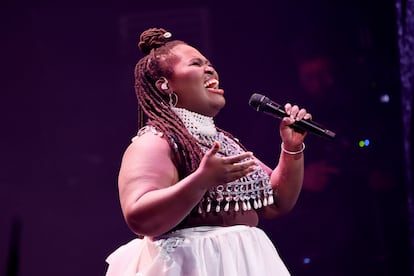
Q. You can sense that experimentation through the different styles in your music.
A. When I lived in Cuba, that was my ecosystem. Jazz was a tool, providing versatility, improvisational skills and virtuosity. Once I left Cuba and started seeing, playing alongside and interacting with other people from other cultures – and having access to the internet – my world exploded. What I saw as a perfect little thing became a giant snowball, which grows bigger every day.
If you call me to sing with a big band, I’m smitten: I’ll sing jazz or [perform] with a symphony orchestra, with lots of love. And you can call me for a reggaeton session and I’ll sit down to do it. [Same with] rap, or hip hop. All this has freed me even more.
Q. You’ve always placed a lot of importance on spirituality. How has that affected your music?
A. It affects it a lot. I’m a very spiritual person. I’ve been a santera (a priestess in the Santería religion) for 11 years and I’m a great believer in it. I came to it through music. Getting closer to Afro-descendant spirituality is about reconnecting with your ancestors and understanding who you are and where you come from. I was guided through the drum. I discovered the drum and Cuban folk music and fell in love with everything that music was giving me. Latinos wouldn’t have salsa without those people, nor bachata, bolero, cha-cha, or mambo.
Most musicians are rooted [in spiritual traditions]. I went back to my roots, which took over my heart and my energy. There’s a philosophy within kari osha (a ceremony in Santería) that says all messages will be sent with music and all messages will be received with dance. I’m an heir to that; it’s stronger than I am.
Q. This mix of genres or styles makes it difficult to pigeonhole your music. How would you like it to be heard?
A. As an academic musician, I’m called in all the time to give master classes. And it often happens that people have [broken down] my music [and] have theorized about it. They sing and measure: one, two, three, four… they have four thousand bars. And I – who wrote it – ask them to forget it and allow themselves to just listen. Paper is just a record, a way for you to theorize it, revise it, write it down… but it’s not my music. You have to listen to the music, allow your senses to be activated. You can measure [a song] 200 times and you won’t find the meaning I want to convey.
Sometimes I go to a red carpet event and people think that it’s my manager who’s the artist, not me
Q. Have you encountered obstacles in the music industry that are related to your race?
A. I define myself as Black. We’re all Afro-descendants: Black people [are] those who have darker skin, some with more melanin than others. Hispanic culture has a racial caste culture: the sense of beauty has been greatly manipulated. This impacts the industry, in terms of what’s shown and what isn’t.
We do have to work three times as hard; [we must have] overwhelming, undeniable talent. Black singers in the industry don’t sing so-so: we have to do it spectacularly well to be given a space. Still, music is a resource that will always save us. Most of the musical genres that are succeeding are Afro-descendant. Even reggaeton: it couldn’t be blacker.
It happens to me all the time, for example, that I go to a red carpet [event] or a makeup salon… and they think it’s my manager who’s the artist, not me. It happens to me all the time.
Q. Which artists have influenced you the most?
A. The great Cuban singers. We’re talking about Celia [Cruz], but also La Lupe, who’s one of my [most beloved] queens, with all of her madness [and] theatricality. She’s one of the artists who has influenced me the most.
Cuba remained in the era of radio, where you didn’t sell [art] with makeup and a wig: you sold it with your voice. That was the only thing that was going to make you famous. Then, there was a shift in the 1960s (the Cuban Revolution) and we didn’t continue down the industry path; we didn’t realize that people could become famous in other ways. In Cuba, we don’t know about autotune. I can branch out and do reggaeton, but always from the Cuban perspective.
Q. What has your latest album – Alkemy – meant to your career?
A. It’s a crazy album, an album that fills my heart. It’s an album I made because I felt like it. And every time I do things because I feel like it – because music and my heart tell me to – life rewards me. And I had my partners in crime: Eduardo Cabra, Rafa Pavón, Vicente García, my whole team…
For me, Alkemy was the transformation of my life. It showed up when I told myself: “I’m not going to care what the world says.” This is the music I want to make right now.
Sign up for our weekly newsletter to get more English-language news coverage from EL PAÍS USA Edition
