
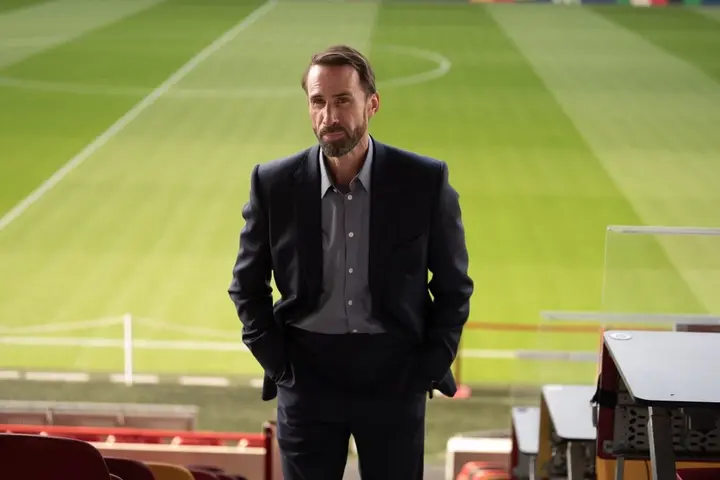
Dear England, the latest BBC adaptation of James Graham’s play asks us to reevaluate our relationship with the England Men’s National Football Team, whilst also asking us if one event can truly define the rest of our lives. For years, the players’ stories have been defined by the weight of expectation from fans and in the case of Gareth Southgate (Joseph Fiennes), it’s always been about the missed penalty drama of Euro 1996. For others, it’s about their roles in different key moments from England’s chequered history.
However, the pressure has always been the same – either succeed or be hated by fans for failing to do so. Over the course of this four-part series, the show cleverly reflects on how we ended up in that position, whilst also telling the story of Southgate’s quest for true redemption and cultural change.
It would be really easy to think that Dear England is solely a programme about football, but it would also be a massive shame for those not interested to miss out on watching completely, as there’s so much more to the show than just that. When he first joined as manager, many doubted his prowess, but over the course of eight years, Southgate, as England Manager, slowly proved everyone wrong. Eventually winning more knockout matches in the role than all the other managers combined since the men last won a Cup in 1966.
That’s not an easy feat. Through Graham’s clever writing, though, the story starts to peel back the layers on how he achieved such an incredible stat, and it does so by looking at the fans, the players, the managers, and the system they live in. When Southgate first took over, many viewed the role as a poisoned chalice. Players didn’t integrate, managers didn’t last, and England couldn’t win a Penalty Shoot-Out.
Whilst many tried to solve this, Southgate realised there was more to it and with the help of Pippa Gregory (the always brilliant Jodie Whittaker) and his team, he did just that. By asking the question of ‘Who are we when we lose?’, they were asking not only how the football team view themselves, but how England as a nation view themselves too. Opening up the show to become about redefining our identity after a setback, not just about winning and losing a game of football.
I think it’s also important to say for the review that I really enjoyed the original play. I found it to be an incredibly inventive way of making a nation-defining story feel accessible to all. It’s very well staged throughout and makes for an impressive and important staged conversation. It also means that going into the show, I was nervous about how they would recreate it. Unfortunately, I think it struggles in the first two episodes of translating the two parts of the play onto the small screen.
It still has some lovely moments, such as Southgate writing his Dear England letter to the nation, but some of the cleverness of doing multiple locations on stage is lost to the hollow feeling of recreations of iconic locations such as Wembley Stadium and St. George’s Park. By the time we get to Episode 3, it starts to feel a bit looser and finds its feet.
It feels less like a recreation and more like its own story. Southgate remains the main focus, but other important characters from the play, such as Gregory, fade away. There are moments where being on screen benefits the show, such as when they can intertwine clips from real-life moments, but it can feel a bit janky when that then cuts back to the actors playing the footballers. The final result ends up feeling considerably less accessible to a non-football fan than the play, but that doesn’t mean it’s not a good watch regardless.
The discourse around the England Men’s national team will always be rife in the news and online because pressure will always exist for them to do well. However, Dear England is a really good start to helping remind audiences that everyone involved is still a human. Some of the magic of the play may be lost, but the sentiment is still there in this essential retelling of the England story. Kindness is important, unity is strength, and this summer, it’s coming home.
★★★★
Premieres May 24th on BBC One / Joseph Fiennes, Jodie Whittaker, Jason Watkins, Francis Lovehall / Creator: James Graham / Dir: Rupert Goold, Paul Whittington / BBC
Discover more from
Subscribe to get the latest posts sent to your email.
