
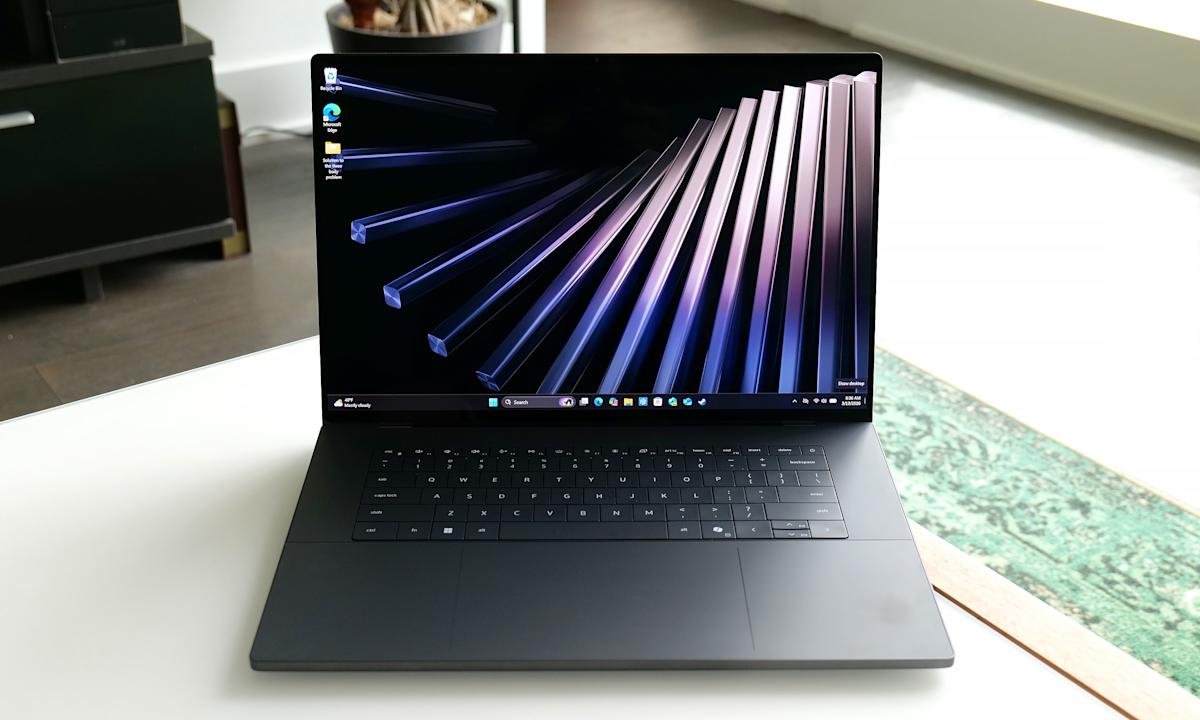
Last year, Dell came this close to abdicating its throne as the maker of the best premium Windows laptops when it announced it was killing off the XPS brand. Thankfully, the company regained its wits, admitted its mistake and doubled down on its flagship notebook line by revealing a full redesign for 2026 with super sleek builds, improved performance and helpful tweaks to nearly everything else we loved about its predecessors. The one blemish to Dell’s crown jewel is some keyboard issues on early units. But make no mistake, the king of laptops is back.
The XPS 16 has nearly everything you want from a premium 16-inch productivity laptop and it’s a worthy flagbearer for one of the most iconic notebook lines of all time.
- Exquisite design
- Ample performance
- Beautiful OLED display
- Solid battery life
- A bit pricey
- Keyboard needs tuning
- No SD card reader
Design and display
For this revamp, Dell didn’t stray away from the XPS line’s typical mix of glass and aluminum. However, this time around, the company streamlined pretty much everything. The XPS 16 now weighs just 3.65 pounds (or 3.85 if you opt for the heavier LCD display), which is almost a full pound lighter than its predecessor (4.56 pounds). That’s a massive drop and it makes this system closer in heft to a 15-inch MacBook Air (3.3 pounds) than a 16-inch MacBook Pro (4.7 pounds), despite the latter being XPS’s usual rival. It’s also noticeably thinner at 0.58 to 0.6 inches (depending on the exact configuration), which is once again a sizable decrease from the previous model (0.75 inches). Honestly, this laptop needs to be held to be truly appreciated. Even after using it for a while, it still feels impossibly sleek every time I pick it up.

The optional 3.2K OLED display available on the XPS 16 is simply gorgeous. (Sam Rutherford for Engadget)
Elsewhere, Dell kept important features like the XPS line’s up-firing stereo speakers (which sound great), along with a decent mix of ports, including three USB-C jacks that support Thunderbolt 4, DisplayPort 2.1 and power delivery. The one thing I wish Dell had included though, is some sort of SD card reader. With the XPS 16 being the largest member of the family, it’s often a prime option for people who like to edit photos and videos on the go, so having an easy way to transfer media from a camera to the laptop would be really nice.
As for its display, Dell’s optional 3.2K tandem OLED panel like the one on our review unit reinforces the laptop’s role as a mobile editing platform. It produces vibrant hues and features a variable refresh rate that can go between 20 and 120Hz depending on what’s on the screen. Despite having a nominal peak brightness of 400 nits, it looks much brighter in person, so you’re getting an excellent viewing experience.
Keyboard and touchpad

The XPS 16’s keyboard looks great, but the lack of an anti-ghosting feature and somewhat shallow key travel aren’t ideal. (Sam Rutherford for Engadget)
Perhaps the biggest change to the XPS line is its reworked keyboard and touchpad, which brings some ups and downs. Dell kept the glass deck and seamless touchpad used on previous models, except now there’s a faint line going around its perimeter, so you never have to guess where it is. The company also replaced the row of capacitive touch function and media controls from its predecessor with regular keys. As a fan of physical buttons, this is just great.
The issue is that for discerning typists, the keyboard seems to be missing anti-ghosting or N-key rollover tech. This means that if you press two keys very quickly one after another, the second press actually gets registered first, which can result in erroneous inputs. We ran into the same problem when testing the XPS 14. Dell claims this issue only impacts the first batch of systems off the line and that units on sale today have had this issue patched already. Furthermore, the company says it will release an update to address the issue on the remaining units, which should be out sometime in March. Though at the time of publication, I haven’t received anything yet.

The XPS 16 also features punchy up-firing stereo speakers that don’t leave much to complain about. (Sam Rutherford for Engadget)
There is another nitpick about the keyboard. While I don’t mind that Dell retained its zero-gap layout instead of going with a more traditional chiclet-style design, the more I type on it the more I wish Dell would offer something with a bit more key travel and heavier actuation. For reasons out of my control, my company-assigned work machine is a Dell Precision 5680 from 2023. I don’t like it very much aside from its keyboard, which is significantly bouncier and just generally nicer to use than the one on the XPS 16.
Performance
A big reason why Dell was able to make the XPS 16 so thin and light is that the company didn’t leave room for discrete graphics. That means you can only choose between a handful of Intel’s latest Series 3 Core Ultra chips, ranging from the Ultra 5 325 to the Ultra X7 358H, with the latter being the one I tested here. That’s not a bad thing though, as the laptop easily handled all the various productivity tasks I threw at it. And even without a proper GPU, the XPS 16 still pumped out 62 fps in Cyberpunk 2077 at 1920 x 1080, using Ultra settings and Intel’s XeSS set to Quality. Those kinds of numbers aren’t going to make anyone toss out their dedicated gaming rig, but once again, that’s not too shabby for a notebook this easy to carry around.
Battery life

The XPS 16 comes with three USB-C port with Thunderbolt 4 which is nice, but sadly it lacks an SD card reader for quickly transferring media from a camera. (Sam Rutherford for Engadget)
Thanks to a larger 99.5Whr battery, the XPS 16 fared better on our rundown test than its smaller sibling. This could be a deciding factor for anyone trying to choose between the two. In PCMark 10’s Modern Office battery benchmark, the XPS 16 lasted just shy of 12 hours (11:53), which is more than an hour and a half longer than what we got from the XPS 14 (10:21). As long as you’re not going to be gone for more than a day or you’re really pushing it, you should be able to leave its power brick at home.
Wrap-up

Instead of killing the XPS name for good, Dell wisely reconsidered and then doubled down. The result is fantastic new version of the XPS 16. (Sam Rutherford for Engadget)
When Dell decided to bring back the XPS name, COO Jeff Clake said the company was going to get back to its roots. That’s the kind of messaging that’s easy to stay on a stage, but after testing out the reborn XPS 16, I can confirm it isn’t just flimsy rhetoric.
This laptop is a shining example of a premium ultraportable Windows laptop done well. It features a super sleek aluminum chassis, strong performance, solid battery life and an excellent display, particularly if you upgrade to the 3.2K OLED option. The connection to the iconic award-winning systems isn’t just skin deep. This thing is just as much an XPS as the ones we loved a decade ago and Dell is driving that point home by letting the XPS logo sit front and center on its lid instead of the company’s usual branding.

At just 3.65 pounds, the 2026 XPS 16 is basically a full pound lighter than its predecessor. (Sam Rutherford for Engadget)
My one complaint is that I wish Dell would bring back the chiclet-style keyboards we got on models from the early 2020s. Though as long as the company can release updated software to fix the ghosting issues I’ve encountered, what’s on there now is more than good enough. Granted, at $2,349 for our review unit, the XPS 16 is a bit pricey, but that’s the going rate for a high-end notebook these days. If you snag a discount similar to the one Dell is currently running , suddenly, you’re looking at an even more enticing package at $1,900.
The biggest reason someone might want to hold off for now is if you do need more powerful graphics, as I’m expecting Dell to release an alternate version of the XPS 16 with room for a discrete GPU (and hopefully an SD card reader) sometime before the end of the year. Despite Dell nearly tossing decades of pedigree in the trash just months ago, the XPS 16 has returned to reclaim its spot at the top.
