
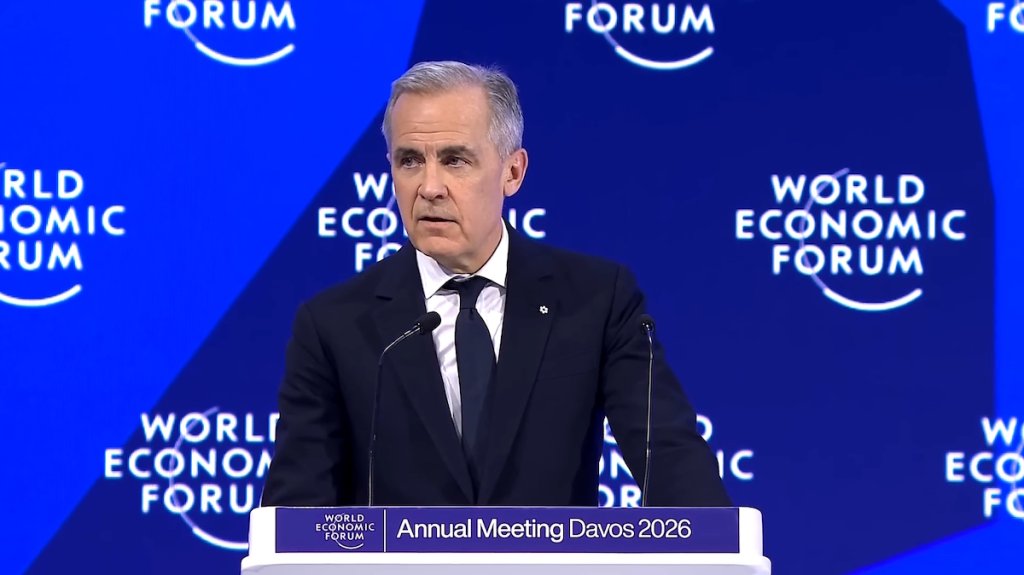
Mark Carney was sworn in as prime minister of Canada a year ago today, and surely even his opponents must admit he’s enjoyed considerable success in his first year on the job.

Many progressive Canadians with deep misgivings about the direction in which Mr. Carney is taking the country are nevertheless watching with a certain amount of satisfaction as the prime minister leaves Conservative Leader Pierre Poilievre squirming.
It’s demonstrably true that Mr. Carney’s actions don’t always match his words. Still, say what you will about this Liberal prime minister’s Conservative-style polices, during his years as a central banker he clearly learned his way around government. As a result, Mr. Carney has been able to plot a reasonably steady course in an unexpectedly chaotic world – a situation made worse the unravelling clown show in Washington D.C.
Judging from recent polling, a lot of Canadians now feel this way, experiencing the sense the adults are back in charge in Ottawa, and grateful that thanks to the timely arrival of Mr. Carney last year the country no longer felt the need to jump from the frying pan into the fire on April 28 – that is, to mark the end of the Justin Trudeau era by replacing the Liberals in the spring general election with the MAGA tribute production planned by Mr. Poilievre.
If another election were held tomorrow, Mr. Carney would win the majority he’s been building by wooing MPs from other parties to join the Liberal ranks in the House of Commons
As I’ve said before in this space, Mr. Carney has proved again that the L-shaped party remains Canada’s natural governing party.
But let’s pause for a moment and consider the Carney Agenda through the lens of the March 4-6 Broadbent Summit. There, some of the floundering but not yet foundering remnants of the federal New Democratic Party’s gathered in Ottawa to ponder how to find a way out of the self-inflicted predicament that took the party from 103 seats in Parliament when the Broadbent Institute was founded in 2011 to seven when the meeting was held, further reduced this week to six.
On March 6, a panel of five social movement activists unpacked what they saw as “the impacts and contradictions of the Carney Agenda.”
Elbows up? Or flooding the zone, as journalist and panel moderator Martin Lukacs put it, with “a veritable tsunami of pro-corporate policies and legislation under the cover of the disorientation and shock of the Trump attacks against Canada.”
Here are some of the observations about our prime minister’s agenda made by the five panelists, in a few places lightly edited for clarity. The entire conversation can be found on a podcast published by The Breach.
These are harsh critiques of Prime Minister Carney’s agenda, and the approach he has taken, but not made without strong evidence. Still, one can’t help feeling that we could have done worse. Indeed, we nearly did!

Janelle Lapointe, climate justice and Indigenous rights organizer from the Stellat’en First Nation, an advisor to the David Suzuki Foundation:
“In this new circumstance where we have Carney as leader, he’s really weaponizing the threat of Donald Trump and saying we need these major projects, and we need them now. What that means is we now have this fast-tracking legislation … that puts these major resource projects forward and removes some of the safeguards that we had, like environmental assessments and consultation processes that were already severely flawed.”
“So now we have these major projects that have extreme risks to our land, our waters, our culture, the safety of our women and girls … And we are told that is a gift to us!
“I think the most sinister part of it is how the Carney Government has repackaged this as generosity and reconciliation, and now we’re in a situation where Indigenous governments are likely going to be taking out massive loans to build some of these projects. … We call that predatory lending. We do not call that economic reconciliation. And when I put it that way, it makes sense why our banker prime minister has been so goddam good at using this tactic!”

Atiya Jaffar, Canada country manager, 350.org, an international climate justice organization:
“What we’re seeing in Carney is that he is fully regressing us back, tearing apart every climate policy that we’ve won over the last decade. But the thing is, these were all mediocre policies. … I would say, in the climate movement, how we’re viewing the Carney Agenda is it’s an agenda of rampant deregulation and rapid deregulation to expand extractivism, and we know he’s borrowing from Trump’s playbook, but he’s also saying that he’s fighting back, and that’s why he won the election.”
“What he’s calling nation-building projects are essentially just projects that that are tearing apart our communities and worsening the climate emergency. … So we’re building resiliency against Trump in America, but we’re also supporting American fossil fuel projects. The logic just doesn’t stand.”
“After this, of course, we had the Alberta-Canada MoU with Danielle Smith. Carney deepened his commitment to deregulation through this in alignment with the demands of the fossil fuel industry. So this MoU led to the scrapping of the pollution cap on the fossil fuel industry, scrapping the clean-electricity regulations. And perhaps most alarming is the Alberta-Canada MoU just put a new West Coast pipeline on the table. This mystery project is intended to bring Canadian tarsands oil to Asian markets through the Pacific Coast.”
“One of the biggest struggles that we’re facing in the climate movement is knowing that public opinion seems to be on Carney’s side. Carney’s agenda seems to be resonant amongst many mainstream and even progressive-leaning Canadians, people are grasping for some economic stability, and the logic seems to be making sense to people.”

Rachel Small, Canada lead for World Beyond War, an international anti-war organization:
“I did not think the Carney Agenda was going to be primarily about building economic prosperity, domestic policy, foreign policy, based on war and militarism. That has been shocking to me. … If I had to sum up that in a word, it’s been about moving Canada closer and closer and closer to the U.S. militarily. … So, yes, despite all the talk about ‘elbows up’ in the Davos speech, all the talk about separating from the U.S., resisting big bullies, etc., what Carney has actually done over the past year is just move Canada horrifyingly, at breakneck speed, down a path based on ever increasing militarization and warmongering. … This is the opposite of what he is saying he is doing! But if you look at what he is doing, this is what it is.”
“Just a couple of weeks ago, the Canadian government released a new defense industrial strategy … literally throwing around about half a trillion dollars, in Carney’s words, to ramp up military production, to ramp up arms exports, to weaken our already completely dysfunctional arms exports permitting process, and basically saying what we’re going to do is we’re going to bank Canada’s future, our economic prosperity, on militarism and war profiteering.”
“This is a radical departure for Canada to be doing this, to be saying this, to not be hiding behind a front of, ‘Oh, we’re a peacekeeper in the world.’ To just be saying, ‘No, actually, we’re going to build our wealth on war and investing in the production of weapons of genocide.”
“The implication – and sometimes this is said overtly, sometimes it’s just implied – is, ‘Oh, this is what we need to protect us from the U.S.’ And, unfortunately, that just couldn’t be less true. It’s truly the opposite. This is an enormous gift to Trump.”

Syed Hussan, executive director of the Migrant Workers Alliance for Change, a member-led organization of migrant farmworkers, care workers, students, and others:
“You’ve got millions of people paying into your welfare system but not being able to access it. That allows for your schools to be funded, for your health care to be functional. Right? So for the past 30 years, migrants have been propping up this country. We’ve been propping up this country while being excluded, while being exploited.
“And now were being scapegoated, and as we’re being pushed out, you’ve entered a kind of Doom Cycle, basically because people are struggling to pay rent, they’re struggling to afford their homes, they’re struggling to get good jobs, and they’re being told the problem is migrants. And then the migrants are being pushed out, but the economy will worsen. … What we can’t do is deal with this overwhelming economic crisis that migrants are both being blamed for and their exclusion is worsening!”
“Then Carney comes in. … What does he do? … They’ve given themselves the power to cancel any group of immigration permit whenever they want. … So we are in a very particular calamitous cycle here, and folks don’t understand it, because what’s happening, in part because the economic contraction, is it is justifying budget cuts to every sector. The racism and xenophobia that is being embedded into people’s minds makes it so that climate has actually dropped as a top issue of concern … Which means that you can’t actually make moves on any of our other social justice issues because people are convinced that if they get rid of immigrants, everything will get better. So fighting against xenophobia and racism is a strategic necessity!”

Nathan Prier, president, Canadian Association of Professional Employees, one of the unions representing employees of the federal government:
“Carney is our boss, and the impact of austerity there is being felt immediately by our members. … Federal workers know how ideological these cuts are. This isn’t just an accounting operation of right-sizing the public sector. They’re being scapegoated for a deficit that they absolutely did not cause, and Carney is taking the possibility of labour peace very much off the table in a very overt way.”
“Who do you think is picking up the slack? I’m asking. Consultants! McKinsey. Deloitte. They cost like a buck-25 on the dollar for what it costs to keep a public servant at their desk. And we’ve shattered the record for the last two years on consultants. … And so lots of my members are now working beside the McKinsey or Deloitte consultant who just replaced their co-worker, and it’s costing more than to keep the old guy at their desk!”
