
Music has stood the test of time and placement as one of humankind’s most treasured, rewarding outlets. Whether the artwork is utilised as a channel of storytelling, reflection of social events or personalised expression, music captures not only one’s ears but their minds and hearts to bridge gaps in individual crisis or a human group’s needs for community and shared sentiments.
This concept is precisely what filmmaker Georgi M. Unkovski taps into in his feature debut, DJ Ahmet, writing and directing a story of music’s power of healing personal agony or sense of loss, as well as bringing people together. Starring the talented performances by Arif Jakup, Agush Agushev, Dora Akan Zlatanova, Aksel Mehmet, Selpin Kerim and Atila Klince, DJ Ahmet reads as a hopeful and expressive piece celebrating life’s arts, becoming one of 2026’s most enjoyable watches.
In the film, 15-year-old Ahmet struggles to find balance for his grieving, pressuring father’s expectations of manhood, helping his younger brother find a voice, his secret passion for DJing and his budding love for a neighbouring farmer’s daughter who is promised to another. After discovering his first love shares his admiration for music and dance, Ahmet finds the strength to defy the village’s regime and share his passion.
Aforementioned, music is the heart of Unkovski’s work, focusing the medium on its ability to create, assist in and maintain a perseverance of identity, with the importance of individual expression being the soul of the film.
With music created and curated by Alen Sinkauz and Nenad Sinkauz, DJ Ahmet makes solid and enjoyable use of its instrumental components. The soundtrack is upbeat, fun and thriving in an enthralling rhythm. It also gels effortlessly with the story as bonds grow within the intoxicating instrumentals.
Speaking of the story, one of the many highlights of the film’s plot is how it showcases resilience against oppressive ideals but not in a trauma-dumping way, still finding and expressing a strong sense of positivity. Ahmet struggles under his father’s intense and toxic parental environment, coming across more as a boss or owner than a loving father. However, unlike other portrayals seen in film of unhealthy homes, there are rarely images and sequences of Ahmet bawling his eyes out or being physically abused. Instead, he powers on through his new friendship and love of music, infusing the film with a hopeful tone that many audiences need.
Clever and diplomatic with its thematic framing, DJ Ahmet also reads as a touching kaleidoscope of binary oppositions, such as young and old generations rising to meet one another. The film centres on a soft blow of a clash of cultures and times within its narrative, exemplified in visual composition as well as plot events and direct dialogue. Audiences are presented with juxtaposition throughout, mostly evident in the setting of villages and sheep farms with characters dressed in traditional clothing, with the older generations verbally affirming the traditional values of farm work and submissive marriage to arranged husbands. Yet there comes a seemingly odd mix of props of iPhones and mentions of TikTok from the younger generation, as well as defying modes of expression through dance.
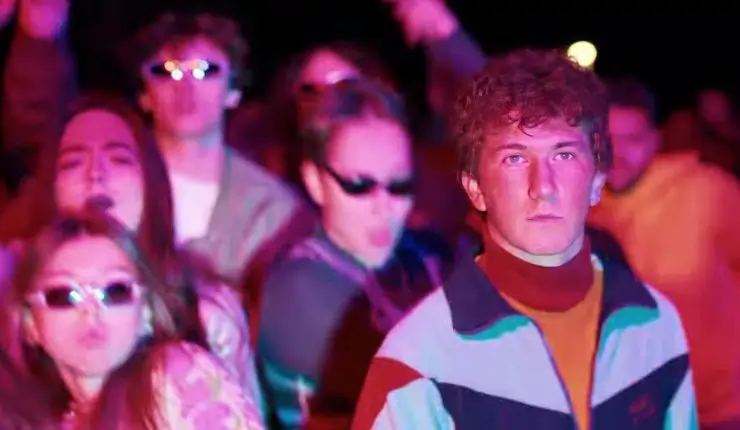
Ahmet’s discovery of the secret music festivals when searching through the woods near his farm portrays this breaking of restrictive tradition with the relief of freedom through dance.
Additionally, Unkovski embeds a consistent thematic value of masculine expectations and identity throughout the film. Ahmet’s relationship with his father and with his brother ispolarising; he struggles to connect with his distant, grieving father as he is shut off from love, yet his brother welcomes a pouring of affection from him.
The more negatively represented characters are granted growth and development as they express a relieving overcoming of their own shame to let the younger characters thrive and love.
DJ Ahmet also delivers a mindful and refreshing take on female empowerment, centred within Zlatanova’s grounded yet captivating performance as Aya, the source of Ahmet’s young affection and the granddaughter of his neighbour who is due to be married. Aya to me was one of the film’s strongest factors. Her character is strong, rounded, unapologetic and charming inside and out. We see her bask in the freedom and expression of music at the festival and through her dance performances, even being so brave as to perform one at a village festival in front of her disapproving father. The film does not beg for praise for featuring an empowered female; it anchors Aya as existing as more than a young female on the verge of womanhood and instead celebrates her as a lover of art.
Following on from this, DJ Ahmet deserves praise for its unique take on Islam, a deeply stigmatised religion which is explored in a foreign, ‘othered’ land to Britain’s eyes. Straying far away from other representations of Muslims based on trauma and ‘otherness’, Unkovski’s film provides positive, upbeat examples of characters and an overall depiction of Islam that avoids any graphic content, despite mentioning arranged marriage and gendered expectations. The village Muezzin (the one who leads the five daily prayers) served as a comic relief character in a balanced and thought-out area of humour, such as needing help connecting his computer and music to the village loudspeakers, where the prayers play from. Overall, the film takes on its religious content and is boldly and refreshingly optimistic despite some difficult subject matter.
Both the handling of subject matter and the overall story themes are amplified by strong, consistent performances bursting with individuality. Each character feels real in this journey and differences, sparking when these paths and mindsets cross.
Such delicate and sweet story material is delivered in refined, gorgeous green landscapes celebrating the film’s setting. These beautiful physical sequences were provided by Unkovski, alongside cinematographer Naum Doksevski and editor Michal Reich, all coming as one to create and present terrific land shots which are gorgeous in imagery and soul.
Overall, DJ Ahmet is one for the lovers of music and the power of dance. Unkovski’s work is well and truly its own, coming in with a bold identity and beautiful voice of expression.
★★★★
In cinemas 27th March/Arif Jakup, Agush Agushev, Dora Akan Zlatanova, Aksel Mehmet, Selpin Kerim and Atila Klince/ Dir: Georgi M. Unkovski/ Conic/ 12
Related
Discover more from
Subscribe to get the latest posts sent to your email.
