

Dmitry Muratov, 64, speaks like someone who has just returned from a journey into an undesirable future that now casts a shadow over countries that once thought themselves immune. “I have to warn you that you are currently interviewing an enemy of the state,” says the Russian journalist.
The 2021 Nobel Peace Prize laureate is referring to the blacklist he has been placed on by Vladimir Putin’s government, the same government that has shut down almost all critical media outlets and imprisoned 48 journalists. Muratov described the democratic dismantling in his country during a lecture at the Auditorio do Mar in Vigo, Spain, where he gave a talk on November 12. Speaking to business leaders, economists, politicians, and bankers attending the Vigo Global Summit, he warned about the new guises under which the same old totalitarianism is advancing around the world. In Russia, “everything is propaganda,” he lamented, adding that when attacks on journalism and the erosion of rights and freedoms began, European authorities chose to look the other way.
At Muratov’s newspaper, it was clear to everyone that Putin was an “authoritarian” politician from the moment he seized power in 2000. Novaya Gazeta, a newspaper founded in 1993 and supported by Mikhail Gorbachev, had no trouble perceiving this, as it suffered from the president’s backlash against its critical journalism from the very beginning. Restrictions on freedom of expression and information in Russia worsened after the Beslan terrorist attack in 2004. Two years later, journalist Anna Politkovskaya was murdered. It wasn’t the first assassination among Muratov’s colleagues at Novaya Gazeta. “I wanted to close the newspaper because it was the third death we’d suffered. The country had become dangerous for journalists,” he recounts. “But my colleagues said no, that we had to keep working.” Then three more journalists and staffers were killed.
What was the European Union doing in the meantime? Muratov illustrates his answer with the example of a “prominent” European leader who, during a visit to Russia, “laid flowers in memory of the journalist Anna Politkovskaya and then went to sign agreements with Gazprom.” “Putin has made a mockery of European politicians. They should have been talking about human rights, but they were only interested in oil and gas,” the journalist says. “At least 16 presidents and ministers from European countries started working for companies owned by the Russian president. German chancellor [Gerhard] Schröder, for the state-owned oil company Rosneft. Also, former French prime minister [François] Fillon. From Finland, from Austria… They all have jobs in Russia, in very large companies.”
Putin revoked the license of the newspaper Muratov directs a few days after launching his attack on Ukraine, which the journalist refers to as a “special operation” to avoid reprisals in his country. The word “war” is forbidden in Russia, although Putin has used it as the invasion has dragged on. After the Kremlin’s military offensive, the younger members of the Novaya Gazeta staff decided to go into exile and start a European edition in Riga, the capital of Latvia. The older staff, including the Nobel Peace Prize laureate, remained in Moscow. They launched a poll so that readers could decide whether to close the publication or continue reporting, even under the boot of censorship. “It was a huge vote; thousands of people participated. They told us to stop messing around, that they understood everything, and that they wanted us to continue,” says Muratov. His work is disseminated through Telegram and YouTube.
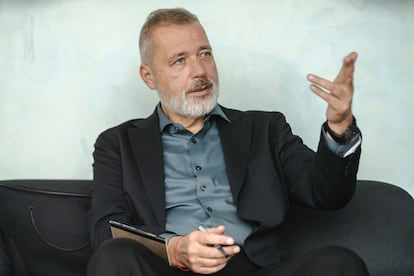
The Russian journalist paints a bleak picture for the profession and freedoms worldwide. Fascism is returning, he warns, censorship has become globalized, and “algorithms do whatever they want.” “People have stopped believing in the truth,” in facts, and most only accept what they see, experience, and feel. “Truth and antibiotics are similar: when used too much, they stop working,” Muratov states. “We journalists have to rebuild everything from scratch.” The editor of Novaya Gazeta calls for the creation of international networks of journalists to combat lies by verifying information, especially now that social media owners want to get rid of fact-checking tools. His team already collaborates with Maria Ressa from the Philippines, with whom Muratov shared the Nobel Prize, and with a Chinese platform. “They call lying as much as you want freedom of expression. That’s our main problem,” he summarizes.
In Europe, instruments still exist to prevent that undesirable future he knows so well, Muratov argues: “The EU has a parliament. You can demonstrate and take to the streets. You have newspapers like EL PAÍS, La Stampa, Le Monde, Frankfurter Allgemeine… You can discuss and talk freely. Here, a musician can sing a song in the street and not go to jail like in Russia. You can express your opinion; we can’t.” He expresses despair over the situation of political prisoners in his country, among them some 50 journalists. No one heeds their pleas for help, he points out. “I spoke with the Pope in Rome, with the Red Cross, with [Emmanuel] Macron… No one is doing anything to free these people,” he laments. “They talk about geopolitics, but no one wants to talk about a specific person. Politics without faces is easier.”
The Nobel Peace Prize laureate avoids commenting on the EU’s differing treatment of Russia and Israel. He notes that he is arranging a visit to the Gaza Strip to see “with his own eyes what is happening.” But, at first glance, he notices differences. The “tragedy” in Gaza is “different from that of Ukraine.” “In my opinion, Hamas provoked Israel. Ukraine never provoked Russia. There were no threats, nor were there any terrorist attacks,” he maintains. “Ukraine and Russia have always been brothers. Arabs and Jews never have been. They are completely different stories. But there are many dead in both places.”
The interview draws to a close, and Muratov makes a stark confession of his despondency regarding Russia’s future: “I have no hope, I live without hope, I am devoid of hope.” His resignation is short-lived. “The younger generation is the best in history. They are against war, they have empathy…” he adds spontaneously. Isn’t that hope? “Well, yes,” the journalist admits with a smile.
Sign up for our weekly newsletter to get more English-language news coverage from EL PAÍS USA Edition
