
It’s difficult to find a new angle in horror films nowadays. Any cabin-in-the-woods story inevitably draws comparisons with The Evil Dead, slasher films with Scream, and anything set in rural America with The Texas Chain Saw Massacre. The challenge for directors today is to offer a new twist on this familiar ground, or at the very least a memorable/marketable killer.
If nothing else, Dolly, the feature-length adaptation of Rod Blackhurst’s short film Babygirl, fulfils that final aspect, an imposing villain with a complicated relationship with the audience. Whether ot not the rest of the film works for you will likely come down to the strength of your stomach, and just how creepy you find porcelain dolls. Blackhurst certainly commits to the theme, with dolls occupying the frame throughout the film, and the oversized porcelain mask worn by the titular villain is undeniably creepy. But beyond that arresting visual, there’s little substance.
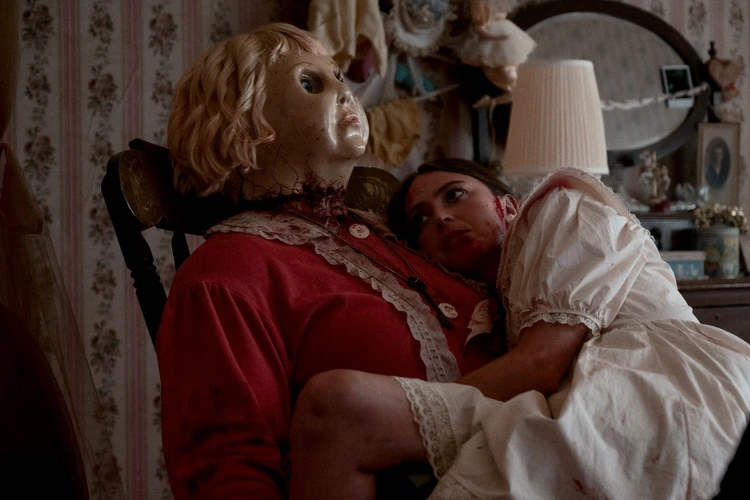
Chase (Seann William Scott) leaves his daughter at playgroup so he and his girlfriend, Macy (Fabianne Therese), can take a romantic hike in the woods – where he’s planning to propose. Unfortunately, they’re not alone. Lurking nearby is Dolly (Max The Impaler): a hulking figure wearing an enormous doll’s head. When their paths cross, Macy is abducted and taken to a decaying family home, where Dolly attempts to enact a macabre parody of motherhood, treating her captive as both doll and infant in service of some grotesque maternal fantasy.
It all starts promisingly enough. Shooting on 16mm film gives the film a real visual identity, and there are some nicely creepy moments very early on. Scott and Therese are instantly likeable, and there’s an immediate investment in their survival – if nothing else, someone has to get back to the daughter. The goodwill evaporates quickly, though, as the script leans into horror clichés without irony. Cliched lines of dialogue, that would be mocked in something like Scream – such as “I’ll check it out” and “I’ll be right back” – are delivered with deadly seriousness, yet without Scream’s self-awareness.
Scott, usually such an energetic presence, gives a muted, understated performance which would be great in a more grounded film, but here it makes him a little dull – something I never thought I’d say about him! Therese gives a more engaging performance, and she makes some nicely judged choices when depicting Macy’s constant struggles to both escape the house and appease Dolly. She’s shown to be intelligent, leaning into her new role in a way to gain trust, although she demonstrates terrible judgment at various points in the film.
It’s an incredibly derivative film, to the point where it feels like the director is trying to make a virtue of just how many films he can rip off. Dolly herself is a knock-off of Leatherface crossed with Tubbs from The League Of Gentlemen. They’re only threatening when the script decides they are. Where something like the little-seen The Hills Run Red found a way to subvert the unfortunate trope of a hulking killer with a childlike facade, Dolly plays its premise straight – and in doing so falls back on the tired and troubling cliche of mentally ill people being murderous psychopaths.
That said, credit where it’s due: Max The Impaler gives an incredibly evocative performance as Dolly. They use their imposing stature to create a character who is terrifying but also childlike. They have a great physicality for the fight scenes, which is perhaps to be expected from a professional wrestler, but more impressive are the moments of gentleness. The character’s signature move of wringing their hands and their sudden shifts between aggression and pitiful vulnerability hint at a more complex figure than the script allows to emerge. The film is clearly aiming for pathos beneath Dolly’s murderous exterior – but compared to something like Barbarian, which finds genuine emotional depth in a similar context, the emotional beats just don’t land. Her sympathetic moments never build to anything, as the characterisation is too inconsistent.
On the plus side, the gore effects are incredible and elicited genuinely visceral reactions from the audience. The house itself feels almost fetid – you can practically smell the rot. It looks as though Blackhurst relied pretty much entirely on practical effects, and this commitment really pays off; wounds look tactile and convincingly nasty. There’s one literally jaw-dropping moment that looks incredible. The forced pantomime of motherhood inflicted on Macy is queasily effective. There are some horrific torture sequences, but it’s often the smaller details – like rancid milk forced down Macy’s throat – that truly churn the stomach.
These moments, though, only serve to make the shortcomings of the script all the more frustrating. You can forgive almost anything in a horror film, but not tedium. Once it becomes clear that Macy is unlikely to be killed, what little suspense the film has drains away, and the film becomes an arduous trudge toward the inevitable conclusion, punctuated with repetitive moments of superficial violence.
Maybe an acquired taste, Dolly certainly has its moments. Gore hounds will relish its nastiness, and the design of the villain may well join the likes of Annabelle and Art the Clown. But it’s derivative, one-note, often incoherent and rarely frightening. The promise over the end credits that Dolly will return plays less as a tease than as a threat – and not an especially enticing one.
★★
In cinemas on March 6th / Fabianne Therese, Seann William Scott, Max The Impaler, Ethan Suplee / Dir: Rod Blackhurst / Shudder, Vertigo Releasing, The Independent Film Company / 18
Related
Discover more from
Subscribe to get the latest posts sent to your email.
