
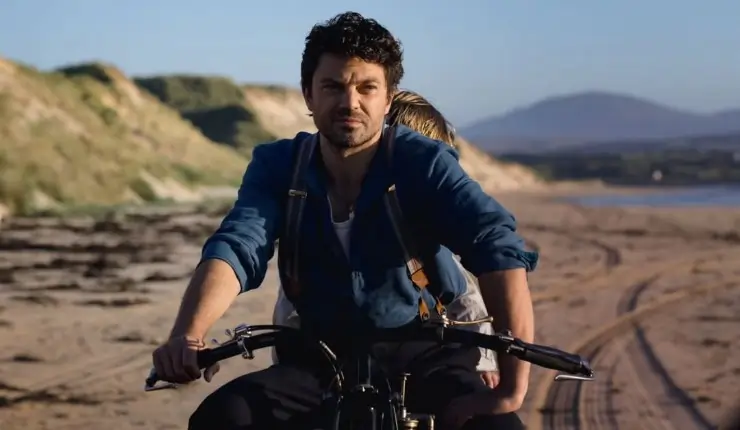
To celebrate the Irish premiere of The Lightkeeper (or Cry from the Sea in some territories) at the Dublin International Film Festival, we had the pleasure of chatting with stars Dominic Cooper and Sarah Bolger on the red carpet ahead of the screening.
Directed by Vic Sarin and written by Ciaran Creagh, the film is set in 1920s Ireland, shot along the coastlines of Donegal and Mayo. The story follows Seamus (Dominic Cooper), a reclusive lighthouse keeper dealing with the loss of his son. His carefully constructed world begins to shift when new figures unexpectedly enter his life. Marie (Sarah Bolger) is his housekeeper and one of the few people he is close to. Blending folklore, romance and psychological drama, The Lightkeeper offers a haunting portrait of isolation.
We began by chatting with Dominic Cooper about stepping into Seamus’ world and filming along Ireland’s rugged coastline.
In terms of approaching the character, did you feel that the isolated landscape helped you lean into that isolation within the character?
Yeah, I did actually. Although weirdly, that landscape I found really healing. Well, I suppose you’re sort of closer to Iceland there, aren’t you? And looking out over that expanse. There’s nowhere in the world like that, really. But what was so warming about it was that yes, the landscape was isolating, but actually the hearts and the people that I met in it were the opposite. And it was so healing at a time of massive loss [as he has spoken openly about how his mother passed around the time of filming]. I always feel like Ireland has this energy, the earth is just bubbling with some sort of magic. Almost like there’s fairies in the soil. There’s something that has happened here. The past is in the soil. And I felt… In fact, I felt when I landed in Dublin, I felt this sort of relief. It was such an odd feeling of calm that came across my body. I took a deep breath and felt calm. I’ve always felt like that when I come here.
And did this film feel uniquely Irish in that aspect or do you think it’s a story that is universal, regardless of its location?
It’s universal in that, I think it’s from a different time. I think it’s very hard for us to understand, really, the concept of not being connected to the rest of the world. The isolation of a man who’s had such extreme loss living in a lighthouse on a tiny island, but it is quite a good reflection of how we’re so reliant on outsourcing what we deal with. I mean, I can’t imagine now being that lonely, but I think it’s quite important for us to remember that we are on our own. We are our own beings. We will die alone. We came into the earth alone. So there’s a reality about it, but it’s through others that he is healed. I think that’s an important message. Actually, it also has religious messages that he fights against at first, but in the end it’s part of the religion that moves him forward and makes him able to continue.
You mentioned a religious aspect to the story. When you were finding your footing with the character, were you trying to embrace the grounded, human element of him, or were you allowing yourself to explore that mythic element a little bit?
Well, he’s desperate for anything. And I think that he’s gone through such trauma. And again, what’s interesting about that time, I suppose, is we didn’t really know nearly as much about trauma or psychology, so he’s he’s using an old myth and touching the water and trying desperately to feel a connection while dealing with a loss, to the loss of his son. I think that’s beautiful.

We also caught up with Sarah Bolger about bringing a fierce Irish presence to the role and returning to Ireland for filming.
For The Lightkeeper, what was it that first drew you to the role — was it the sense of coming home, the script, or the character?
Yes! Oh God, coming home to Dublin, but more importantly, I think, being able to play an Irish woman. My aunt looked back on my family tree, and told me about my great-great-grandmother, Maggie Kinsela, who would have been alive in 1924. I really tried to embody that person. Fierce Irish women of old, who maybe didn’t have the circumstance at the time to speak loudly, but that lived fierce lives. And I wanted to really create that kind of woman and sort of bring modern elements into this character. Because I do think, as Irish people, we have gone through so much strife, and there’s an ability in us to sort of seek and live for tomorrow and survive. I just think this movie sort of embodies all those things that allowed me to create a character that felt of the period, but also with a level of modernity.
Do you think it’s a film that could be set anywhere, anytime? Or do you think it’s important that it was made as it was?
I think it’s important because it’s a movie about personal grief and communal expectations and by that, I mean of the time. What is expected of you. Even people’s understanding of grief or mental health during that period. And I think that there was a reason why it’s set in 1924. I think that was sort of perfect for the story.
How much did filming in those remote parts of Donegal and Mayo shape the atmosphere on set for you?
Being able to film in Mayo and Donegal, I would say, we did pick the top ends and farthest parts of Ireland. I think because of the character, specifically Dominic’s character, Seamus, there’s an isolation to that character. There’s an internal monologue that he doesn’t want other people to narrate. And I think that, the tippy top and farthest west of the country really helped bring that element forward.
The Lightkeeper / Dir., Vic Sarin, / Screenplay: Ciaran Creagh / Score: Johan Söderqvist / Editing: Austin Andrews / Ireland and Canada
Related
Discover more from
Subscribe to get the latest posts sent to your email.
