

Dragon Quest VII Reimagined is perhaps one of the most unique video game remakes I’ve ever seen.
It takes the eponymous 2000 PS1 RPG, which is something of a black sheep in the series for its rather grueling 100-hour runtime, and aims to dramatically streamline the experience. It’s also the second time Square Enix has made such an effort, following 2016’s 3DS remake of VII, and where that version brought the campaign length to about 80 hours, Reimagined knocks it down to a comparatively brisk 50-ish hours.
Of course, attempting to bring more people into Dragon Quest is an understandable endeavour, but it’s led to quite a bit of debate. Indeed, it’s been fascinating to see the response to Reimagined so far, with some welcoming the removal of bloat, while others arguing that too many of the edges have been sanded off in the process.
Ultimately, my opinion falls somewhere in the middle. As someone who’s long felt that games are often overlong and tedious, especially in the RPG space, I appreciate trimming the fat on something like Dragon Quest VII. I’ve never played the original game, and so Reimagined is, in theory, the perfect starting point for me. And while I don’t have a deep understanding of the many changes that have been made, RPG Site‘s Adam Vitale offers in-depth insight into all of that as someone who’s played the previous versions of VII. Suffice it to say, it sounds like many smart tweaks were made across the board, from the removal of a lot of unnecessary backtracking to the ability to speed up battles and even skip others entirely if you greatly out-level the enemy. I’m all for that, since it allows for a tighter experience.
At the same time, though, Reimagined cuts down pretty much every other point of friction, especially when it comes to the RPG systems, which is unfortunate. For instance, dead party members automatically revive after battle, removing both that element of challenge and the amusing image of their literal coffins following around surviving characters. Markers litter the maps to tell you exactly where to go, and party members and NPCs provide frequent clues. Key items are automatically used in the right spots. There are frequent statues throughout the world that fully heal your party.
All of this means that Reimagined is now the opposite of grueling: it’s just plain easy, and that detracts from the otherwise solid jobs (Vocations) system. To be clear, I’ve long supported having lower difficulty settings in games to give players options. But the problem here is that pretty much none of these parts of Reimagined are optional, and it seems like a clear solution would have been to simply make them as such. I certainly would have appreciated an opportunity to mix-and-match some of these settings, especially since there are already some modular difficulty options to tweak factors like damage dealt, experience earned, and monster strength.
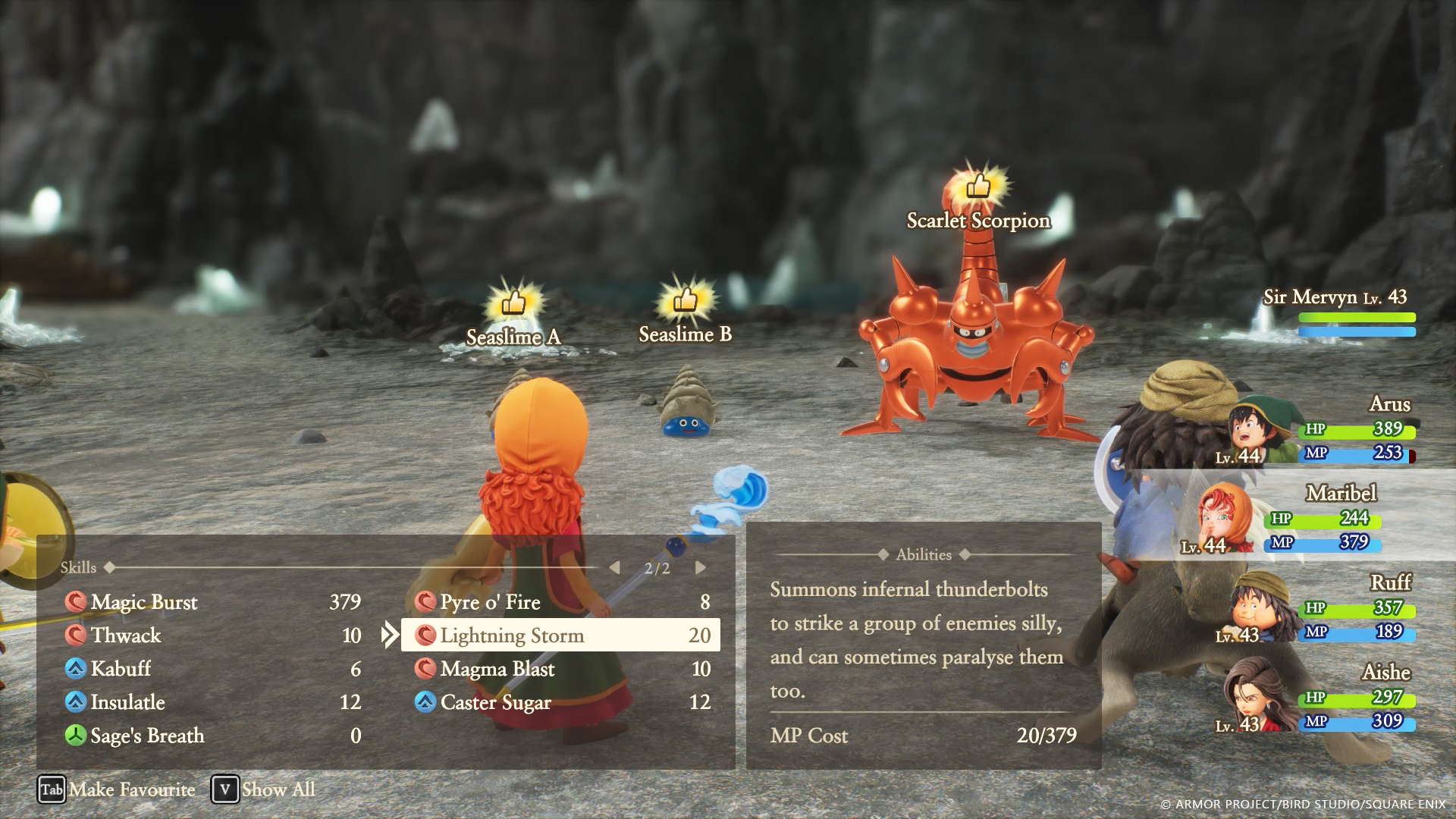
With all of that said, I do kind of see what they were going for. Besides making it more approachable, removing a lot of that friction does, in a sense, hone in on VII‘s core whimsical spirit. The game follows a boy named Hero, his best friend Prince Kiefer and co. as they leave their cozy little home to learn more about why they’re the only remaining island in the world. It’s a rollicking, time-travel-fuelled adventure that is further conveyed through Reimagined‘s gorgeous, dioramic visuals, which bring a stunning sheen to the whole experience.
Admittedly, I don’t love that the main character is, like many other Dragon Quest leads, a generic, speechless person named Hero. (One of the reasons I’ve always preferred Final Fantasy to Dragon Quest or even the fellow Akira Toriyama-drawn Chrono Trigger is that most of those games have clear, well-defined protagonists, versus silent avatars for the player.) And so, I initially found a similar detachment in Reimagined, and that didn’t help with the rather slow (and almost entirely combat-free) introductory hours or relatively uninteresting larger supporting cast.
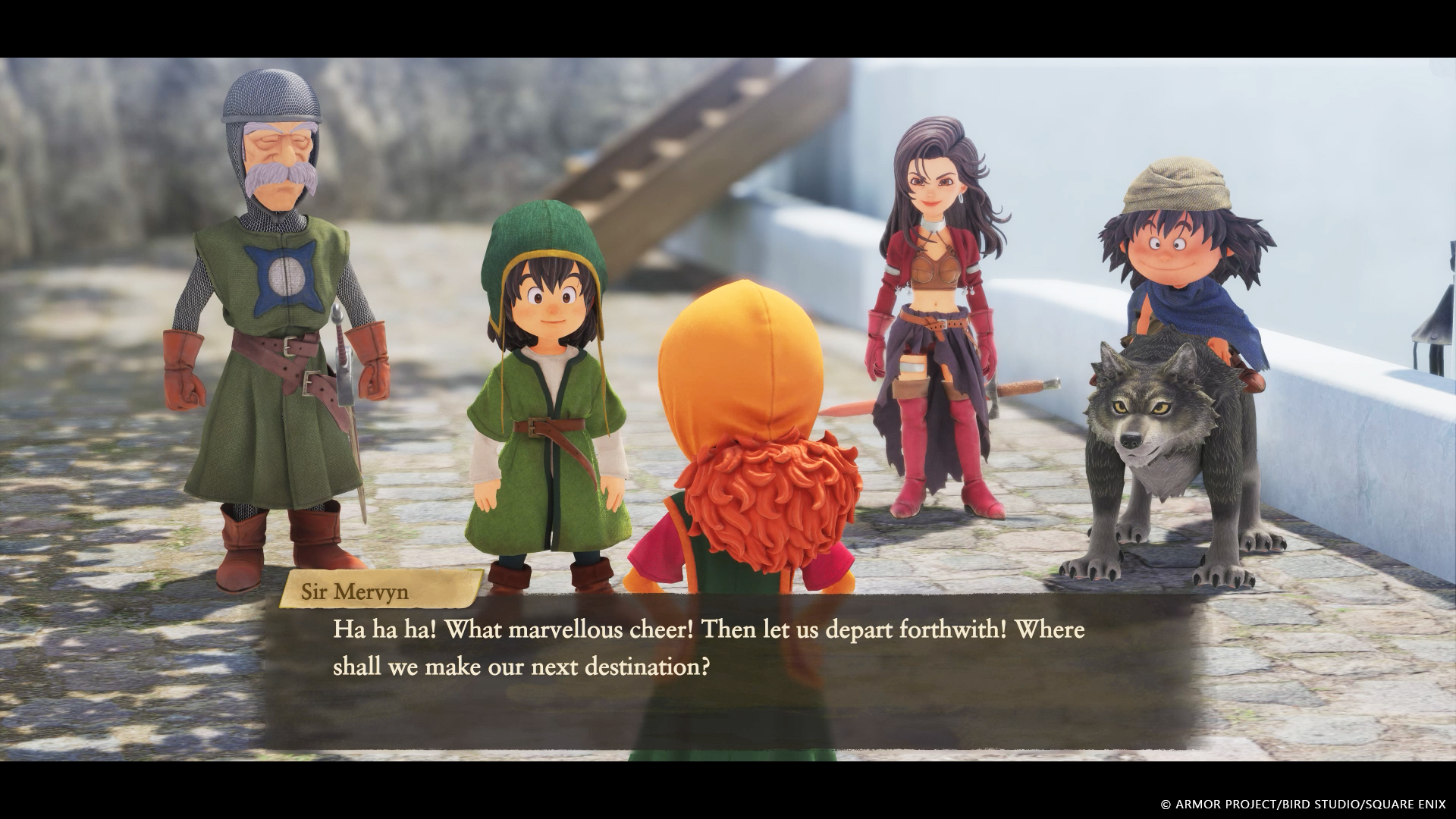
But eventually, I came to appreciate what is the real narrative highlight of Reimagined: the world itself. Indeed, your journey to uncover the secrets of the world gives the game a refreshing short story structure. Essentially, you’ll visit a place in modern time and then revisit it in the past to learn what happened to it. This helps condense the still-meaty experience into a more manageable and compelling anthology, of sorts, where each island has its own narrative hook.
In the end, that’s what makes Dragon Quest VII Reimagined a success for me. Although I do wish there weren’t so many mandatory settings and features that oversimplify parts of the experience, the storybook presentation and intriguing worldbuilding make it worth checking out.
Dragon Quest VII Reimagined is now available on PS5, Xbox Series X/S, Nintendo Switch, Nintendo Switch 2, PlayStation 5, and PC.
Image credit: Square Enix
