
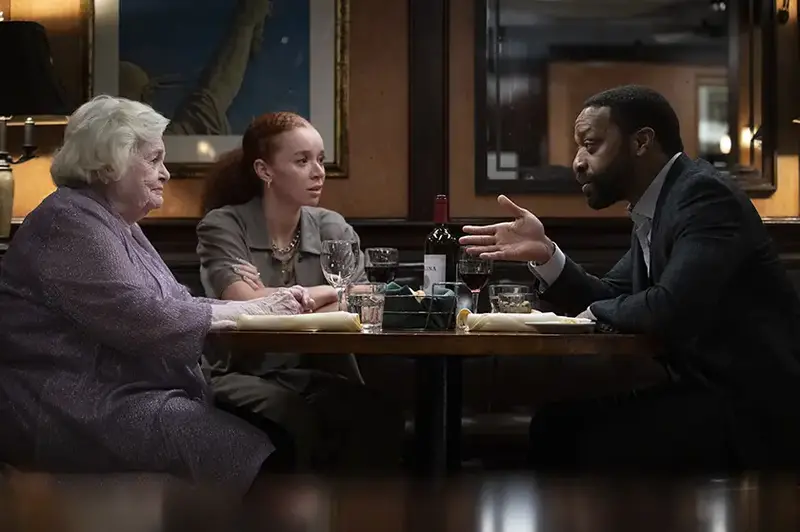
It’s a week when two award-winning actresses move behind the camera and launch their directorial debuts. Both Scarlett Johansson and Kate Winslet have moved to new territory with family-orientated stories driven by female characters. Johansson’s Eleanor The Great also taps into her own heritage but comes at its story from an unexpected angle, one that turns out to be the most divisive aspect of the film and, depending on your point of view, its fundamental weakness.
Now well into her 90s, the Eleanor of the title (the redoubtable June Squibb) is a Jewish woman who has shared a Florida apartment with her closest friend, Bessie (Rita Zohar) for years. The two are like sisters, so when Bessie dies, the devastated Eleanor moves to live with her daughter and grandchildren in New York. Visiting the local Jewish Community Centre in search of company, she’s accidentally drawn into a support group for Holocaust survivors and, in an effort to fit in, pretends to have shared their experiences. In reality, her stories belong to Bessie. She also meets journalism student Nina (Erin Kellyman), who is writing about the group and decides to put Eleanor at the centre of her feature, particularly her plan to be bat mitzvahed. But when Nina’s father, a top TV journalist, hears the story, he starts to dig deeper, and it’s only a matter of time before the truth comes to light.
As Eleanor the Great opens, we’re won over by the relationship between the two elderly friends and Eleanor’s waspish tongue in particular. She sets the tone perfectly by putting a gormless supermarket assistant in his place, but does it with a smile and a twinkle in her eye, so you’re never quite sure how much of a rebuke it really is. This and many other moments provide the required laughs, making it deceptively easy to settle into what appears to be a comfortable film. It’s also a role that’s right up Squibb’s street, initially similar to her first-ever lead in last year’s Thelma. That was an out-and-out comedy. This is a different proposition altogether.
Eleanor has lied. There’s no malice behind it, but while she feels awkward about pretending Bessie’s trauma was her own, she never really shows any signs of wanting to volunteer the truth. But in lying about the Holocaust, she’s essentially disrespecting one of the most horrific periods of modern history and even though the script touches on how the truth is so often one of many shades of grey rather than black and white, it does little more than scratch the surface. Surprisingly, when Eleanor is forced to admit what she’s done, it’s only Nina who’s seriously upset, with everybody else displaying a remarkable level of understanding. If only we were all so forgiving. There is something naïve and simply too easy about the total absence of any criticism, especially from the survivors’ group, and what could have been a knotty moral dilemma is just pushed to one side.
For those who prefer to believe that people can be so generous with their forgiveness, it’s not a problem. For those with a different viewpoint, it’s a big stretch, especially after witnessing a distressed Bessie physically shaking as she relates her experiences to Eleanor as if they were yesterday. It makes such pretence all the more questionable, the film’s narrative choices safe to the point of cosy and leaves the cast walking an emotionally dubious tightrope. It’s easy to be charmed by Eleanor the Great: the performances are nonetheless good, it’s warm and has some delightful moments – mainly from Squibb – of pure chutzpah. But the fact that it takes a sticking plaster to the central issue instead of grasping the opportunity to confront it is inescapable. And that’s its biggest sadness.
★★★
In cinemas from December 12th / June Squibb, Erin Kellyman, Chiwetel Ejiofor, Jessica Hecht, Rita Zohar, Stephen Singer / Dir: Scarlett Johansson / Sony Pictures / 12A
Related
Discover more from
Subscribe to get the latest posts sent to your email.
