
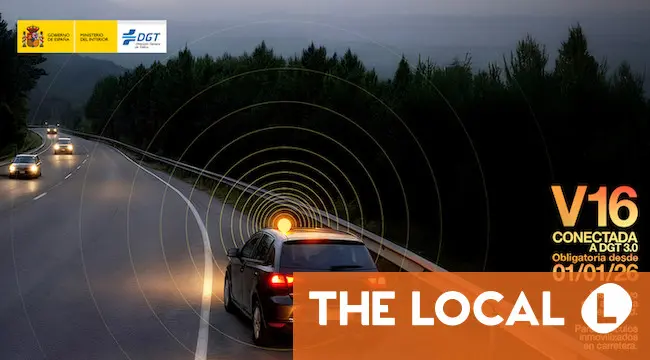
The European Commission has questioned whether Spain’s new and mandatory V-16 emergency lights breach EU law, another blow for the controversial device which 28 million drivers have been told to buy for around €50 each.
Spain’s General Directorate of Traffic (DGT) made it mandatory for all drivers in Spain to have V-16 emergency lights at the start of 2026 as a replacement for the standard warning triangles, then announcing there would be a grace period without fines for those who hadn’t bought the device yet.
READ ALSO: Spain won’t fine drivers without V-16 light for ‘reasonable’ amount of time
However, European institutions have warned that the V-16 light may not comply with the EU directive on emergency signalling equipment and are even considering vetoing the new regulations for failing to comply with EU law.
The beacon meant to be a safer option than warning triangles as drivers don’t have to get out of their vehicles and face oncoming traffic when their cars have a breakdown, although there have been many doubts cast over it’s effectiveness.
The V-16 device is a small yellow or orange LED light that is equipped with geolocation connectivity and is capable of emitting a high-intensity 360º light intermittently and continuously for 30 minutes.
The issue is that Spain requires that the V-16 light includes a geolocation system and connectivity with the DGT 3.0 platform.
According to various reports published in recent days, the EU believes that this requirement could violate the principle of free movement of goods and EU regulations.
Brussels is reportedly studying the compatibility of the new Spanish rules with EU law, which opens the door to a procedure that could force a review or even the removal of the requirement.
Advertisement
This could be a blow to millions of drivers across Spain who already purchased the light for around €50 when it became mandatory and have had it in their vehicles for almost two months already.
The European Commission has stated that the Spanish Government did not notify the European Union of the ongoing implementation of the V-16 and the DGT’s 3.0 geolocation platform, as required by European legislation.
The organisation’s executive vice-president Stéphane Séjourné explained that “the Spanish Royal Decrees have not been notified according to the procedure of Directive (EU) 2015/1535.”
This regulation ensures that “EU countries must inform the European Commission of any draft technical regulation before its adoption,” and from the date of notification, a three-month status quo period is established, during which the member state – in this case Spain – must refrain from adopting the technical regulation in question, allowing the Commission itself and other nations to examine the proposed text and respond.
READ ALSO: Spain’s V16 light: Everything drivers need to know
Advertisement
The V-16 light allows the DGT to know exactly where the breakdown or accident happened. When switched on, information is sent every 100 seconds about your location, until it is deactivated.
Spain is the only EU country to have made such a device mandatory for drivers.
If Brussels rules that they violate EU regulations, the government could be forced to amend the rules. This would affect both drivers who have already purchased the device and manufacturers who have adapted their production lines.
Spain’s Interior Minister Fernando Grande-Marlaska is scheduled to appear before the Spanish Congress on Wednesday February 25th to report on the confusing implementation of the V-16 emergency signalling beacon in Spain.
Marlaska has previous defended the V-16 light by stating that 25 people die each year in Spain as a result of leaving their vehicles to place down emergency warning triangles.
Advertisement
Spanish consumer watchdog Facua have been among the biggest critics of the Spanish government for not properly informing the country’s 28 million drivers about which V-16 light to buy, leading many of them to waste money on beacons they bought online which aren’t officially recognised by the DGT.
In late 2025, Spain’s Civil Guard Police also criticised their effectiveness. They claimed that they’re not useful on roads with a high number of bends as oncoming drivers don’t get the pre-warning that a triangle provides.
They also stressed that the V-16 lights are not bright or visible enough during daytime hours, rendering them almost useless.
Furthermore, there are articles in the Spanish press citing the inventors of this device, who apparently said that they were meant only for people with physical disabilities, not for them to be compulsory for the entire population.
