
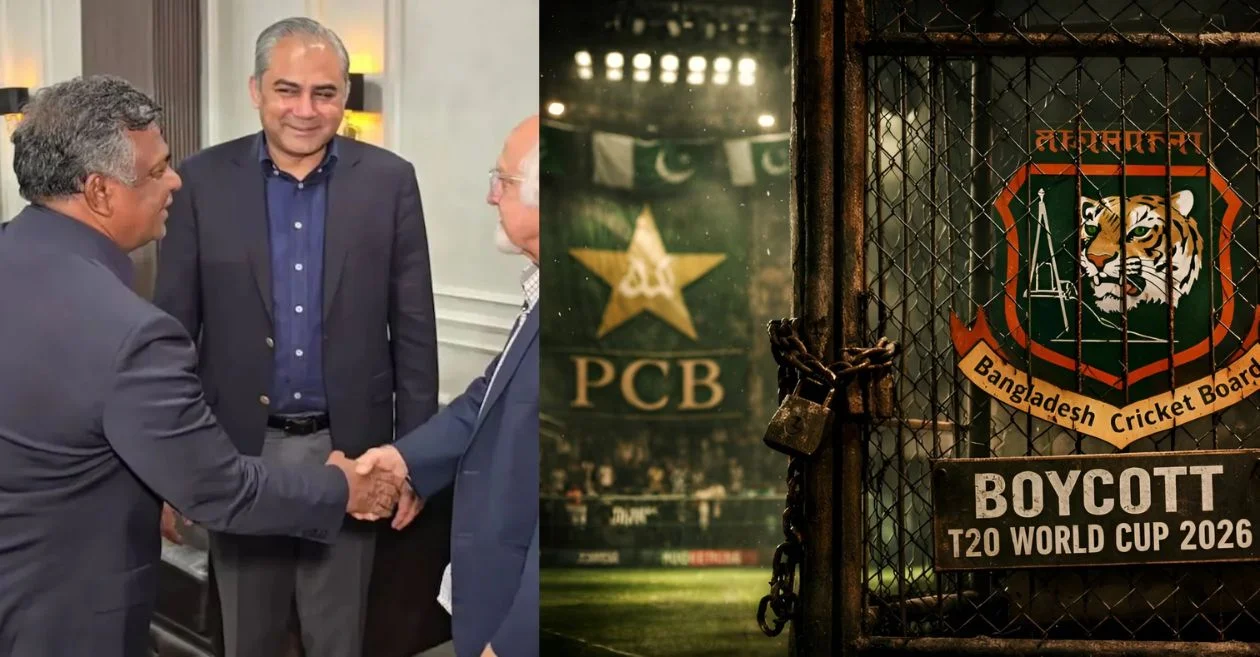
In a scathing assessment of one of the darkest chapters in Bangladesh‘s cricket history, former Asian Cricket Council (ACC) CEO and ex-BCB official Syed Ashraful Haque has exposed the high-stakes political maneuvering that led to the nation’s removal from the T20 World Cup 2026.
While the world’s elite teams compete across India and Sri Lanka, the Bangladesh remain absent, a direct consequence of what Haque describes as a premature and naive decision by the board’s leadership to boycott matches on Indian soil. The fallout, triggered by a dispute over Mustafizur Rahman‘s IPL exit, cost the board millions in revenue.
The ‘Mohsin Naqvi trap’: How the BCB chief was influenced over T20 World Cup 2026 participation
Syed Haque has made explosive claims regarding the influence of Pakistan Cricket Board (PCB) chief Mohsin Naqvi on BCB President Aminul Islam. During a bombshell interview with RevSportz on February 19, 2026, Haque asserted that the decision to prioritize ‘security issues’ over participation was a tactical blunder orchestrated by external actors.
“Possibly, though I prefer not to discuss politics. As a cricket administrator, I focus on honesty and commitment. Aminul Islam, likely being naive, was influenced by Mr. Mohsin Naqvi, the current ACC president, who persuaded him to go along. At the end of the day, who won?” Haque was quoted as saying by the Firstpost.
Haque further explained that Aminul Islam failed to grasp the nuances of global sports governance, leading him to prioritize government optics over the welfare of the players:
“He lacks an understanding of international cricket diplomacy. He walked into a trap, overly concerned with pleasing the government rather than protecting his players, who are the nation’s greatest assets. Players like Liton Das, Mustafizur Rahman, and Najmul Shanto are in their early 30s, missing this World Cup is an injustice to them.” the former BCB official added.
The Mustafizur Rahman catalyst and the price of defiance
The crisis was sparked by the BCCI’s directive to Kolkata Knight Riders (KKR) to release Mustafizur Rahman on ‘security grounds,’ which the Yunus-led interim government in Dhaka viewed as a national insult. However, Haque argued that using this as a reason to boycott a World Cup was an act of administrative self-destruction.
“I always believed the decision taken by the Bangladesh government at the time was premature. There was no justification for such a drastic decision simply because Mustafizur Rahman was not allowed to play in the IPL in India. We had ample time to negotiate with the BCCI and, if necessary, the Indian government. The ICC organised the tournament and provided security, which they fulfilled. If we still had concerns, the government could have requested additional assurances regarding player safety.” Haque concluded.
The ICC eventually replaced Bangladesh with Scotland after the BCB ignored multiple ultimatums to confirm their travel to India.
Also WATCH: T20 World Cup 2026: Suryakumar Yadav playfully checks Abhishek Sharma’s pockets during the training session
