
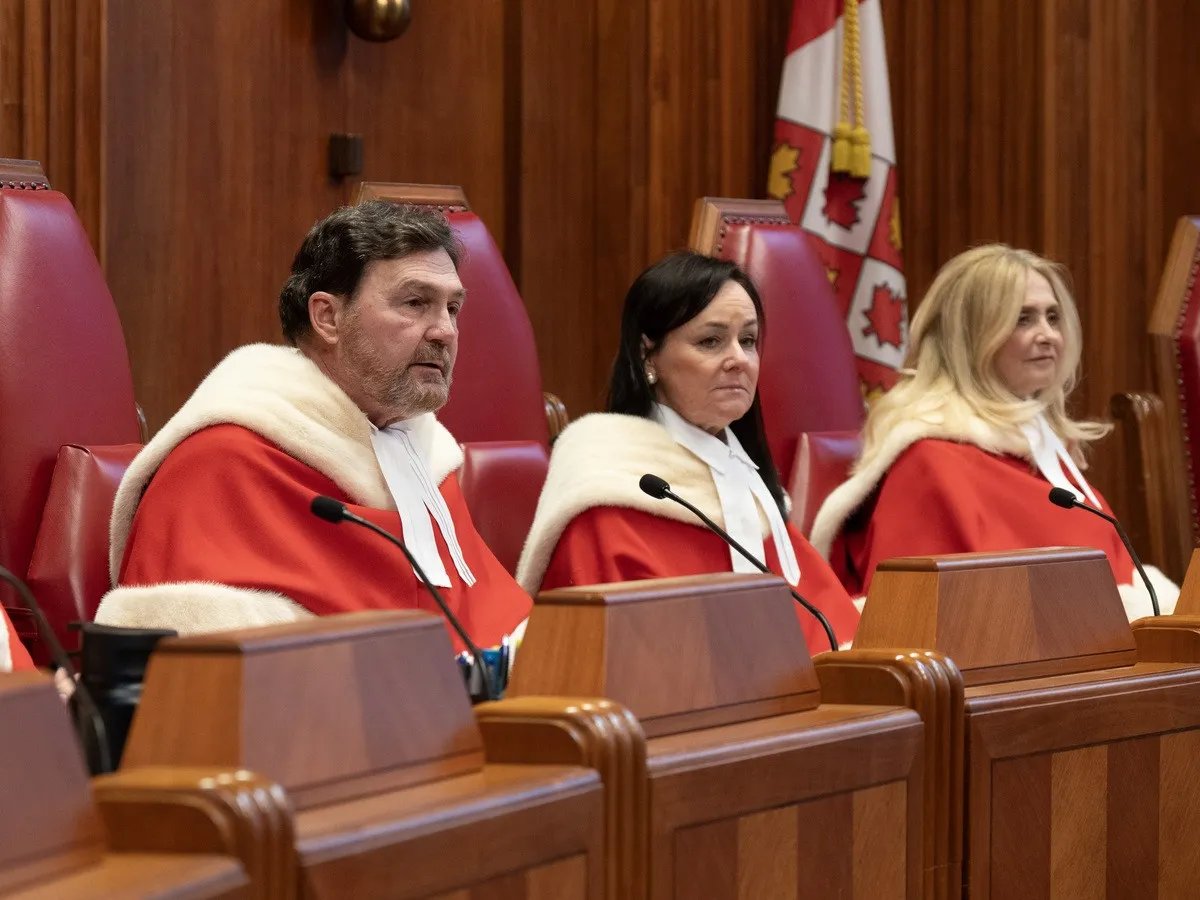
OTTAWA — Chief Justice Richard Wagner said the Supreme Court’s decision on the appeal of Quebec’s Bill 21 and use of the notwithstanding clause will not be decided based on “extremist or catastrophic” examples after some parties hypothesized the clause could wielded by a tyrant or used to uphold laws legalizing slavery or summary execution.
On the final day of hearings on Bill 21 on Thursday, two Supreme Court of Canada (SCC) justices pushed back on some of the “catastrophic” scenarios evoked by parties calling for new limits on governments’ ability to invoke the notwithstanding clause.
The controversial clause allows a government to suspend certain Charter rights for up to five years, at which point the invocation must be reviewed by legislators.
The case is the most substantive review of the notwithstanding clause by the top court since its inception as part of the Charter over four decades ago.
To make their point, opponents of Bill 21 raised a cornucopia of hypothetical situations in which legislatures could wield the notwithstanding clause to shield discriminatory laws or run roughshod over a host of Charter rights.
On the first day of hearings, counsel for a Quebec teacher’s union argued that a Canadian “mini-Trump” could invoke the clause found in section 33 of the Charter to do anything the U.S. president is doing now — legally.
“Everything, or almost, that is happening in the United States could happen here in a perfectly constitutional manner” due to the current interpretation of the clause, lawyer Frédéric Bérard told the court.
“We can no longer analyze (section) 33 in the same way that we did” back in the 1980s, he added.
On Wednesday, the federal government took the argument a step further.
As part of its argument that the court should impose limits on the invocation of the notwithstanding clause, constitutional lawyer Guy J. Pratte lobbed a question at provinces arguing the opposite.
If there is no limit to the invocation of section 33, could it be used to shield hypothetical laws that legalize summary executions or slavery, he asked.
“It’s not a question of whether (provinces) want to do it, or whether they’re inclined to do it. It’s whether they can do it,” Pratte said.
On Thursday, as dozens of interveners opposed to Bill 21 made five-minute submissions to the court, a few threw in their own hypothetical extremes.
Could a province invoke the nothwithstanding clause to pass a law removing Acadian art, the Acadian flag, Acadian food, Acadian music or the famous Acadian “tintamarre” festivals from the province’s French-language schools, asked Société de l’Acadie du Nouveau-Brunswick lawyer Dominic Caron.
That’s when Wagner cut in for the first time to say enough with the extreme examples.
“I don’t think we’ll resolve this case by resorting to extreme scenarios,” the chief justice chided in French.
But a few minutes later, he and Justice Malcolm Rowe cut in again with the same remark, this time when counsel for the Community Legal Assistance Society raised the question again of if section 33 could be used by a “tyrannical government”.
“As I mentioned before, I don’t think this case will be disposed of by extremist or catastrophic scenarios,” Wagner said.
But when the lawyer, Jonathan Blain, argued back that many of the atrocities of the 20th century are the result of discriminatory legislation, Rowe cut in as well.
“You have less confidence in the good sense and goodwill of Canadians than I do. We’re not teetering on the edge of the precipice of fascism. That’s not the reality,” the justice said.
Over the four days of hearings, dozens of groups and individuals argued against Quebec’s controversial secularism law, whereas a handful — including the Quebec government — defended it.
The 2019 law prohibits certain Quebec public sector workers, such as judges, police officers, teachers and prison guards, from wearing religious symbols at work. It also requires them to perform their duties with their faces uncovered.
To pass his 2019 bill, Quebec Premier François Legault invoked section 33 of the Charter of Rights and Freedoms.
But a group of six provinces argued that the court has no power to limit the invocation of the notwithstanding clause and to do so would amount to a constitutional amendment by the court.
The Ontario government countered that any new limits on the invocation of the controversial clause in the Charter risked causing “serious, irreparable and unpredictable” harm on the Canadian federation.
The SCC is also pondering the question of if a court can assess if a law invoking section 33 still breaches the Charter rights suspended by the notwithstanding clause.
The case is historic in more ways than one. With four days of hearings, it’s one of the longest cases ever heard by the Supreme Court. It also involves over 60 appellants, respondents and intervenors, the most in the court’s 150-year history.
The SCC reserved judgement and will issue a decision in the future.
National Post
cnardi@postmedia.com
Our website is the place for the latest breaking news, exclusive scoops, longreads and provocative commentary. Please bookmark nationalpost.com and sign up for our politics newsletter, First Reading, here.
