
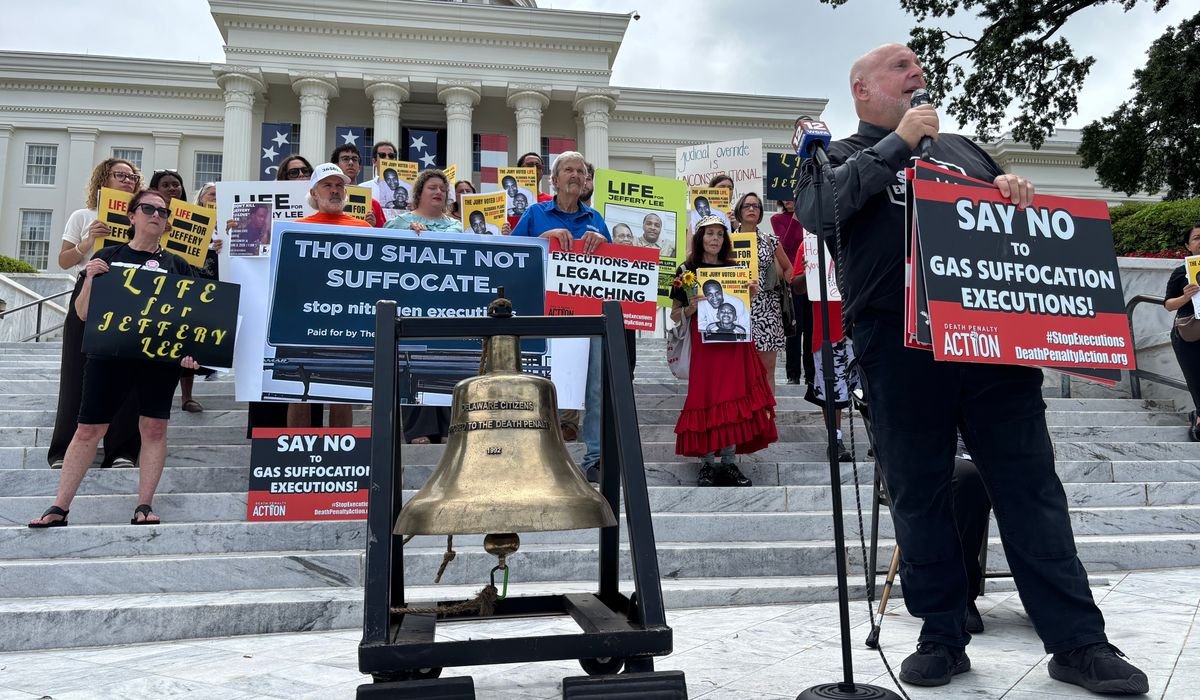
A federal appeals court ruled Monday that Alabama’s nitrogen gas execution method likely inflicts a cruel and constitutionally impermissible degree of suffering on condemned inmates — but stopped short of blocking a scheduled execution set for Thursday.
The three-judge panel of the 11th U.S. Circuit Court of Appeals found that Alabama’s nitrogen hypoxia protocol causes condemned prisoners to experience what the court described as “air hunger” — an oxygen deprivation response that “triggers the body’s extreme physiologic need to get more oxygen” and produces intense physiological stress and suffering lasting between one and three minutes. That duration, the panel concluded, renders the method unconstitutional under the Eighth Amendment’s prohibition on cruel and unusual punishment.
“Counting to 60 or 180 seconds is not a quick exercise, and constitutionally speaking, that timeframe is intolerable given the suffering that would likely take place under Alabama’s nitrogen hypoxia protocol,” the court wrote. “Such suffering, we believe, is over and above the mental distress that typically accompanies the knowledge of impending death by execution.”
The ruling stems from an appeal by death row inmate Jeffrey Lee, 50, who is scheduled to be executed by nitrogen gas in Alabama on Thursday. Lee was convicted of the 1998 murders of Jimmy Ellis and Elaine Thompson during a robbery at a pawn shop in Orrville, Alabama. He also shot a third employee, Helen King, according to court documents.
The panel — consisting of Judges Adalberto Jordan, Robert J. Luck and Embry Kidd, appointed respectively by Presidents Barack Obama, Donald Trump and Joe Biden — ordered U.S. District Judge Emily Marks to hold a new hearing to determine whether executing Lee by firing squad, his preferred method, is feasible. The court declined to grant a stay of execution, however, because Lee has not yet established that a firing squad is a viable and substantially less harmful alternative, as required under the legal standard for a preliminary injunction.
The ruling directly contradicts Judge Marks’ May 29 finding, in which she concluded that while nitrogen gas executions do cause “air hunger” lasting up to three minutes, the level of suffering did not rise to the constitutional threshold of pain “superadded” beyond what is necessary to carry out a death sentence. The appellate panel disagreed, finding that same suffering constitutes a substantial risk of serious harm above and beyond death itself.
Alabama became the first state in the country to carry out a nitrogen gas execution when it put Kenneth Eugene Smith to death in January 2024. The state has since used the method in six additional executions, and Louisiana has employed it once. The procedure involves strapping the inmate to a gurney and fitting a mask over his face through which ultra-high purity nitrogen gas flows, displacing breathable air until the inmate loses consciousness and dies. Witness accounts from the first four Alabama executions have described inmates writhing under their restraints, shaking and gasping for several minutes, and appearing to struggle consciously against the process.
The Execution Intervention Project, an anti-death penalty organization that has challenged nitrogen gas executions in court, called Monday’s ruling the most significant legal development in the effort to stop the method. The group called on Alabama to halt Lee’s execution and urged Gov. Kay Ivey to acknowledge that a federal court had found her state’s protocol likely produces conscious suffocation for minutes on end.
Lee’s execution would be Alabama’s first of 2026. Ms. Ivey in March commuted the death sentence of Charles “Sonny” Burton just two days before his scheduled execution, saying it would be unjust to execute a man who was not the triggerman in the 1991 robbery that led to his conviction. That decision was unrelated to the nitrogen gas controversy and was only the second time in Ms. Ivey’s nine years in office that she has commuted an inmate’s sentence. She has presided over 25 executions.
This article was constructed with the assistance of artificial intelligence and published by a member of The Washington Times’ AI News Desk team. The contents of this report are based solely on The Washington Times’ original reporting, wire services, and/or other sources cited within the report. For more information, please read our AI policy or contact Steve Fink, Director of Artificial Intelligence, at sfink@washingtontimes.com
The Washington Times AI Ethics Newsroom Committee can be reached at aispotlight@washingtontimes.com.
