
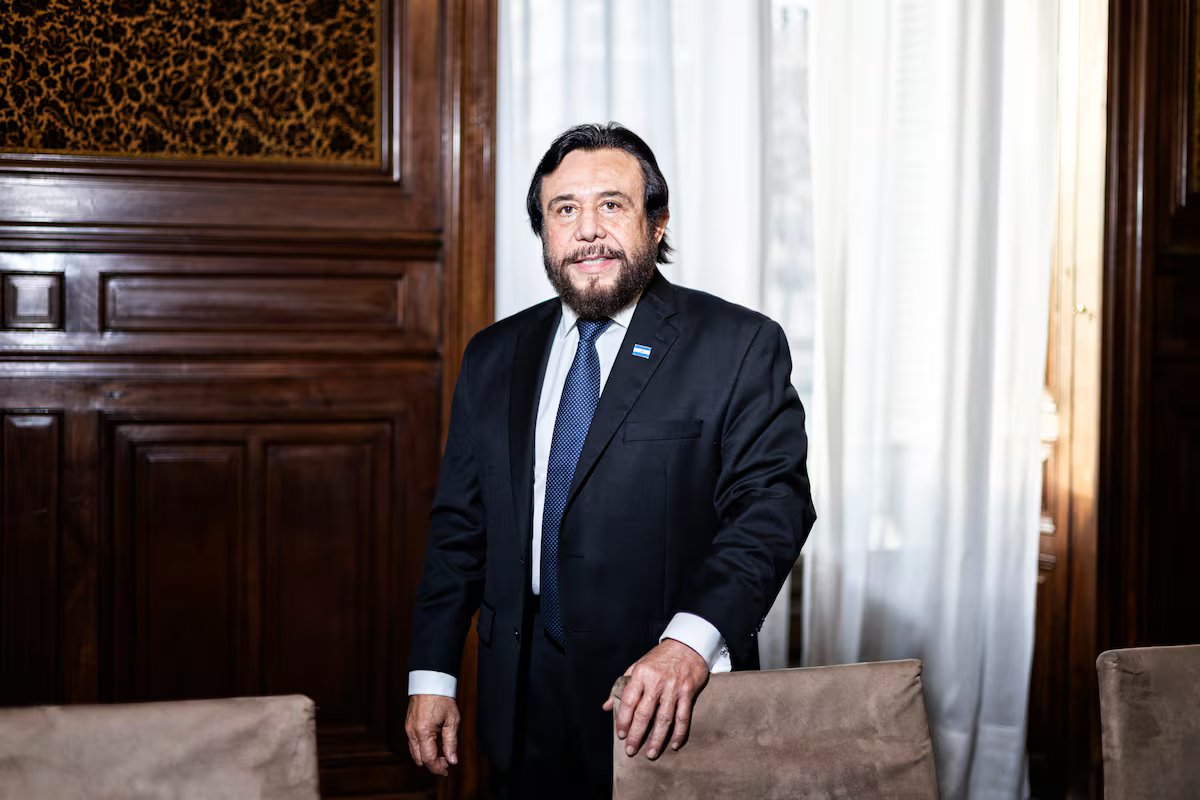
On his third visit to Spain as vice president of El Salvador, Félix Ulloa, 74, divides the world into those who oppose Nayib Bukele and those who support him.
The lawyer, who was born in the city of Chinameca, arrives at a sweet moment for his country. El Salvador has become a pawn (or perhaps a bishop) in the Trump administration’s continental strategy. “The country isn’t the same as it was in 2019 or 2022,” he asserts, during an interview with EL PAÍS that was held on Wednesday, February 18, at the Casa de América cultural center in Madrid. As a summary of President Bukele’s six years in office, he cites security, economic growth, Shakira’s recent concert, the more than four million tourists annually, as well as over 100 pristine beaches for surf lovers.
However, in the last four years, the Central American country has lived under a state of emergency, which has been marked by nearly 100,000 arrests, human rights reports about torture and abuse, persecution of journalists and critical voices, as well as state participation in Donald Trump’s mass deportations.
In Madrid, where he met with business leaders, lawyers and conservative politicians, Ulloa defended the constitutional reform that, last August, endorsed the president’s indefinite reelection and paved the way for Bukele to run for a third term.
Question. The year began in Latin America with the capture of Nicolás Maduro by U.S. special forces. And now, we’re witnessing the economic strangulation of Cuba. How are these changes being viewed from El Salvador?
Answer. President Bukele is in charge of foreign policy. I can speak about [El Salvador]: I’m not familiar with his [foreign policy] agenda.
Q. Bukele supported Venezuelan opposition leader Juan Guaidó at one point and spoke out against the regimes of Maduro and Nicaragua’s Daniel Ortega.
A. I discuss development and the economy with the president, as well as law and institutions. We talk about El Salvador.
Q. El Salvador has joined Trump’s so-called “Board of Peace.” Bukele is scheduled to meet with the U.S. president in Miami on March 7, at a regional summit alongside the leaders of Argentina, Bolivia, Ecuador, Honduras and Paraguay. What does he hope to achieve?
A. He’s been invited, yes. But I insist that I’m not going to talk about foreign policy.
Q. Then let’s talk about El Salvador and the fourth anniversary of the imposition of the state of emergency, which began in March of 2022.
A. Let’s talk about achievements. If you’re going to ask me about some journalist from El Faro (a media outlet critical of the government, now operating in exile in Costa Rica), that’s just a broken record.
Q. El Salvador’s economy grew by 3.5% in 2025, according to the World Bank. Bukele remains popular: there are early legislative and presidential elections scheduled for 2027. And the president has said that he plans to be reelected until 2033.
A. [It’s actually] 4%, according to our figures. And he’s not going to be “reelected” [just like that]: he’s going to run again.
Q. Reelection wasn’t contemplated in the Salvadoran Constitution.
A. But [the Constitution] was changed.
Q. Isn’t that the same thing Hugo Chávez did when he was president of Venezuela, and who was criticized by El Salvador?
A. It’s the same thing that’s done by the Socialist Party or the People’s Party in Spain when they call early elections: they run for [another term]. The difference is that Spain has a parliamentary democracy, while ours is presidential.
Q. In Spain, there are no term limits. And the Constitution hasn’t been amended.
A. That’s what the people decided [in El Salvador]. When the people grew tired of the two parties that governed them for 30 years, they gave Bukele a majority in 2019 and again in 2024.
Q. Did the Salvadoran people trade freedom for security?
A. Have 97% given up freedom, or only 3%? Who do we believe? Last week’s poll by the newspaper La Prensa Gráfica says that 91.9% of Salvadorans approve of Bukele’s administration and that more than 90% want the state of emergency to continue. And the European newspapers are always against it. Who do we listen to?
Q. Putin also had high approval ratings at one point…
A. And Xi Jinping has served three terms in China.
Q. China doesn’t seem like a typical democracy.
A. You’re wrong. In China, there’s what I call a consultative democracy. It’s not European democracy, but it works for them. Why is China at the top right now? Because they’re doing well. What is it that people want? To be like Spain, which is in a terrible state? When European and American newspapers criticize Bukele, what they’re really criticizing is a model that regional policymakers are seeing as a solution to many of their problems. The opinion of an academic or a journalist isn’t the same as that of someone who makes decisions.
Pope Francis said that the case of El Salvador should be viewed from the perspective of the lives that have been saved. How many people would have died if the gangs had continued killing? What about the human rights of 80% of the population, of the families who were left orphaned? Which media outlet is talking about that?
Q. More than four years after being the first country to adopt it as legal tender, Bitcoin has depreciated. And the fate of the famous “Bitcoin City” that El Salvador planned to open is unknown.
A. It remains official currency, but taxes can no longer be paid with it. We’re building the new airport – which is 40% complete – with a Spanish company. A city will be built around it, [consisting of] hotels, housing, etc… and that will be the Bitcoin City, located at the foot of the Conchagua volcano.
Q. The toll of the four years of the state of emergency – according to organizations like Socorro Jurídico Humanitario (translated as Humanitarian Legal Assistance) – is nearly 100,000 detainees (in a country of six million) and more than 470 deaths in prisons. And around 8,000 prisoners have turned out to be innocent, with no connections to gangs.
A. Have they published the lists of the dead? They can say 600, 200, 300, 100…
Q. Venezuelan prisoners – who were detained in the Terrrorism Confinement Center (CECOT) mega-prison, after an agreement was made with Trump to imprison alleged members of criminal gangs – have made allegations of torture.
A. That was Maduro’s propaganda. CNN published a photo of an alleged torture victim. The guy walked onto the plane and, when he arrived in Venezuela, they took him out in a wheelchair. It’s all a setup. There’s no torture in El Salvador: the proof is that the International Committee of the Red Cross investigates the [detention] centers.
Q. Latin American history is full of strongmen, of caudillos. This trend appears to be returning. Isn’t there a danger that the new leaders will be very similar to the old dictators?
A. Freedom and security must be accompanied by the well-being of the people. I fought against a dictatorship because it was a military regime imposed [on us] by force. In El Salvador, there’s a democracy; the people vote freely and elect a man who has strong leadership. Our model combines democracy and strong leadership. The people [hold us accountable]. If Bukele starts making mistakes, he’ll see his approval rating plummet.
Q. But you’re going to hold elections under a state of emergency. You’re a lawyer… how can anyone vote like that?
A. Well, by voting like [we did] in 2024. The state of emergency only affects people involved in crime; it doesn’t affect ordinary people. The press criticizes us, but everywhere, people want a Bukele.
Q. Where?
A. In Latin America. And also in Europe. If criminals want to live in a five-star hotel, they’re very mistaken. When you govern and a small group is taking away all of society’s rights, what’s your priority? It’s not the same looking at these problems from the comfort of your living room. We said that we were going to [impose order]. And we have. Happiness has returned to the communities: children are laughing again and going to the park, people carry their cell phones in [public]… they’ve gotten their lives back. The most important human right is life.
Q. If the results are so positive, are you going to lift the state of emergency?
A. The people want it. They feel protected.
Sign up for our weekly newsletter to get more English-language news coverage from EL PAÍS USA Edition
