
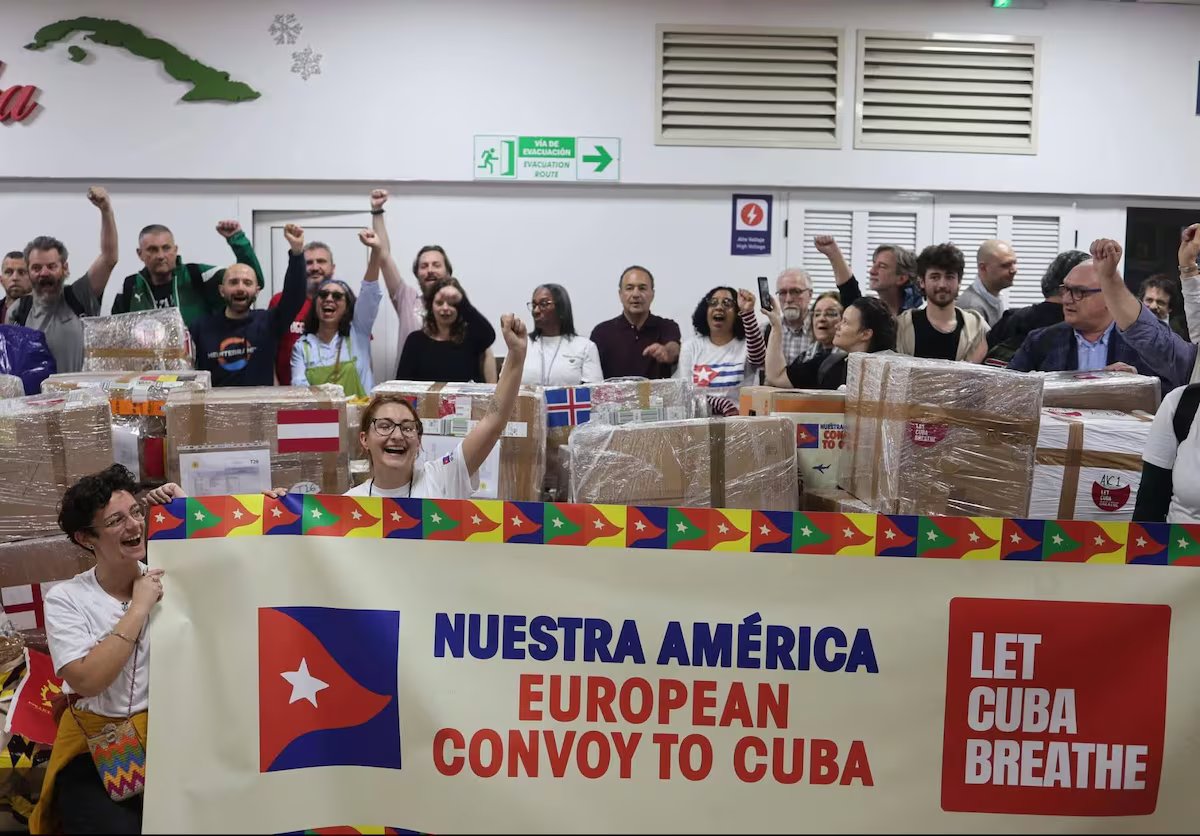
Cuban authorities applauded the arrival Wednesday at Havana’s airport of a convoy from Europe carrying five tons of humanitarian aid valued at €500,000 ($573,394). The initiative, spearheaded by the Progressive International, a left-wing transnational organization, and supported by well-known activists such as Swedish activist Greta Thunberg, aims to alleviate the crisis gripping Cubans amid heightened tensions with the Trump Administration, which is demanding a change in the island’s leadership. “This demonstrates the magnitude of the battle being waged around the world today for Cuba, a battle fought because of the example we represent,” said Rodrigo Zarza, director for Europe of the Cuban Institute of Friendship with the Peoples.
The newspaper Granma, the official organ of the Cuban Communist Party, reported that Neos Airlines flight NO230 landed in Havana with five tons of medical supplies, “which will be distributed in coordination with Cuban institutions.” The initiative is part of “a campaign carried out in various countries, in which solidarity groups and some 700 individuals offered their contributions,” according to the Cuban media outlet. The aid, called “Let Cuba Breathe,” departed from Italy on March 17 as part of the Nuestra América Convoy to Cuba, an international movement that aims to break the economic blockade imposed on the island by Washington.
“We are mobilizing for Cuba, delivering critical humanitarian aid to its people. The Trump Administration is suffocating the island, cutting off fuel supplies, flights, and essential resources for survival. The consequences of the U.S. blockade are lethal, for newborns and parents, for the elderly and the sick. That is why we are mobilizing by air, land, and sea in solidarity with the Cuban people. Since its launch, we have received overwhelming support from communities around the world, committed to breaking the criminal U.S. blockade. Now we welcome them to this historic mission, expanding the coalition from a small flotilla to a global convoy that will converge on Havana,” said the organizers of this initiative.
The Progressive International reported that 120 representatives from 19 countries arrived in Cuba, including members of political movements, unions, and four members of the European Parliament. The medical supplies will be distributed by the Cuban government to four hospitals in the capital. Authorities also received solar panels and photovoltaic systems.
This is the first arrival on Cuban soil of vessels that are part of the Nuestra América Convoy, the humanitarian project promoted by Progressive International to deliver “critical aid” to the Cuban people, according to the organization. On March 21, several vessels from Mexico are expected to arrive in Havana as part of this convoy, carrying “food, medicine, and essential supplies” for the island, according to a statement from the organizers. In total, the organizers expect to deliver 20 tons of food and medicine. The activist Greta Thunberg said she supports the initiative because “international solidarity is the only force powerful enough to stand up to imperial figures like Trump and [Israeli Prime Minister Benjamin] Netanyahu who would prefer to see our fundamental rights in ruins.”
The aid comes at a time of crisis for Cubans, who are facing a collapsed economy plagued by blackouts lasting up to 18 hours, entire days without water service, rampant inflation of 10%, food shortages, starvation wages, and where the dollar is devouring the Cuban peso. Following the January 3 attack in Caracas that resulted in the capture of President Nicolás Maduro and his wife, Cilia Flores, Trump stated that Cuba is “a failed nation” and that he intended to “help the people of Cuba” and “the people who were forced to leave Cuba and [who are] living in this country.” Thirty-two Cuban soldiers, 21 members of the Ministry of the Interior, and 11 members of the Revolutionary Armed Forces died in the U.S. intervention in Venezuela. The Cuban regime has hailed them as heroes.
Sign up for our weekly newsletter to get more English-language news coverage from EL PAÍS USA Edition
