
First Reading is a Canadian politics newsletter curated by the National Post’s own Tristin Hopper. To get an early version sent directly to your inbox, sign up here.
TOP STORY
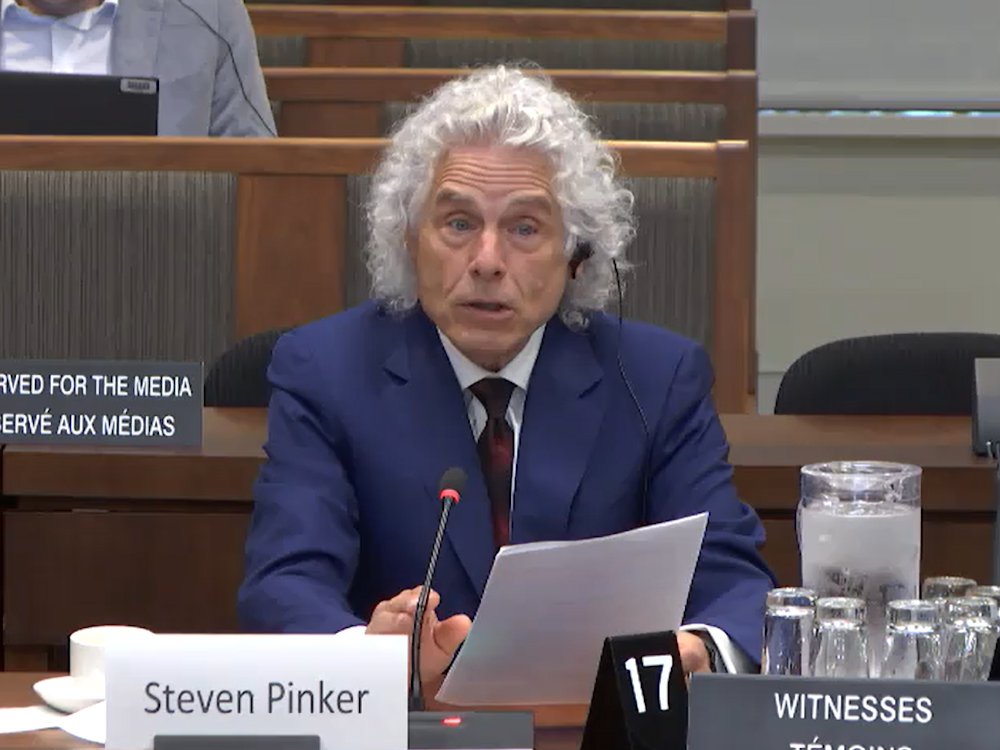
Diversity mandates as practiced by Canada are eroding basic science and discrediting the academic system, the renowned Harvard cognitive scientist Steven Pinker warned in recent testimony to a House of Commons research committee.
“Allocating funding to scientists based on their race or sex works against the interest of science and the nation,” Pinker
of the Standing Committee on Science and Research.
Rather, said Pinker, universities need to drop their “obsession” with enforcing ethnic diversity and focus instead on cultivating “viewpoint diversity.” “As the joke went, in a university, diversity means people who look different but think alike,” he said.
Born and educated in Montreal, Pinker ranks as one of the world’s most well-known Canadian academics. His books can regularly be seen atop The New York Times bestseller list, and his 2002 work The Blank Slate was a finalist for the Pulitzer Prize.
Pinker’s testimony was mostly a broad critique of diversity quotas, which he said had their origins in the 1970s in the United States. Nevertheless, in recent years it has indeed become standard practice for Canadian universities to ascribe race-based quotas to everything from admissions to hiring to grant funding.
In
, the Aristotle Foundation for Public Policy found that it was a near-universal practice of Canadian universities to either screen for candidates based on race or sexuality, or to require them to file “diversity statements” expressing adherence to campus “anti-racism” policies.
Multiple Canadian universities have also begun setting aside program seats that
by members of a specific race. Toronto Metropolitan University, for one,
opened its medical school last year
with a requirement that 75 per cent of all admissions go to Black, Indigenous and other “equity-deserving” applicants.
Pinker told the committee that his own Harvard students, when faced with mandatory diversity statements to obtain a research position, have sometimes filled them out using the AI program ChatGPT.
Said Pinker, “they could not honestly fill them out; it would go against their conscience to say things that they knew were not true, but they knew they would be blackballed and eliminated from a job if they expressed their true opinions.”
Professor Stephen Pinker @sapinker calls out DEI at committee this week: “It’s a problem” and creates a “chilling effect” on federal scientific research in more ways than one.
Are Liberals destroying academic freedom? pic.twitter.com/AQJeytMdTa
— Vincent Neil Ho (@vincentneilho) September 17, 2025
In Canada, many of these identity-based policies have been driven by federal order. The more than $300 million in annual funding for Canada Research Chairs, for instance, requires universities to meet strict hiring quotas on race, sex and ability: 50.9 per cent of funds must go to women, 22 per cent to “visible minorities” and 7.5 per cent to “persons with disabilities.”
Pinker told the committee on Monday that it’s not reasonable to expect that every single branch of science is going to have an ethnic makeup that’s exactly proportional to the general population.
“It leads to rather monstrous consequences like saying ‘there are too many Asians on this committee,’ or too many Asians are getting funding, or too many Jews, or too many Sikhs, or too many Arabs,” he said.
Pinker said that under the guise of “looking” diverse, universities have increasingly become subject to chilling “monocultures” that shun and punish dissenting opinions.
“As a cognitive scientist, I can attest that the human mind is vulnerable to many biases and fallacies. The strongest is the ‘my side’ bias, the conviction that my tribe or coalition or party is correct and that a rival coalition is ignorant or evil or both,” said Pinker.
Pinker said the usual way around this is to maintain an intellectual culture in which biases can be freely attacked and criticized by colleagues who think differently. “One person can point out another’s errors and the whole community can be more rational than any of the individuals in it,” he said.
Pinker has previously
described his political alignment
as “liberal Democrat” and once told a writer for the Harvard Crimson that a framed candid photo of him meeting then prime minister Justin Trudeau was “one of my proudest possessions.”
Nevertheless, in recent years Pinker has become an outspoken critic of a “social justice monoculture” at North American universities.
He’s a co-founder of the
Council on Academic Freedom at Harvard
, a group pledged to endorsed free speech and viewpoint diversity at the Ivy League school.
When multiple Harvard campus organizations openly endorsed Palestinian terrorism in the immediate wake of the October 7 massacres, Pinker
in the Boston Globe on how to “save Harvard from itself.”
Among Pinker’s points was a call for the university to “disempower” DEI. “Universities should stanch the flood of DEI officials, expose their policies to the light of day, and repeal the ones that cannot be publicly justified,” he wrote.
Also testifying at Monday’s committee was Azim Shariff, a UBC psychology professor whose research has touched on how institutional politicization affects public trust.
In a 2024 study, Shariff’s team found that even when an institution (such as the Catholic Church, police or Major League Baseball) had politics that aligned with a person’s own leanings, it still caused that person to lose trust in the institution.
“We found that the perceived politicization of institutions—the extent to which institutions were perceived as allowing their political values to impact their work — was associated with lower trust toward those institutions as well as lower willingness to support and defer to their expertise,” it read.
On Monday, Sharriff told Parliamentarians that “Canada, unfortunately, has a reputation for having a somewhat politicized academy.”
“Politicization in science, it’s like bacteria in an operating room,” he said. “There’s no way you’ll be able to get rid of it entirely, but you do want to do as much as you can to remove it, and I don’t think you should trust any surgeon who’s not trying to do that.”
IN OTHER NEWS
After nearly two years of anti-Israel demonstrations blockading streets, massing outside of Jewish-owned businesses or picketing public spaces, the
Liberals are promising to table an “anti-hate” bill
that Attorney General Sean Fraser says would fix most of the worst issues. Among its rumoured contents are a ban on the display of terror symbols such as the Hezbollah flag, and a ban on blockading community centres and places of worship.There’s just one problem: The demonstrations are already breaking all kinds of laws, it’s just that police refuse to enforce them.
Here’s a few …
- Various provincial motor vehicle acts, all of which have some sanction against obstructing roadways.
- Section 423 of the Criminal Code. It’s considered “intimidation” to “block or obstruct a highway.”
- Section 430 of the Criminal Code. It’s “mischief” to “obstruct, interrupt or interfere with the lawful use, enjoyment or operation of property.” This is notably the main charge thrown at the Freedom Convoy organizers.
- Section 319 of the Criminal Code. “Public incitement of hatred.” This is a difficult charge to prosecute, but there’s no shortage of video evidence of these demonstrations endorsing violence or using violent terms such as “intifada.”
- Section 65 of the Criminal Code. This one bars you from wearing a mask in the commission of an offence. It could be relevant given that men concealing their faces with keffiyehs while blockading public spaces is a regular feature of these demonstrations
… and much more. You can read more about it in Carson Jerema’s column “
Has Sean Fraser even read the Criminal Code?
”
First Reading is a Canadian politics newsletter curated by the National Post’s own Tristin Hopper. To get an early version sent directly to your inbox, sign up here.
The post FIRST READING: Diversity mandates killing Canadian science, famed academic tells Commons committee appeared first on Loonie Politics.
