
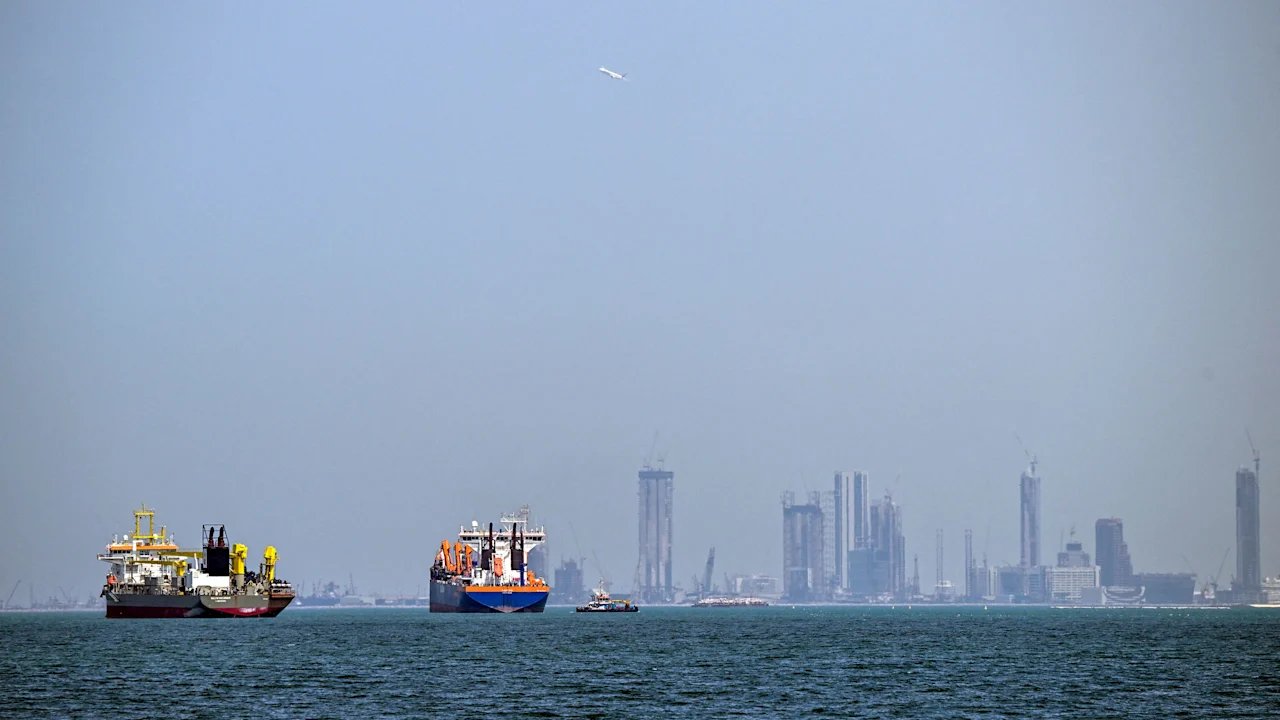
When global trade buckles, Ryan Petersen is the person executives call. The founder and CEO of Flexport offers a real-time account of the Strait of Hormuz crisis—what he’s seeing on the ground, on the water, and across the supply chains straining under the pressure. As ripple effects of the crisis are being felt in different ways in different parts of the world, Petersen provides both a micro and macro view that business leaders need to hear.
This is an abridged transcript of an interview from Rapid Response, hosted by the former editor-in-chief of Fast Company Bob Safian. From the team behind the Masters of Scale podcast, Rapid Response features candid conversations with today’s top business leaders navigating real-time challenges. Subscribe to Rapid Response wherever you get your podcasts to ensure you never miss an episode.
The attacks on Iran have effectively closed the Strait of Hormuz, the world’s most critical oil choke point. Oil prices are up, ships are stranded, global shipping is kind of in limbo. So I know this is changing as we speak, but from what you can see at Flexport, what does the traffic jam look like? What’s the snapshot right now?
The big story, of course, here is oil and energy generally, natural gas, all of that. I think that’s pretty well covered in the media—that prices have been spiking and shortages are starting to appear. Places like Australia, which is very energy-rich but doesn’t produce a lot of oil, are running out of diesel and moving toward a world where they’re just not going to have enough fuel. There are secondary things that are less well covered, which are maybe even more impactful, around fertilizer. That’s actually probably a more important story here.
It’s planting season, and if those don’t come to market, you’re going to have big, big problems in food production around the world. Container shipping is not that impacted, actually, just because the Persian Gulf is a cul-de-sac. You don’t really need to go in there. Air freight’s a bigger deal. The Middle Eastern airlines own somewhere between 15% and 20% of all cargo airline capacity, depending on what source you look at. And Dubai is the biggest cargo airport in the world.
Huge numbers of planes that go from Asia to Europe stop over there to refuel, and it’s a hub for transshipment of cargo. So there, you’ve seen the price of air freight double since the war started. And it’s even up 50% to 60% on trades that would seemingly have nothing to do with that, like Vietnam to the US across the Pacific. Air freight prices have gone up 50%. I saw the United Airlines CEO say that they’re modeling this is going to cost $11 billion in fuel expense.
So these costs are going up because fuel prices are going up, or also because it’s disrupting routes or forcing people to change direction? Or is it hard to know right now?
It’s both. Fuel price is the big one, but it’s going up also because supply and demand is sort of a global market. And if you pull out all that Emirates and Etihad and Qatar Airways capacity—those are big airlines—then they start moving planes around, and it’s all kind of fungible. A plane that’s flying across the Pacific could instead fly somewhere else. Freight is a very mercenary market. They get away with what they can get away with.
The actual big impact here is that, in February, the container shipping lines had, for the first time, started to return to the Red Sea. We haven’t had container shipping through the Red Sea and the Suez Canal since December 2023 because of the Houthi terrorist attacks in the Red Sea. And they just started to return in February following the ceasefire in Gaza.
And now they’ve all immediately gone back to routing around Africa. So that’s actually the bigger impact for container shipping because, again, the Persian Gulf is the cul-de-sac, whereas the Red Sea is massively important for container shipping.
I mean, are container ships stranded? Are they stuck?
Yeah, a small percentage. I saw someone who had gone and counted them all, and he said there are 57 container ships inside the Strait of Hormuz. Now, many more are on routes that would have called in the Strait of Hormuz and have had their routes disrupted and are dropping containers at random ports. If you had a container that was meant to go to Dubai, they’re just leaving it wherever. And now it’s your problem as a business.
Oh, really? They’re just like, “I’m letting it off here”?
Yeah. Let’s say you were going from Argentina to Dubai. What they’ve been doing is saying, “All right, just drop it at the next port of call.” So now you have a container stuck in Morocco or Brazil or France or somewhere, and you’re only given seven days of free storage at that port before you start paying big fees. So yeah, there are definitely some cases where people are living business nightmares right now.
As you talk about this, the United States is a little more insulated from some of this than places in Europe and Asia. Is there a scenario where American companies gain a competitive advantage from this? Is it good? Or is that a misread of the situation?
Well, certainly our oil companies are. I mean, Texas is going to boom. The price of oil’s gone way up. Texas college football’s probably going to have a great NIL team. No, sorry. It’s not appropriate to joke. Yeah, certain segments of the US are going to do very well.
We’re the biggest oil producer in the world, so it’s going to be very good for them. But on a net economic basis, most of America—yeah, we might be better off than other countries because we have oil and energy and food, but it’s not a zero-sum game, the economy. If others do worse, it doesn’t mean we do better. We actually also do worse.
For folks listening to this, what do you feel is at stake for global trade right now, in this moment?
It goes beyond trade. You’re just starting to realize how tied to globalization our economies are, how interconnected everything is. I had someone last night tell me, “Oh, we should just close the Strait of Hormuz forever and just get on with it.” The naivete of not realizing that it’s not just oil—and oil is not just about pumping gas into your car.
That’s what you’re used to because that’s where you see it in your life. But it’s part of so many different products. It’s a precursor to so much in the chemicals industry. It goes into all sorts of plastics. These glasses that I’m holding. Helium—30% of the world’s helium comes from Qatar. It’s not just for clowns at children’s parties. It is used to make semiconductors. You can’t make semiconductors without it. You can’t launch SpaceX rockets without helium. We just don’t understand how much of this stuff matters.
The U.S., post-World War II, kind of established this order that said, “Hey, everybody can trade with everybody. And you can just send a ship wherever you want, and the US Navy will provide freedom of navigation.” And that worked until, really, we’re now seeing with the Houthis and now the Iranians that maybe the US Navy can’t provide that guarantee anymore. And so much of our civilization depends on it that it’s a really, really important question. And if the Trump administration backs off, is there an off-ramp here? Does that mean Iran backs off? If they don’t, then what?
It is existential, I think, for the modern economy. People look at the stock market or the price of fuel or something, but this is much more than the price of some commodity or equities or bonds. It’s how all of the economy functions now. Every company is interconnected with everybody else. And if you stop that, you end up in a much darker place. So let’s all pray. Civilization depends on peace, and we often just take it for granted. So pray for those who are trying to bring back a peaceful world.
