
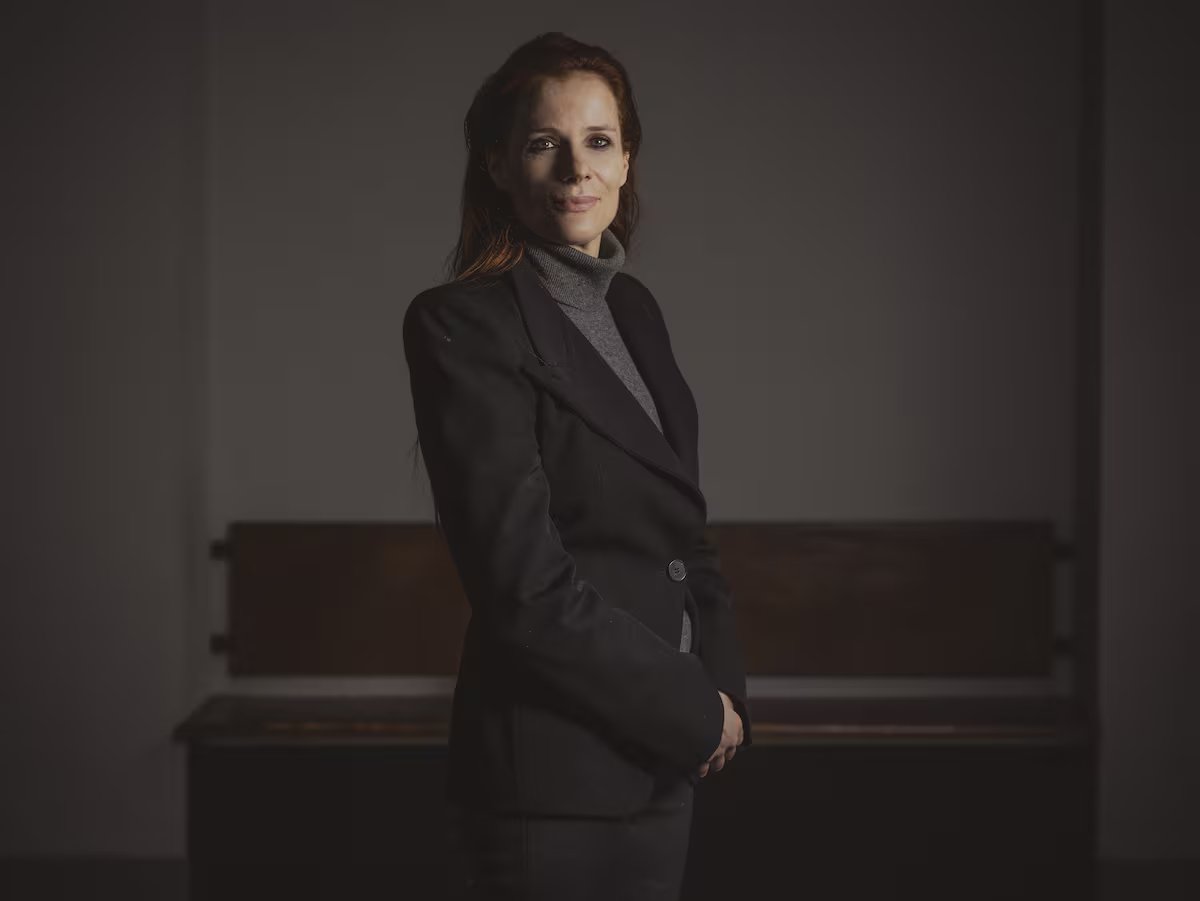
She defines herself as NATO’s “futurist.” Florence Gaub (Munich, 48) heads the Research Division at the NATO Defense College in Rome. A Franco-German political scientist specializing in foresight, she studies trends and scenarios to anticipate future crises. She is the author of The Future. A User’s Guide, to be published in English next month by Hurst. This interview was conducted in mid-February in Paris and completed on March 2, two days after the start of the U.S. and Israeli attacks on Iran.
Question. You specialize in forecasting crises. Did you see this latest one coming?
Answer. This war has been brewing since at least the early 2000s, when the Iranian nuclear program was first discovered. When the source of a conflict is not resolved and material capability coincides with the will to act, war is always just a matter of time.
Q. You say your family history explains your vocation.
A. My German grandfather was a Luftwaffe pilot. My French grandfather was in the Resistance against the Nazis. From an early age, I was aware of what war was and that the two countries I came from had been enemies. I was struck that this still weighed so heavily 30 years later. My career stems from there: I wanted to understand how a society digests a war, how it rebuilds itself, and above all, what can be done to ensure it does not happen again.
Q. You joined NATO at just 31.
A. Yes, I was very young. The position required 10 years of experience, but they were looking for someone who spoke English, French, and Arabic, held a doctorate, and knew the Middle East well. There were not many such profiles. I suppose they would have preferred an older gentleman, but they ended up with me.
Q. You don’t fit the classic profile of a defense expert. You draw inspiration from science fiction, publish futuristic comics, and employ humor. How do you fit into a place like NATO?
A. I’m not the norm, either in the way I think or in the way I look. But that hasn’t worked against me. Military personnel tend to be very practical: if an idea can help solve a problem, they will listen. In the EU, where I worked for six years, there was a more ideological component. NATO is more pragmatic: its goal is security. That gives me greater intellectual freedom.
Q. Why do you define yourself with such an unorthodox term as “futurist”?
A. Many people dislike it, but it’s the simplest way to explain what I do. My job is to think about what kinds of conflict or catastrophe could occur in the near future. I study trends, weak signals, and cause-and-effect relationships. The question is always the same: what should we do today to avoid one scenario or tip the balance toward another?
Q. What time horizon do you work with?
A. At NATO there are teams working on a six-month horizon and others looking 20 years ahead. I am in the middle range: between two and five years. I combine method and intuition. I analyze long-term trends, such as demographics or the climate crisis, alongside more volatile ones, such as politics. You have to take risks when proposing possibilities. An overly cautious scenario is never useful: you must always consider what might go off-script.
Q. Are you often wrong?
A. Of course, sometimes. What matters is not always being right, but understanding where and why you were wrong.
Q. Does your ego suffer when you fail?
A. There is a brief moment, yes. Over the years, I have learned to date my ideas, not marry them. You must have flexible relationships with your hypotheses and let them go when they are no longer useful.
Q. In recent years, what major crisis did you fail to see coming?
A. Greenland, without a doubt. It was a blind spot. There were signs, but I wasn’t looking there. One must learn to admit that.
I saw the war in Ukraine coming, but I don’t consider it a success. If you see something and fail to convince those who should be listening, you have failed
Q. And the invasion of Ukraine, which many European specialists did not believe would happen?
A. I saw it coming, but not because I was especially brilliant — rather because I had good contacts who saw it clearly. I would arrive at the office convinced that the war would begin that day, while my superiors treated me as if I were overreacting. That is why I don’t consider it a success. If you see something and fail to convince those who should be listening, you have failed.
Q. And the genocide in Gaza?
A. I wasn’t surprised that the conflict resurfaced. The first rule is that a conflict never disappears: it shifts, changes form, and returns until someone finds a solution. What did surprise me was the degree of violence Israel has exercised.
Q. Is it harder today to predict the future than previously?
A. I’m not sure that’s it. What has become more difficult is making decisions. Leaders today have an immense amount of information, moving at great speed and not always reliable. That is one of the great problems of our time.
Q. Despite spending your days imagining crises and catastrophes, you say you are optimistic. Can you explain that?
A. The more you think about the worst-case scenarios, the more you see the ways out. Our job is not to say, “Everything is going to go wrong.” What is useful is showing that there is always room to maneuver, even in terrible situations. Sometimes I read a report and think: “Shit, we’re screwed.” But even then, thinking in terms of options gives you the capacity to act and brings you back to optimism.
Q. Where are the flashpoints that interest you today?
A. The Arctic, space, the maritime sphere, and everything related to disinformation, cyberattacks, and infrastructure sabotage. Military history shows that we tend to get the location of conflicts right and get almost everything else wrong: when they break out, how long they last, and what technology they are fought with. We must prepare for every surprise.
Many wars do not begin with bombs or tanks, but with a failure of communication
Q. Many people fear that artificial intelligence is the great danger of our time. You don’t see it that way.
A. It worries me, but it is not the greatest risk. AI still poses, above all, a regulatory problem. What frightens me most is something else: that we stop talking to one another across rival countries, that we lose the ability to understand how the other side thinks. We are losing strategic empathy. And that is where the real danger begins. Many wars do not start with bombs or tanks, but with a failure of communication.
Q. Is the risk of a third world war becoming increasingly apparent?
A. Yes, but not for the reasons people think. It’s not that someone one day presses the button for war; rather, you can slide into a conflict of this kind without anyone wanting it: an accident, a misreading, a verbal escalation, decisions taken under pressure. Very often, a line gets crossed that nobody wanted to cross. That is why investing in defense is as important as investing in diplomacy.
Q. What has changed since Trump returned to the White House?
A. He is a leader who uses surprise as a method. His strength lies in offering a vision of the future, even if it is entirely illiberal. Far-right movements succeed because they promise a rupture. Traditional parties, by contrast, limit themselves to managing the present. The former imagine a different future, while the latter promise that everything will remain the same as it is now — an idea almost no one believes and that no longer mobilizes the public. They have not understood that the future is a strategic idea.
Sign up for our weekly newsletter to get more English-language news coverage from EL PAÍS USA Edition
