
Every year, thousands of people flock to Newfoundland’s shores to gaze at icebergs as they glide past. A McGill scientist made a similar journey a century ago, but instead of watching the bergs, he was hunting them.
Howard Turner Barnes was an American-Canadian physicist at McGill University. His focus was ice engineering, and finding ways to “control and destroy the immense masses of ice which are so universally feared in the shipping world.”
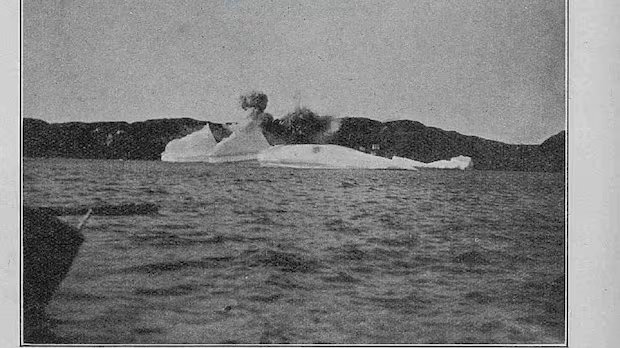
In 1926, Barnes and a team sailed into Twillingate’s harbour to climb atop icebergs floating nearby. Their plan? Pack the ice with highly combustible thermite — and then ignite it.
Barnes was part of the race to make seafaring safer, something that had taken on greater significance after the RMS Titanic was downed off Newfoundland’s coast on its first voyage in 1912, killing approximately 1,500 people.
In the aftermath of the Titanic tragedy, there was a race to make seafaring safer. A century ago, one McGill physicist decided blowing up icebergs with thermite was the way to go. MUN professor Chis Kozak and C-CORE’s Des Power weigh in on why it wasn’t a great idea. The CBC’s Elizabeth Whitten reports.
In one experiment, Barnes and his team detonated a 100-pound charge, which resulted in a fire that spanned over 125 feet, “with a great explosion of the ice and the throwing off of great masses of ice from the sides and ends of the main plateau.”
The heat from the thermite created cracking that went on for hours and could even be heard from land, he wrote in the The Marine Observer, adding it could be from five miles away. Days later, Barnes said, the iceberg could be seen “rapidly going to pieces.”
For him, the experiment was a success.
‘Like a meteorite’
A century after the Barnes experiments, CBC News met with Memorial University chemistry professors on a sunny but bitter January morning outside of the school’s core science facility to get a first hand look at the power of thermite.
Prof. Chris Kozak sets up a bucket filled with sand, and a stand that holds two pots filled with the thermite mixture. Using a sparkler as the detonator, he sets it alight and steps back.
Within moments, a reaction starts. First with some small sparks peeking over the pot, and then erupting into flames. In seconds, it’s over.
The bottom of one of the pots has fallen off into the sand, and crouching down, Kozak uses tongs to display the fused iron now left at the bottom.
“There’s molten iron there, in the bottom of the pot there,” he said.
“It’s like a meteorite.”

The iron oxide was reduced to molten iron, which solidified in the cold air, he said, adding the temperature went beyond what his thermometer could measure at 600 C.
“The temperature of this reaction can … hit well over 2,000 degrees. So more than enough heat to break up an iceberg,” said Kozak.
Kozak said thermite produces a “vigorous reaction” and needs to reach 1000 C to ignite.
Thermite can generate a lot of heat that melts ice. That water turns to steam, which Kozak said expands, causing a rupture in the iceberg breaking it into “smaller bergy bits.”

Thermite is made of iron oxide — basically rust — and aluminum powder, Kozak said.
The aluminum tries to “rip the oxygen” off the iron oxide, forming the more stable aluminum oxide.
For the demonstration, Kozak said it would not be safe to get a chunk of ice to mimic the Barnes experiment for a number of reasons.
“If we were to do it over a block of ice, it would end up turning the area that we were around into a sauna effectively,” he said. “So very, very nice for this time of year, but not a particularly safe way of doing it. So we want to practice safety first.”
Using a chunk of ice could result in bringing boiling water down the heads of those standing nearby, he added.
On paper, there is a logic behind using thermite.
“It’s a very heat producing reaction,” Kozak said. “So I could see the rationale behind why that might be an appealing thing to use to break up icebergs.”
‘Chaotic nature of the berg’
But packing icebergs with thermite never caught on, despite Barnes writing of his experiment’s success.
C-CORE, a research and technology company based in St. John’s, has been researching icebergs for decades.
Des Power, vice-president of remote sensing, pointed to a number of problems with the Barnes experiments.
“The issue with jumping on top of an iceberg, it’s the chaotic nature of the berg. As they melt, they could roll, flip and so on, and it ends up being a dangerous situation,” he said.
Then you’re dealing with igniting the thermite and trying to get to safety as Kozak said.
“You don’t know what the end result is going to be in terms of how the iceberg is going to break up,” he said.

Even Barnes wrote of the dangers.
Twillingate residents tried to dissuade his team from going near the bergs out of concern for their safety, but Barnes wasn’t deterred.
“I personally was quite ready if necessary to suffer the consequence of what they term my foolhardiness with the loss of my life if in consequence I could prove to a doubting world that icebergs could be controlled and destroyed by human means,” he wrote.
C.A. Berry, a colleague of Barnes, slipped from a berg and slid about 600 feet. Berry managed to use a spike on his shoe to stop his descent, about two feet from the edge.
“There are much better techniques of tracking and mitigating icebergs than doing it that way,” said Power.
“If you were to take, let’s say, a 100-metre iceberg and pack it full of explosives and blow it up into five bits that are all 20 and 30 meters wide, now you’ve got instead of having one problem, you’ve got five problems,” said Power.
Tactics change
Icebergs are tracked for a number of reasons, Power said. That includes tourism, but also for safety reasons for a number of fields, including commercial shipping and oil rigs.
In response to the Titanic tragedy, the International Ice Patrol was formed in 1914 to be on the lookout for icebergs in “berg-y water,” said Power, and its methods have evolved alongside technology.
“State-of-the-art back in the Titanic era would have been eyeballs, and eyeballs at night don’t work particularly well,” he said.
Tracking efforts eventually adopted aircraft, which was the standard into the 1990s until satellite radar was underway.
About a decade ago, Power said, satellite constellations, where a number of satellites work together, enabled higher resolution and greater accuracy when it came to tracking icebergs.
C-CORE can also place GPS trackers onto icebergs with drones, which can track and predict the icebergs trajectory, he said, and incorporate weather models and machine learning techniques.
Sometimes icebergs are shuffled out of the way with force, like towing with ships or pushing them with water hoses.
“Typically the way to deal with them is to tow them out of the way or or do some other ice management exercise,” said Power.
“You just want to know well in advance to be able to figure out the best approach for any particular iceberg.”
Download our free CBC News app to sign up for push alerts for CBC Newfoundland and Labrador. Sign up for our daily headlines newsletter here. Click here to visit our landing page.
