
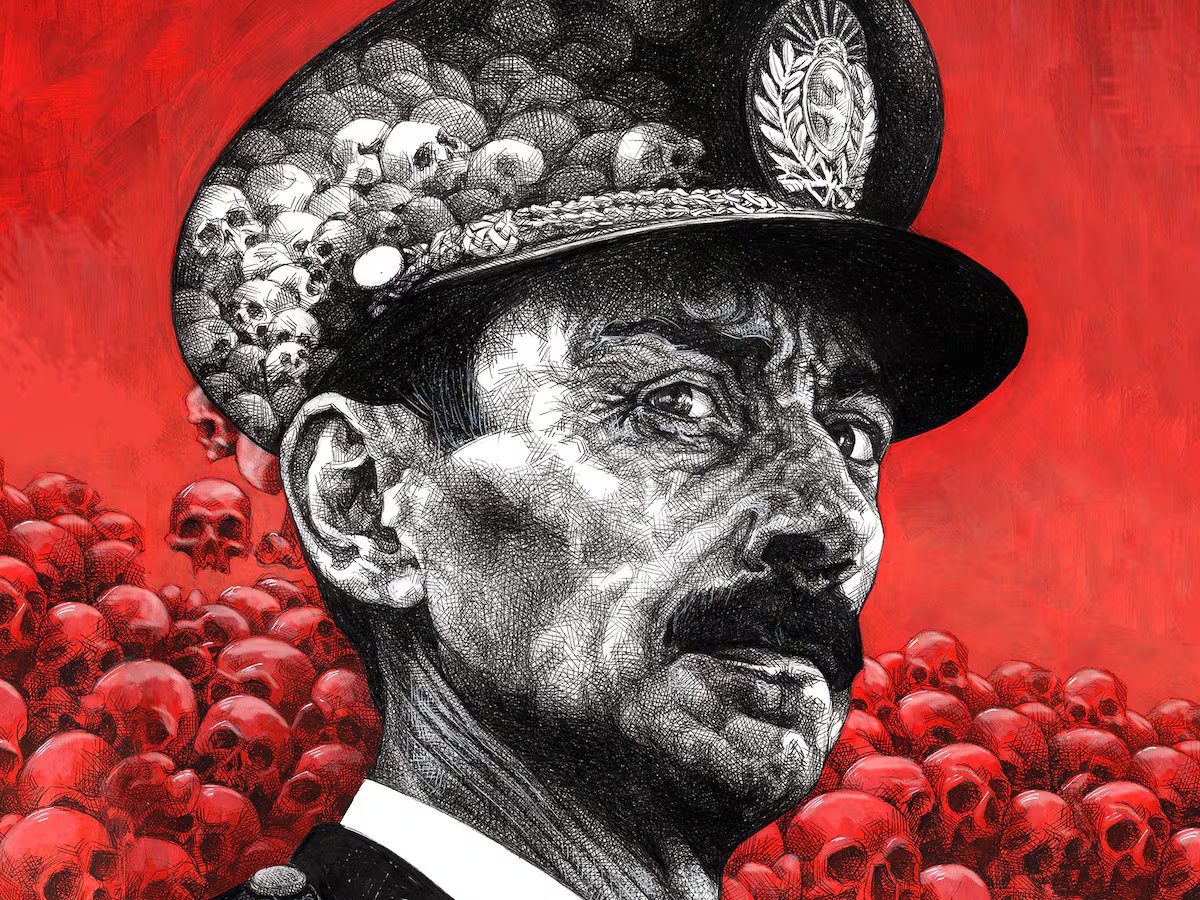
Fifty years later, there are still unburied dead and nameless graves. Fifty years later, there are still people who, unknowingly, live with someone else’s identity. Fifty years later, there are still unsolved crimes and unpunished criminals. There are still trials underway and trials that haven’t even begun. Fifty years after March 24, 1976, the day the last military dictatorship and its machinery of extermination began in Argentina, the process of memory, truth, and justice that made the country exemplary is under threat, besieged by a government that, since 2023, has canceled or neutralized human rights policies and promoted discourses aligned with denialism.
But, while the national state withdraws, the immense cultural and artistic production that in five decades has been central to coping with the grief and trauma of the genocide continues to generate books, films, performance interventions and other artistic expressions, in a journey that has gone from testimony and denunciation of the horror to, more recently, the freedom to imagine and resignify the still open wounds through fantasy, irony, and humor.
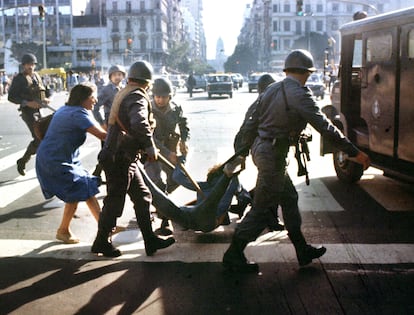
“We will fight relentlessly against subversive crime in all its manifestations, to its total annihilation,” declared dictator Jorge Rafael Videla (1925-2013) shortly after assuming the presidency. The “war on subversion” — that is, against the armed organizations of Peronism and the left — would serve as the justification for the self-styled “National Reorganization Process” implemented by the dictatorship until 1983. According to the Argentine justice system, it was based on a systematic plan of state terrorism that deployed clandestine centers for kidnapping, torture, and murder throughout the country.
The disappearance of 30,000 people and the appropriation of some 500 babies — according to estimates by human rights organizations — summarize the atrocities committed. Their counterpart was, and continues to be, the tireless demand sustained to this day by the mothers and grandmothers of Plaza de Mayo in their search for their children and grandchildren.
To remember is always to forget, and throughout these 50 years, the construction of collective memory about the dictatorship has been a shifting field of disputes and tensions. There, writers, artists, intellectuals, and academics sowed the seeds of their works — members of a cultural community that was especially targeted by the dictatorship through disappearances and threats that drove many into exile. As an inextinguishable symbol of that brutal persecution, the burning of 24 tons of books published by the Centro Editor de América Latina in 1980 remains. That same year saw the publication of Artificial Respiration, Ricardo Piglia’s cryptic novel, which is perhaps the best example of how, under the regime of terror, when censorship reigned, literature resorted to displaced allusion, to allegorical or metaphorical narratives to recount what was happening.
Military secrecy […] turns most arrests into kidnappings that allow for unlimited torture and execution without trial
Rodolfo Walsh, ‘Open letter to the military junta’ (1977)
From the final stages of the dictatorship, the military’s “war on subversion” rhetoric began to be challenged by denunciations of human rights violations against innocent victims. The Mothers of Plaza de Mayo were pioneers, beginning in 1977 with their marches in front of the Casa Rosada, their heads covered with headscarves. “The disappeared,” Videla declared in 1979, “is an enigma, has no existence, is neither dead nor alive, is disappeared.” The Mothers countered the sinister clandestine nature of the repression by displaying photographs of their children.
“Among the Mothers, there was a very early awareness of the need to find ways to take action that would make them visible to society and the international press, as well as to each other,” says Ana Longoni, a PhD in arts, specializing in the intersections of art and politics. “There are two main frameworks for representing disappearances,” she explains. One was the use of photographs, which began as an individual resource and then became collective, when banners with numerous photos together appeared. The other framework, she says, was “the silhouettes,” the drawing of human figures with the names of the missing persons, a proposal by the artists Julio Flores, Rodolfo Aguerreberry, and Guillermo Kexel to “materialize the absence of the disappeared with a mark in space.” Like the photographs, the silhouettes were adopted by human rights organizations and, over time, became central to numerous interventions in public spaces, known as the Siluetazos (Silhouette Protests). “If the photos seek to emphasize a biography prior to the abduction,” Longoni observes, “the silhouettes emphasize the void left by those lives torn away, interrupted.”
My entire country was transformed into a single, numerous death that at first seemed intolerable and that was later accepted with indifference and oblivion
Tomás Eloy Martínez, ‘Lugar común la muerte’ (1979)
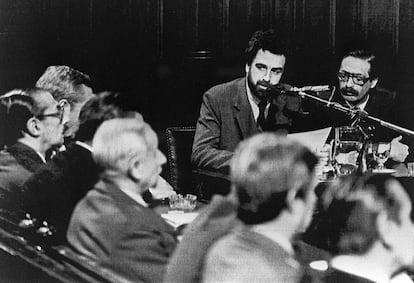
Before the eyes of a society shaken by what it had failed or refused to see, the restoration of democracy brought an explosive exposure of the crimes perpetrated by the dictatorship. The testimony of survivors and the families of the disappeared became the dominant narrative. The National Commission on the Disappearance of Persons, created by the Radical Civic Union president Raúl Alfonsín (1983-1989), produced the foundational document of the era, Nunca Más (“Never Again,” 1984). Its interpretation of the recent past proposed the so-called “theory of the two demons”: society as a victim of the violence of both left-wing and right-wing extremism.
The culmination of that first post-dictatorship period was the trial of the military juntas, recently recreated in the film Argentina, 1985 (Santiago Mitre, 2022). In that trial, nine of the 10 leaders who governed the country between the coup and the Falklands War (1982) were tried. Five of them were convicted of kidnapping, torture, and murder; Videla and Emilio Massera received life sentences. But the hope of extending justice to the entire structure of those responsible soon turned to disillusionment. Pressure and uprisings by the armed forces led Congress to pass impunity laws to prevent the trials from progressing. These laws were further reinforced by the pardons granted to the recently convicted military officers and also to former guerrillas, issued between 1989 and 1990 by Peronist President Carlos Menem (1989-1999).
“The ‘Never Again’ report and the trials of the juntas were a turning point,” argues sociologist and researcher Valentina Salvi. “The disappeared, who were previously considered subversives, came to be seen as people with rights, whose lives were violated by repressive violence. The notion of state terrorism emerged forcefully, as a way to differentiate between human rights violations committed by the state and the violence of armed organizations.” But this narrative, Salvi points out, by emphasizing a humanitarian perspective, obliterated “the status of these disappeared individuals as militants and members of armed organizations, and failed to account for Peronism’s responsibility in the process.” Cinema expressed this imaginary, where denunciation assumed that innocence and apoliticism were synonymous, in films such as The Official Story (Luis Puenzo, 1985), distinguished with the first Oscar for an Argentine film, or Night of the Pencils (Héctor Olivera, 1986).
Under the bushes / in the tall grass / on the bridges / in the canals / there are corpses
Néstor Perlongher, ‘Cadáveres’ (1981)
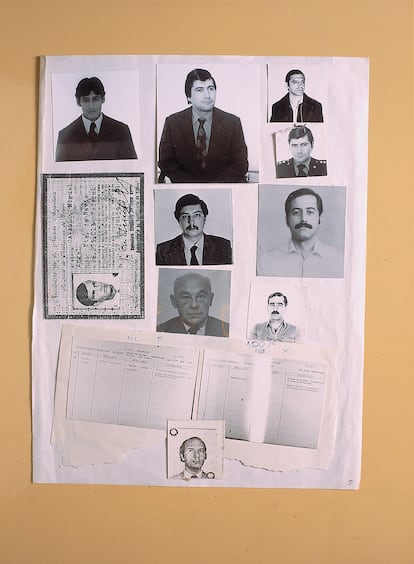
In the mid-1990s, when the memory of the terror seemed to be fading under the “pacification and national reconciliation” promoted by Menem and his pardons, what had been denied found ways to return. The events commemorating March 24 became increasingly massive. 1995 was a pivotal year. That year saw the emergence of the organization HIJOS (Sons and Daughters for the Assertion of Identity and Justice Against Oblivion and Silence), which brought together descendants of the disappeared. Since those responsible for the genocide could not be brought to justice, HIJOS set out to denounce the repressors and mark the places where they lived with the slogan “Justice and Punishment.” These public shaming protests introduced another way to make the demonstration visible and, as the Mothers of Plaza de Mayo had done, appealed to aesthetic resources of urban intervention, now with the Street Art Group (GAC). Also in 1995, the Argentine army issued its first institutional self-criticism regarding the crimes committed. And it was that same year when the book The Flight, by Horacio Verbitsky, revealed the public confession of a repressor, Adolfo Scilingo, about the macabre death flights, in which thousands of detainees were drugged, transported in airplanes, and thrown into the sea, alive, naked.
A renewed memory boom began to take shape, a surge in literary and cinematic works of denunciation, testimony, or analysis, but now under a narrative that would reclaim the political activism of the 1970s as an essential part of the victims’ identity. Examples include La voluntad. Una historia de la militancia revolucionaria en la Argentina (1997-1998), the monumental trilogy by Eduardo Anguita and Martín Caparrós, and Poder y desaparecido: los campos de concentración en Argentina (1998), by Pilar Calveiro. In the world of cinema, one can cite the documentary Montoneros, una historia (1998), by Andrés Di Tella. Around the same time, fiction was exploring new approaches, as in Villa (1995), where Luis Gusmán presented a doctor complicit in the repression as the narrator.
At what age can you start torturing a child?
Martín Kohan, ‘Dos veces junio’ (2002)
The profound crisis that gripped Argentina in 2001 ushered in a turning point for the country. This included, of course, a shift in how the dictatorship and its legacy were addressed: the main change lay in the role of the state. The governments of Peronists Néstor Kirchner (2003-2007) and Cristina Fernández (2007-2015) embraced the demands for memory, truth, and justice championed by human rights organizations, in a partnership that broadened the possibilities for commemorating and confronting the harm of the genocide, as well as mitigating the risks of these organizations becoming enmeshed with a political party. Policies of remembrance were institutionalized through reparations for victims and the establishment of museums and memorials at the sites of former detention centers, with the Navy Mechanics School (ESMA) serving as a prime example. After the annulment of the impunity laws and pardons, around 2006 the trials of military personnel and civilians accused of crimes against humanity were restarted.
In the cultural sphere, the dawn of the 21st century brought with it the emergence of works created by the generation following that of the disappeared — those born in the 1970s and later. If there is a common thread running through their various books and films, it is perhaps an exploration that — operating within the blurred boundaries of autobiography and fiction — critiques the sacralization of the discourse surrounding memory and human rights. This period can be considered to have begun with the release of Los rubios (2003), Albertina Carri’s film that ostensibly presents itself as a documentary about her parents’ disappearance.
“When memory was at risk of becoming official, new generations proposed new narratives to relate to loss, mocking and inventing new experimental and playful characters to revisit the legacies of terror,” analyzes sociologist Cecilia Sosa, PhD in drama. Thus, humor, fantasy, and irony emerge in books such as Los topos (2006) by Félix Bruzzone, Diario de una princesa montonera: 110% verdad (2012, expanded in 2021) by Mariana Eva Pérez, and Aparecida (2015) by Marta Dillon, three authors who are children of the disappeared. “In Los rubios,” says Sosa, “Carri reconstructs her parents’ absence as a ‘reality show’ of memory, proposing a new community where grief becomes a transferable and expansive experience. In Los topos, Bruzzone’s autobiographical fiction gives birth to the unforgettable transsexual character of Maira, a newly disappeared person, as a legacy of state violence. In Diario de una princesa montonera, Pérez reveals the sorrows and pleasures of the world of the hijis [children of the disappeared] and, during a tour of the ESMA, demands a VIP star for the room where her mother gave birth to her brother, ironically commenting on the privileges of the victims. In Aparecida, Dillon writes about the experience of recovering her mother’s remains 35 years after her murder and talks about the possibility of organizing ‘a postponed funeral as if it were a party.”
The freedom to reimagine the dictatorship introduced by these and other works — such as Lola Arias’s biodrama Mi vida después (2009) — opened multiple paths that continue to be explored today. Mariana Enriquez’s literature, in Nuestra parte de noche (2019) and other texts, employs the horror narrative to depict the sinister persistence of the dictatorship as an omnipresent, dark latency. With an ethnographic approach, anthropologist Mariana Tello Weiss studies in Fantasmas de la dictadura (2025) the haunting of the families of the disappeared by “apparitions, specters, and tormented souls.”
Terror does not operate solely on the victims, but fundamentally on society as a whole
Daniel Feierstein, ‘Genocide as a social practice’ (2007)
Not without setbacks, the public policies on historical memory enshrined in 2003 continued for 20 years, spanning the administrations of conservative Mauricio Macri (2015-2019) and Peronist Alberto Fernández (2019-2023). With the rise to power of the far-right populist Javier Milei, what seemed to be a deeply rooted social and institutional consensus was shattered. Human rights departments and programs were gutted of funding and staff. The state withdrew its support for trials for crimes committed during the dictatorship and, among other measures, obstructed the search for the children of the disappeared who were appropriated by repressors, as denounced by the Grandmothers of Plaza de Mayo. In the 42 years since the return of democracy, the Grandmothers have succeeded in restoring the identities of 140 grandchildren; they are still searching for another 350.
The narrative the government is trying to establish revives a discourse born within the military and among genocide deniers. Unlike in the early days of democracy, it doesn’t consist of vindicating “the heroes who fought against subversion,” already delegitimized by the judicial demonstration of the abhorrent crimes they perpetrated, but rather in the idea that it is necessary to construct a “complete memory.” Valentina Salvi, coordinator of the book What are the Right Wing Doing with the 70s? (2026), argues that this discourse “uses the slogans of human rights organizations” to demand justice for the victims of armed groups (to date, Argentine courts have determined that these were not crimes against humanity and the statute of limitations has expired). And regarding this idea of a complete memory, she warns, in recent years a much crueler and more belligerent memory has developed among ultra-right-wing youth, one that stigmatizes women, the disabled, migrants, and also the disappeared and their families.
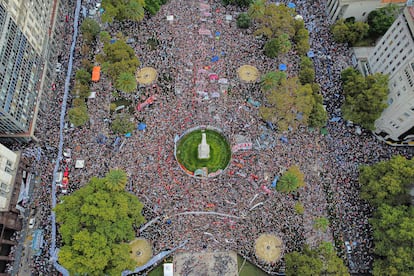
In this context, Argentina marks the 50th anniversary of its last military coup. On March 24, thousands of people, carrying photos, silhouettes, and other reminders of the disappeared, are expected to demonstrate in Plaza de Mayo, called together by human rights organizations to commemorate the Day of Remembrance. The Casa Rosada is also expected to release, as it has in the previous two years, an official statement that downplays state terrorism. The words and images that endure will contribute to shaping the country’s past and future.
Sign up forour weekly newsletterto get more English-language news coverage from EL PAÍS USA Edition
