
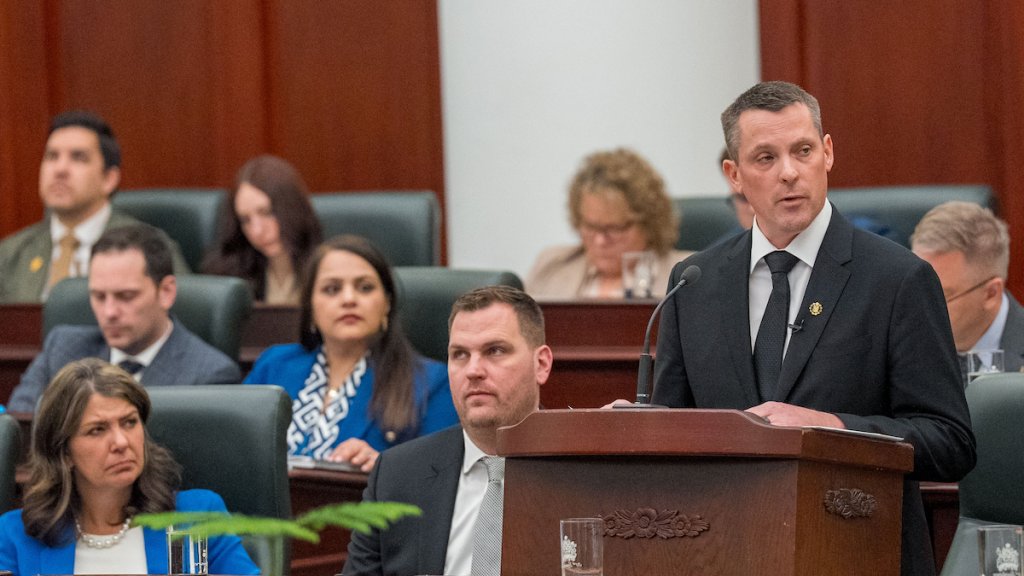
This afternoon, Finance Minister Nate Horner will rise in the Legislature to read Alberta’s Budget Speech.

One hopes Mr. Horner has bought himself a nice new pair of shoes, as is uniquely traditional for finance ministers on Budget Days in Canada. That should offer some psychic compensation for having to admit he’s about to post a significant deficit in a place that’s made a cult of deficit avoidance.
Mr. Horner will have the challenging job of again demonstrating that Alberta is the poor little rich kid of Confederation – flat busted broke and still rich enough to feel comfortable giving all those other provinces advice about how to run their economies.
He will approach that problem, though, with generations of Conservative experience behind him. After all, this too is a Budget Day tradition here in Alberta, where we have had the good fortune to find ourselves located atop a resource that has, more or less, persisted in being extremely valuable most of the time for a long time. And, moreover, in a country that generously places natural resources under the jurisdiction of 10 of its sub-national governments.
Another tradition of the Westminster Parliamentary system everywhere it is practised is that the budget is supposed to remain a secret until it is tabled in the House. This is supposedly to prevent anyone from gaining an unfair financial advantage by knowing where the big bucks are about to be spent.
So seriously was this taken once upon a time finance ministers were expected to resign if any such data was discovered to have leaked out before its proper moment. For a variety of reasons, I would suggest this parliamentary convention is as dead as the proverbial mackerel, unlikely ever to be honoured again, and not just in Alberta.

Indeed, as long ago as 1983, federal budget minister Marc Lalonde refused to resign when he accidentally leaked a few budget details by leaving them on his desk when a TV cameraman showed up to record a pre-budget interview. (Mr. Lalonde was said to have observed that Ottawa was proof Canada still had capital punishment, and that the best thing about the place was the train to Montreal, proving that he had an excellent sense of humour. But je digresse.)
Anyway – and this is the buried lead of this piece – the United Conservative Party Government has been revealing budget details for days, not exactly in leaks, but in official statements, grim warnings, and promises that notwithstanding a little belt tightening here and there, everything will be copacetic.
So while the Budget Speech is a more important and useful occasion in the Parliamentary calendar than, say, a drivel-filled Speech from the Throne, what Mr. Horner reads tomorrow is unlikely to come as much of a surprise to anyone who’s been paying attention.
Yesterday, Education Minister Demetrious Nicolaides announced in a press release a “historic” $10.8 billion will be spent on education operations – assuming, as they always say, that the budget is passed, which of course it will be since the UCP enjoys a majority in the Legislature.
On Monday, the premier and her preventative health cabinet sidekick, Adriana LaGrange, announced in another press release the government will spend another “historic” $7.7 billion paying, recruiting, and training physicians.

Both announcements are examples of political damage control – both health care and education are important portfolios in which the UCP Government’s performance has been widely perceived by voters as less than stellar. Both announcements involve a certain amount of budgetary sleight of hand – as the fine details in the budget today may or may not clarify.
Neither tells the whole story of how the money will be spent, which is useful detail some reporter can dig out of the budget if she has time – since one of the government’s post-budget strategies is sure to be loads of new announcements and re-announcements designed to deny the small number of journalists still in the business the time to comb properly through the budget documents.
Both announcements are intended to assuage hostility within the UCP base to the idea of running a significant deficits in circumstances in which normal conservative deficit strategies are more likely to provoke a recession, and make it worse if that happens.
Thus, as the CBC blandly reported yesterday: “The province has been making funding announcements ahead of Thursday’s budget, which is expected to have a multi-billion dollar deficit due to a decrease in oil prices. Alberta is heavily dependent on resource revenues.” (As a generation of children used to say: “Thank you, Captain Obvious!)
Reporters willing to sign a temporary non-disclosure agreement can join a budget “lock-up” this morning to quickly scan the fine print and get a few questions answered by finance department spin providers. That can help get an uninformative story into print a little more quickly, one supposes, but it’s doubtful it produces many worthwhile insights.
One final Alberta budget tradition is the practice of assigning budgets lame titles – “Meeting the Challenge,” was last year’s if I recall correctly. (Yawn.) “A Responsible Plan for a Growing Province” was also pretty dull. “The Alberta Advantage,” once famous, has become notorious.
Maybe this year’s can be the “Blame it all on Trudeau Budget.” That would be on brand.
