

Gisèle Pelicot would set the breakfast table before going to bed. The honey, the napkins, the plates, the jars of jam. The next day, she would only have to get out the butter and make the toast while the smell of coffee filled the kitchen of the small house where she lived with her husband. It was more convenient, of course. But over time — and perhaps this is one of the few symptoms that emerged unconsciously while everything was happening — she realized that this habit could be a mechanism for mentally skipping bedtime. As if her brain, out of some kind of protective instinct, didn’t want to process that time.
One morning, Gisèle Pelicot received a call from the police station to come in with her husband. She was 68 years old and had been married to him for half a century. They had experienced their ups and downs. But she knew he was the man of her life, which is why they had retired to that little yellow house with blue shutters in a village in the French Provence, where their children and grandchildren visited regularly.
Two months earlier, however, something had happened. A supermarket security guard had caught her husband filming up the skirts of several female customers. The police went to the shopping center and questioned him. They confiscated his cell phone and laptop. Then they let him go. Back home, he told Gisèle about it, burst into tears, and said he didn’t want to lose her. And she, as she had done before, decided to move on and waited for the police call to give her statement and forget about the whole thing. She had decided to forgive him. So the visit to the police station would be a formality. But when they walked in, they were separated, and she sat in a room with a police officer who asked her a few questions. At one point, the officer wanted to know how she would describe her husband. “A good and kind man. A great guy, that’s why we’re still together,” she replied.
“I’m going to show you photos and videos that you’re not going to like,” he warned her.
Right there began the second half of Gisèle Pelicot’s life. A mother of three and grandmother of seven, she watched the other part of her life story crumble. Suddenly, 50 years of marriage became a shapeless mass of happy memories mixed with the most extreme horror. There were also profound gaps in her memory caused by the drugs her husband had administered to her for 10 years, allowing him to present her to 50 men who came to rape her at their home. His computer contained thousands of photos, videos, and messages advertising on a dating website the possibility of abusing his wife while she was sedated.
On January 26 of this year, Gisèle Pelicot walked through the door of her new literary agency, which is promoting her book, A Hymn to Life: Shame Has to Change Sides, scheduled for release on February 17. Written with journalist Judith Perrignon, the book recounts her descent into hell and how she has managed to rebuild her life. Pelicot, 73, was radiant. She smiled cheerfully, as if wanting to ease the burden she knew her interviewers would feel when they saw her for the first time, aware of the extreme suffering she had endured.

Although it may seem strange, she appears to be a happy woman. She is about to publish a bestseller, has begun traveling the world, and lives peacefully on the Île de Ré with her new partner, whom she met just before the trial began. Today, she is an enduring symbol of women’s fight against gender-based violence, thanks to the dignity and fortitude with which she faced a trial she insisted on being held publicly to focus the attention on the defendants and not the victims, as is so often the case. “It is time for shame to change sides,” she proclaimed to explain her historic decision, which prompted France to amend its laws and question its very nature.
Question. When the trial began, you said your life was a field of ruins. How are you today?
Answer. Much better. I was able to do some introspection and take stock of my life. I’m trying to rebuild it. And honestly, it’s going well.
Q. Has writing this book helped you?
A. The book was a way for me to get to know myself, to understand how I kept going. And I believed it could help other people. We can go through very difficult trials in our lives, but we have resources we’re not even aware of.
Q. Is it possible to integrate the good memories of those 50 years and separate them from the horror so as not to amputate more than half of one’s life?
A. I tried to hold on to the best memories I had with Mr. Pelicot. I needed to know that those 50 years weren’t just a lie. I separated the negative aspects, the traumas, locked them in a chest, and threw away the key. I only keep the best things. I shared a lot with him; we fell in love at a very young age and had three children. And I can’t erase that. Some might find it strange or surprising. But I don’t harbor hatred or anger. Only a feeling of betrayal, of powerlessness, and indignation. Hatred and anger destroy you.
Q. Is it possible to miss someone like that?
A. I have moments of sadness, of course. I miss Christmas, birthdays, the birth of our children, and our wedding. We experienced everything together. But I had only ever known the good side of Mr. Pelicot. The good man, incapable of such horrors. Everyone said we were a role model of a couple. When the police asked me how I would describe him, I said he was a great guy. Sub-Officer Perret [who led the investigation and to whom Gisèle says she owes her life] said he hadn’t slept for 10 days thinking about how he was going to tell me. He knew it would destroy my life.
Q. The supermarket security guard who stopped your husband was crucial. That’s where the investigation began.
A. Without him, I wouldn’t be here now. But he was threatened afterward by the rapists and their families. We live in a society that cultivates denial, but that man saved my life. So did Perret’s perseverance; he could have thought Mr. Pelicot was just a harmless old man. But he decided to examine the material and begin the investigation.

Q. What do you think your husband’s limits would have been if he hadn’t been discovered?
A. He would have killed me. He sedated me constantly, my memory gaps grew longer and longer, I couldn’t remember anything. When he brought his men home, I woke up with no memory at all. It took certain circumstances to remind me what was happening, like a call in the morning from a friend telling me I’d been acting strangely the night before, saying incoherent things. I wondered if I’d been drinking, why I wasn’t coherent, repeating the same phrases over and over. Then I’d ask Mr. Pelicot, and he’d say I looked fine and that I shouldn’t worry the children.
Q. Didn’t you remember any of it?
A. Nothing. No memory. Not even in my body. I went to see a specialist to see if there was any kind of body memory. He found nothing. Not even the physical part was there when they did all that to me, which is lucky. When I got up and had breakfast with him, he looked me in the eyes as if nothing had happened after I was raped. When you love someone, it’s impossible to imagine they could do something like that.
Q. Would you like to erase the rest of the memories of this story?
A. We can’t forget, it’s impossible. We have to live with it. I’ve written this book to give hope to others and a little color to my own life. I want to make the most of the good years I have left and be surrounded by people who love me. That’s my only goal.

Q. In the book, you say you are an enemy of death. But at some point you must have thought it would be the best way to end your suffering.
A. The day I got back from the police station, I thought I’d get in the car with my dog and be done with it all. But it was a fleeting thought, 10 seconds. I’ve fought death since I was little, and I know I won’t be immortal, but I want to live.
Q. I suppose you must have lost faith in humankind. And as you recounted, you leaned on your dog.
A. Oh… My dog. My little one. Sadly, he left me in December. He had cancer, and I made the decision… [She bursts into tears, the only time in the interview]. But please, don’t make me talk about this because it’s the only thing I can’t do without crying, and my makeup will run [she smiles]. Without him, I don’t know if I would have made it.
Q. Have you ever found an explanation for your husband’s behavior?
A. He had a very difficult childhood, with a tyrannical and authoritarian father. He was raped at the age of nine in the hospital, then participated in another gang rape as a teenager… but that doesn’t excuse anything. He should have been supervised, monitored. However, he had hidden that side of his personality. His lawyer said something very beautiful at the trial: “Mrs. Pelicot reconciled him with himself, but she didn’t cure him.”
Q. You have always praised the work of Mr. Pelicot’s lawyer.
A. She was the most elegant of all. The day I arrived at the Avignon court, there were 44 lawyers challenging me. But she walked across the courtroom, shook my hand, and said, “Don’t give him any gifts.” She never attacked me; she was always kind. I suppose it was also because Mr. Pelicot had confessed to everything, and the videos left no room for doubt. She knew I wasn’t responsible, aware, or guilty of anything. And that made the other lawyers uncomfortable. “Mrs. Pelicot isn’t my adversary,” she told them.
Q. They nicknamed her the devil’s advocate.
A. Yes, but she accepted this role because everyone has the right to a defense, even for the indefensible. Mr. Pelicot was called a monster. To me, he remains just a human being who committed monstrous acts.
Q. The defense also wanted to demonstrate that Mr. Pelicot was not the one in charge.
A. But he was. Even though those men knew I was sedated. They would log onto that website and come, fully conscious, to rape an unconscious woman. Most of them saw that something wasn’t right. But they made excuses. One said he noticed I felt hot. Another said he was going to report it, but he got up very early in the morning and, in the end, didn’t. Some claimed that Mr. Pelicot was threatening them… but the videos show how they were in cahoots. The level of denial is brutal. Drug-facilitated sexual assault is an instrument of violence, and violence is an instrument of male domination. It’s that simple.
Q. Listening to them, it seemed that they never understood what rape is.
A. They knew it perfectly well, even if they weren’t intellectually very sharp. But they knew it would get them convicted. Terminology is important. And that’s also a problem. At first, the presiding judge was just talking about sex scenes. I got angry, I told him they were rape scenes, and that I felt like I was the guilty one and there were 51 victims. Their lawyers coached them to testify that they weren’t raping, that their brains weren’t there… I heard ridiculous arguments about their responsibility for their actions. But they were all convicted.
Q. There was one victim for 51 defendants. That was also exceptional.
A. Yes, it’s usually the other way around. And it was incredibly violent, very strange. Because I had all the evidence. The videos showed each crime and the perpetrators, one by one. And yet, there were lawyers who maintained that I was an accomplice, a suspect. Or even that I had consented to it.
Q. Not only them. Many people, at first unable to find explanations for the horror, asked themselves those same questions.
A. I know, they said it was impossible that I didn’t know anything. But they didn’t understand that I was under general anesthesia. I consulted neurologists who told me I was anxious, that I’d had a stroke, or that I was suffering from Alzheimer’s symptoms. Gynecologists told me I had a cervical infection. And, in fact, it caused an HPV infection that I had surgery for in November. And all of that is a consequence of the rapes. But they treated me as if I were the guilty one. That’s why I say this society cultivates denial. And that has to change.
Q. Do you think it’s a masculine thing?
A. Yes, violence is an instrument of male domination. In France, we have passed a law defining consent. That’s progress. But there’s still a long way to go.
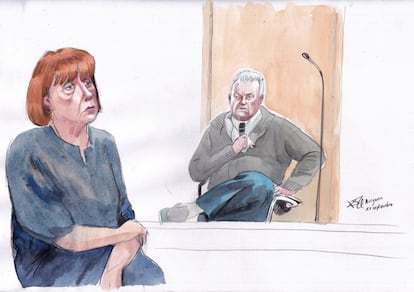
Q. What kind of society did you find when the case broke? I mean doctors, police officers, judges, social services…
A. Society wasn’t prepared for a case like mine. Not even the presiding judge was. He was trying to protect the defense lawyers. I had the impression they had the right to insult me, to humiliate me, to demand videos in which it clearly wasn’t me to try to prove my consent… My legitimacy was questioned. They even made my lawyers, with whom I worked for three years, doubt me. I had never consented to Mr. Pelicot photographing me.
Q. You decided to open the court doors so that everything would be public. And yet, you suffered the humiliations you describe.
A. At first, I wanted complete secrecy. I hid for four years. I preferred that no one know who I was, to protect my family. But one day my daughter told me, “Mom, you’re going to give them an incredible gift.” I didn’t feel capable, but in May 2024, walking through the countryside, I told myself that shame had to change sides. My lawyers were surprised. They gave me a week to think about it, but the next day I confirmed it. They warned me that the accused wouldn’t forgive me and would challenge me. And they did. But I was determined that the shame would change sides: a trial like this is usually a double punishment for the victims. We had to work for the community, fighting against that shame.
Q. The phrase became a great slogan. And, interestingly, another Gisèle had uttered it long before.
A. Yes, the lawyer Gisèle Halimi, when she defended two women in 1978 who had been raped by three men [she managed to prevent the trial from being held behind closed doors so that the public could participate in the proceedings]. Although I didn’t remember it. The decision was a victory. They had prepared for a closed trial, where no one could know what was happening or what they were saying. And when they heard that it wouldn’t be like that, I felt their gaze, what they were thinking: “You want to play this game? Well, now you’ll see.”
Q. How have you managed to free yourself from feelings of hatred or revenge?
A. I’ve always operated this way in my life. I try to create a bubble and keep the anger and hatred out. I put up barriers. I felt humiliated and betrayed. But I had questions for Mr. Pelicot, and I wanted answers. Besides, I didn’t want to give the defense attorneys that luxury; they were trying to make me consumed by hatred. I just wanted to be positive, and I had ways to stay calm. Sometimes I looked at pictures of my family, of places I love.
Q. Why did you decide to keep the surname Pelicot?
A. I got divorced the day the trial started. But I kept it for my family and my grandchildren. I did it publicly and intentionally to even things out. I didn’t want my grandchildren to be ashamed of having that surname; I wanted them to be proud. From that day on, Pelicot would be their grandmother. And you know, my youngest granddaughter came to school one day, and her teacher told her about me. She said I had spoken on behalf of all women. And my granddaughter was very proud.
Q. The relationship with your family, especially with your daughter, was complicated. She and a second son distanced themselves from you over some decisions they disagreed with. They even left you alone on New Year’s Eve and Christmas Day, without seeing your grandchildren on the worst year of your life.
A. Look, it’s a myth that tragedies bring families together. A tragedy like this is a conflagration that destroys everything in its path. And everyone tries to rebuild themselves as best they can, as best they know how. And it was very hard for Caroline. And, on top of that, she has a lingering doubt that could haunt her for life [on Mr. Pelicot’s computer there were photos of his daughter naked and apparently sedated, which suggest, even though he denied it, that he may have raped her]. Our relationship is improving, we’ve reconnected, and she’s healing. It’s like a long illness that needs time.
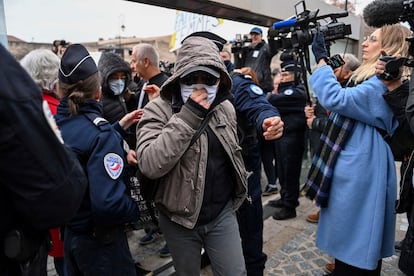
Q. You haven’t spoken to each other for a long time, including the days of the trial.
A. It’s true that communication broke down at a certain point, but perhaps it was something we needed because we are all very different and each of us copes with suffering in our own way. They were very close to him. He was an ever-present father, who seemed well-intentioned and caring. He was a good husband, too. So we all suffered from that unexpected explosion, capable of destroying a family.
Q. Your daughter believes the trial did not end satisfactorily for her.
A. I know. She says she’s been forgotten in this whole process. She’s still haunted by that terrible doubt. And at the end of the process, she filed a complaint against her father. I don’t know how it will all end, but I hope she gets the answers she’s looking for and that she can find some peace. It’s very difficult for victims not to be recognized as such. And she believes she is one.
Q. What do you think?
A. I also have that nagging doubt. In the two photos I saw, she appears to be asleep. They can’t be compared to mine, but in those images, there’s an incestuous look directed at his daughter. And that’s intolerable.
Q. If the complaint is successful, there will be another trial. Aren’t you worried about going back into court now that you’re rebuilding your life?
A. I’ll be there, by her side.
Q. You say in the book that you want to go to the prison where Mr. Pelicot is being held to get more answers.
A. During the trial, I couldn’t speak to him, couldn’t ask him questions directly. I haven’t gone to see him yet, despite the rumors. But I will, because he’ll soon have been there for six years. I want to talk to him and get some answers that I don’t know if he’ll give me. I need to find him.
Q. During the process, two other much older unsolved rape cases involving him came to light. One ended in murder. Do you think he was capable of it?
A. In November 2022, the police called me. I was sick, lying on the sofa. And they told me about it. There was an attempted rape in May 1999, but I have no strange memories. Mr. Pelicot’s DNA was found, but there was a failure in the custody of the evidence, and the statute of limitations has expired. I imagine that woman hasn’t been able to recover because she didn’t have her due process and wasn’t recognized as a victim. She has two children and doesn’t want to be seen, and I understand that. There’s also another case involving a violent death. I say he’s presumed innocent. And I just hope he’s not the perpetrator because that would be another descent into hell.
Q. The person waiting for you in the next room is your new partner. It’s incredible how love can blossom in the middle of such a process.
A. As you can imagine, I wasn’t expecting to fall in love amidst everything that was going on. But fate brought an incredible person with true values into my life, and he changed everything. I need to love. But not just anyone, okay? None of that internet stuff, I’m traumatized for life by that. Mr. Pelicot already did that [she laughs].
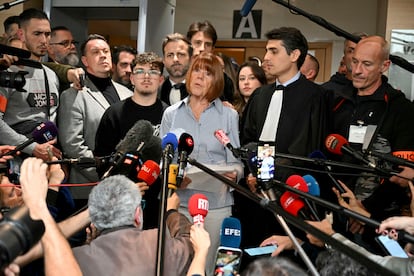
Q. You haven’t lost your sense of humor and can already joke about this.
A. I haven’t lost my passion for life either. We mustn’t lose hope.
Q. During the trial, there was much talk about the banality of evil. That idea that rapists were ordinary people, our neighbors.
A. They were ordinary, that’s for sure. There was an age range from 22 to 70 years old, from all walks of life… But that’s not a reason to lump all men together. We shouldn’t divide men and women, pit them against each other. We’re made to live together.
Q. You said when the trial ended that you didn’t want this to be a trial of women versus men.
A. I’ve always been a free woman, financially independent. Even when I was with Mr. Pelicot. I’m not a radical feminist, but we never truly know the person we live with. The wives of the rapists who testified, for example, all denied that their husbands could have done such a thing. I could have been one of them, too. It’s very difficult to accept that you live with a rapist. My family was destroyed, but so were 50 others. Many of those women don’t have jobs; they were dependent on their husbands and have young children.
Q. I always found it astonishing that there were some 80 people [the 51 who were convicted plus about 30 who were never identified] willing to rape an unconscious woman within such a small radius. There was a criterion of proximity, even convenience, for committing the crimes.
A. It’s a universal issue; there are similar cases in many places. Chemical submission is an instrument of violence. And no matter how many laws we pass, it won’t change if we don’t change how children are raised and instill respect for others. The mindset must change.
Q. Do you think that because of the large number of men willing to go to your house, the trial became a trial of men?
A. Yes, many men are asking themselves questions these days. Some stop me in the street and tell me they’ve changed their behavior, their jokes, the way they treat their partners. But Mr. Pelicot never had a wrong look or anything that could betray his other side.
Q. If there were so many men willing to rape you in such a small area, how many might there have been in the entire country?
A. This past weekend, a television program conducted an experiment. They aired an ad similar to the one my ex-husband posted online inviting people to rape a sleeping woman. The photo was an AI-generated image of a woman. It read, “Come have sex with my sleeping wife: she’s 50 years old.” Within 48 hours, it received 30 requests from people ranging in age from 26 to much older.
Q. Do you think the internet and some of its effects played a significant role in your case?
A. Of course. All those men could find anything, no matter how perverse. And the proof is that the police shut down that website in June, but two others are still open. They’ll never manage to close them all. And the same thing happens with pornography; it’s tragic that our children have unlimited access to that world and learn about their sexuality there. It has to be curbed, it has to be restricted, rules have to be put in place. And we have to educate kids in school, talk about all of this. If someone gets caught up in that system, it’s very difficult to get out. It’s like drugs, an addiction.

Q. During the appeals process, in which videos recorded by your husband were shown again, he lowered his gaze, and the judge asked him why. He replied, “Because I still get aroused.”
A. It was very shocking. But then, in October of that year, when he was caught at the supermarket and the investigation began, when he probably knew he would be arrested soon, he drugged me and raped me three times. More and more frequently each time because he knew he wouldn’t be coming home again. He wanted to make the most of that time. I don’t know how I’m still alive.
Q. Is forgiveness possible?
A. Forgiving is very complicated, but I don’t want to live in hatred and I won’t.
Q. What would you like to do from now on?
A. The book is a testament and a message of hope. But I will always keep a watchful eye on what’s happening. And if I can help, even in medical schools to explain what happened, I will. But right now I just want to travel, to have some peace and quiet.
Sign up for our weekly newsletter to get more English-language news coverage from EL PAÍS USA Edition
