
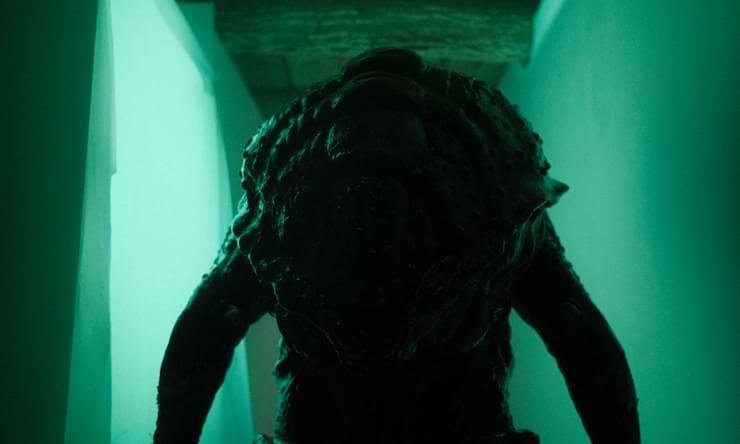
God of Frogs is certainly original – and originality, here, is both its greatest strength and its most persistent liability. Set deep within a humid, time-stalled jungle where an elemental amphibious deity rises every twenty-five years to feed, the film traces one family’s cursed entanglement with a human-sized pond beast across four time periods. A self-aware horror with a frog at its centre is, admittedly, not something cinema has overexploited. Yet novelty alone cannot sustain dread.
The opening chapter, set in 1969, leans heavily into sun-drenched pagan horror, evoking the bleached, ceremonial unease of Ari Aster’s Midsommar. A woman is summoned to what appears to be a sensual initiation ritual, bathed in radiant, almost celestial light. The aesthetic is deceptively pastoral: white linen, flower garlands, slow, reverent camera movements. But the seduction curdles into grotesquery when her suitor is revealed to be an enormous amphibian idol – a damp god of fertility rendered obscene. The sequence is visually arresting, but the film mistakes escalation for depth. An especially brutal moment involving the slicing of a pregnant stomach feels engineered for outrage rather than mythology. Instead of enriching the creature’s lore or suggesting an ancient cosmology, the shock flattens into provocation.
The structure, fractured into generational chapters, promises something epic and folkloric, a curse reverberating through time. By 1994, the tone pivots. Gone are the ritualistic tableaux; in their place, a group of film students on a road trip, cameras in hand, irony at the ready. This segment feels more contemporary, even meta-textual, and is notably better performed. The acting here sheds the earlier theatricality for something looser and more naturalistic. There are hints the film might interrogate its own absurd premise, students documenting a legend that may or may not want to be documented, but this self-awareness never coheres into satire or insight. A garish psychedelic interlude, complete with bargain-bin visual distortion, derails the mounting tension. Dialogue gestures toward authenticity but rarely lands; characters speak as if conscious of being archetypes.
Across its remaining time jumps, performances veer unevenly between solemn mythmaking and camp excess. Horror depends upon conviction; the audience must believe the characters believe. Too often here, exaggerated line readings and inconsistent tone drain scenes of menace. The film wants to balance operatic folklore with creature-feature pulp, but it cannot decide how seriously to take its amphibious deity.
And then there is the frog itself. For a monster so central, its physical realisation is surprisingly unpersuasive. The effects- a combination of practical suit work and digital augmentation- never fully convince. Texture, weight, and scale feel inconsistent. In close-up, the creature risks resembling a damp theme-park animatronic; in wider shots, it lacks the imposing physicality that might anchor the mythology. Horror history is filled with monsters that become frightening precisely because we glimpse them imperfectly. Here, overexposure is the problem. The frog is shown too clearly, too often, and without the tactile realism required to make it uncanny. What might have thrived as a half-seen presence, ripples in stagnant water, a croak in the dark, becomes literal and lumbering.
There are intriguing ideas buried beneath the excess. The cyclical structure hints at inherited guilt, at ecological revenge, at nature demanding repayment from a single bloodline. The jungle setting, thick with rot and humidity, suggests a world indifferent to human morality. At moments, God of Frogs gestures toward folk horror traditions- insular communities, ritual sacrifice, blurred boundaries between devotion and coercion- but it lacks the narrative discipline to sustain atmosphere. Exposition accumulates where ambiguity might have unsettled. By explaining its creature’s habits and appetites so thoroughly, the film drains the myth of mystery.
Despite its ambition and undeniably singular premise, God of Frogs struggles to maintain momentum. The characters remain thinly sketched, defined more by their position in the timeline than by interiority. The plot meanders between chapters without escalating stakes, and the promised generational reckoning never quite detonates. Self-awareness flickers but never sharpens into wit or commentary; the film seems unsure whether it is critiquing horror tropes or indulging them.
By the final act, exhaustion replaces unease. Rather than feeling disturbed, I felt distanced- aware of the machinery straining behind the spectacle. The idea of a cyclical amphibian god haunting one family across decades is bold, even perversely compelling. But boldness needs restraint. As it stands, God of Frogs feels less like a whispered jungle folktale and more like a concept stretched beyond its tensile strength- fascinating in outline, ungainly in execution, and, ultimately, easier to admire than to endure.
★
On UK digital from 2nd March / Kate Vernon, Alexander Eling, Corteon Moore, Erika Prevost, Lynne Griffin, James Gilbert, Rodrigo Fernandez-Stoll, Darius Rathe, Christian Lloyd / Dir: Adrian Bobb, Ali Chappell / Miracle Media / TBC
Related
Discover more from
Subscribe to get the latest posts sent to your email.
