
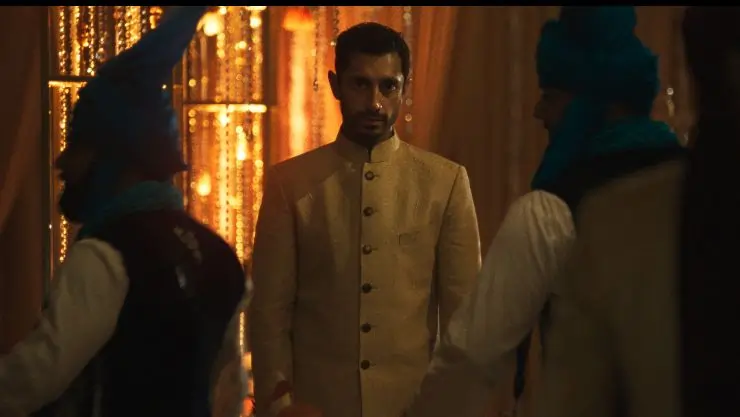
Aneil Kari and Riz Ahmed have formed a partnership to rival Scorsese and De Niro. In 2022, they won the Oscar for their short film “The Long Goodbye,” in which the anxieties of British Asian families become manifest. With Hamlet, they reunite for a feature-length project, boldly reimagining one of the most iconic works in British literature. Their adaptation brings a fresh cultural perspective to Shakespeare’s tragedy, reinforcing the timeless and universal nature of the Bard’s themes.
Throughout his career in both music and film, Riz Ahmed has chosen projects that allow him to explore his British Asian heritage, as well as how the two cultures intersect and clash. In Hamlet, he steps into one of William Shakespeare’s most famous roles, using it as another vehicle to examine cultural identity, grief, and inner conflict. Kari relocates the play to contemporary London, centring it around a wealthy South Asian family mourning the loss of a patriarch—Hamlet’s father, a powerful business tycoon. When Hamlet encounters his father’s ghost after a night of drinking in a strip club, he learns of his uncle’s betrayal and is consumed by the need for revenge. What follows is a dark and tragic unravelling, as Hamlet grapples with madness and morality, ultimately triggering a devastating chain of events.
While the original dialogue of the play remains intact, the film’s contemporary setting brings new context and vitality to a story that has been staged countless times. There’s a rebellious spirit in Kari’s vision; he takes on a British behemoth and makes it entirely his own. This feels especially powerful within the current political climate in Britain, where limp Union Jacks hang from lampposts across the country, symbolising the exclusion and suspicion toward cultures outside the white British mainstream.
In contrast, it’s energising and deeply moving to see a literary figure like Hamlet immersed in a South Asian community, sharing samosas with his family, hearing his father speak Hindi, and witnessing the vibrant ceremonial dress of a South Asian wedding. In Kari’s adaptation, Shakespeare’s world blends seamlessly with British Asian culture. It’s a wonderfully fresh and urgent approach, showing how embracing culture, rather than fearing it as a contaminant, can lead to something truly remarkable.
Riz Ahmed has never been better. While some audiences might approach Shakespeare with hesitation, Ahmed’s delivery of the text is so studied and immersive that he could turn his audience into literature scholars without them even realising it. His physicality equally matches his command of the language. Every movement and gesture enhances the poetic rhythm of his speech, making the film both accessible and freshly engaging. Ahmed doesn’t just perform Shakespeare; he translates it into something completely new and unique.
However, Kari’s adaptation keeps Hamlet too tightly at its core. This intense focus often sidelines the supporting cast (Joe Alwyn as Laertes, Morfydd Clark as Ophelia, Timothy Spall as Polonius, and Sheeba Chaddha as Gertrude), leaving them with little to do. When they are on screen, they rise to the challenge, matching Riz Ahmed’s spirit and emotional intensity. However, the adaptation strips away many of the nuanced elements of the original play, reducing the supporting roles until they are almost redundant.
Clark, in particular, delivers a sensitive and emotive performance as Ophelia. Despite this, the character is underused and underdeveloped. Her limited screen time and the script’s narrow focus fail to explore the psychological complexity of her character. While Ahmed and Clark share a brief but spellbinding chemistry, it isn’t enough to fully realise Ophelia as a woman with limited agency, caught between the conflicting demands of the men in her life. Thus diminishing the character and robbing the play of one of its greatest strengths.
Kari also sometimes struggles to keep the play cinematic. While the images he presents on screen are refreshing in terms of a Shakespeare play, the overall project lacks a cinematic quality. This isn’t the case for the full feature: a dance sequence recreating the murder of Hamlet’s father by a South Asian troupe is particularly intoxicating. However, a large amount of film is fairly televisual and struggles to take command of the visual landscape of the play.
Despite these uneven moments, the film remains an invigorating and original take on a classic. To reinterpret such a foundational work with this level of individuality and contemporary resonance is no small feat. Kari and Ahmed appear to be at the beginning of a promising director-actor partnership, one that brings fresh energy and perspective to well-worn material. Their Hamlet is filled with talent, risk, and vision; qualities that mark them as collaborators to watch closely in the future.
★★★★
Out in UK & Irish Cinemas from 6th February / Riz Ahmed, Joe Alwyn, Morfydd Clark, Timothy Spall, Sheeba Chaddha / Dir: Aneil Kari / Universal Pictures / 15
This review is a of our 2025 BFI London Film Festival | original review link
Related
Discover more from
Subscribe to get the latest posts sent to your email.
