
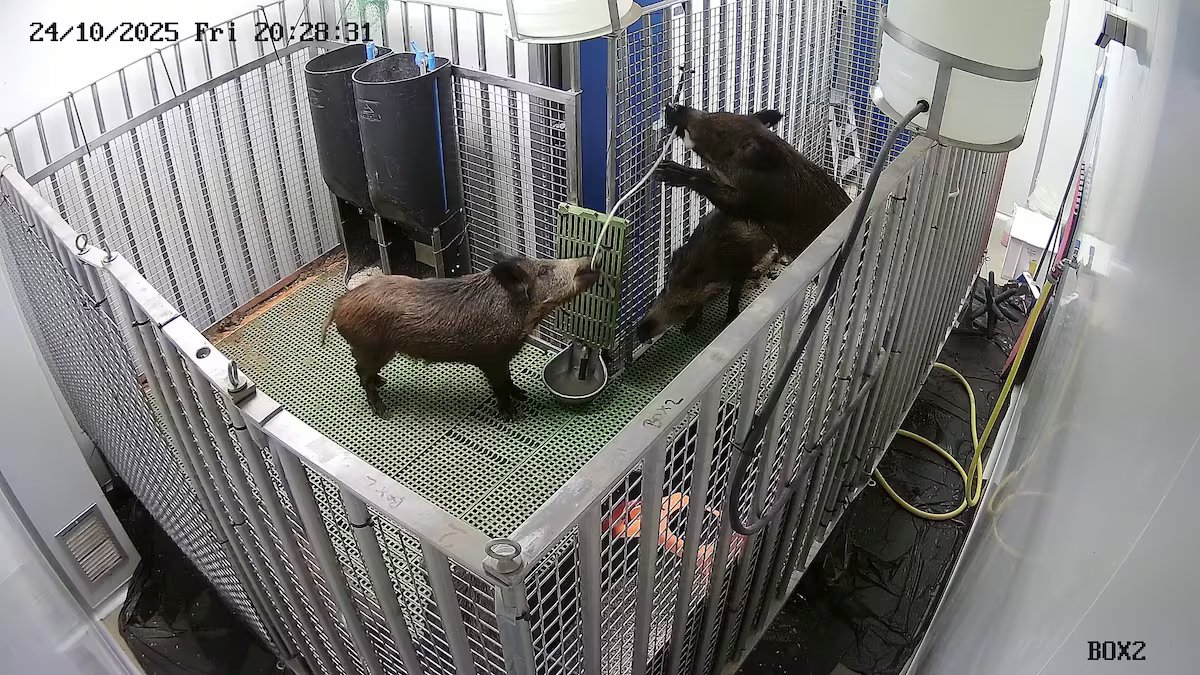
The worst animal pandemic in history, the deadly African swine fever, has just entered Spain. The prime suspect is a hypothetical sandwich made with imported sausage contaminated with the virus, thrown in a trash can, and devoured by wild boars that feed on human garbage in the Collserola Natural Park area in Barcelona. For the moment, only nine cases have been confirmed in wild animals, but the Spanish pig farming sector is understandably on edge. In Spain, there are more pigs than people: 49 million people compared to the 54 million pigs slaughtered last year. And veterinarian José Ángel Barasona has a warning: there is no vaccine, nor will one be available in the near future. Authorities and farmers will have to resort to medieval measures in the face of a plague: isolating the sick and disposing of their carcasses.
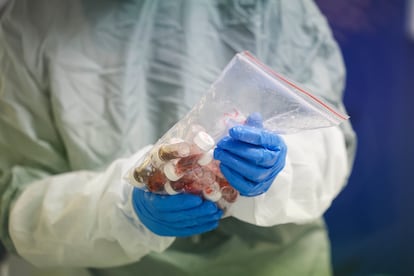
Barasona, 39, hurries through the high-security laboratory of the Veterinary Health Surveillance Center (Visavet) at the Complutense University of Madrid. In its freezers, at -80 degrees Celsius (-112ºF), his team stores samples of some of the African swine fever viruses that have brought entire countries to their knees. Here lies the virus responsible for the plague that ravaged China. Following an epidemic that began in August 2018, the Asian country lost almost 1% of its gross domestic product — around $100 billion in just one year — according to calculations by economists at Wuhan University. In those months, the virus killed or forced the culling of 200 million pigs in China, according to an estimate by the international bank Rabobank. A simple chorizo sandwich can bring a country to its knees.
A European consortium coordinated by the Complutense University of Madrid received €10 million ($11.7 million) from the European Union in 2019 to try to create a vaccine against swine fever. The project ended last year without a definitive success, but with a candidate: a vaccine prototype derived from a virus obtained from a wild boar that was walking peacefully through a Latvian forest in 2017, without showing any symptoms of the disease. That case was unusual. Swine fever can reach 100% mortality, as explained by pathologist Antonio Rodríguez Bertos, who leaves the Visavet laboratory after dissecting an infected wild boar. What he saw in its organs does not surprise him. The virus, with symptoms similar to those of Ebola, causes unmistakable internal bleeding. If it enters a farm, it can kill all the pigs in just a few days.
The consortium’s initial trials were promising. The experimental vaccine, administered in tasty corn baits infused with truffle essence, protected 92% of wild boars in the laboratory in 2019. However, that was a first version using the naturally occurring, attenuated virus. The biggest fear is that a live vaccine could be affected by a phenomenon known as “reversion to virulence,” whereby the weakened virus regains its destructive power. The consortium then focused on genetically refining the pathogen to eliminate its main virulence factors, but this reduced efficacy to 50%, as Barasona acknowledges.
“One of the obstacles to obtaining a vaccine against this disease is the very limited balance between efficacy and safety. If we want very high safety, we’re going to have relatively low efficacy,” reflects the Córdoba-born veterinarian. All the experts remember what happened in Vietnam. Besieged by a plague that caused the death of six million pigs (20% of the total), Vietnamese authorities decided in 2022 to apply a vaccine developed urgently by a local company, but they suspended vaccinations when the injected pigs began to die.
No one has achieved an effective and safe vaccine in over half a century of research. African swine fever virus is exceptional, the only known virus of its kind (Asfivirus), and is incredibly complex. It has almost 200 genes, 20 times more than the COVID-19 virus. Molecular biologist Carmina Gallardo compares it to the AIDS virus because it does not induce neutralizing antibodies. That is why developing a vaccine is so difficult.
The natural reservoir of the virus is the African warthog, native to Africa and popularly known for the character Pumbaa in the film The Lion King. The current global crisis began in 2007 when, allegedly, the crew of a ship from Southeast Africa left contaminated food waste in the port of Poti, Georgia. The plague entered the EU in early 2014, via Lithuania and Poland. Since then, the disease has spread relentlessly from east to west, at a rate of about 66 kilometers (41 miles) per month, according to a study led by epidemiologist Marta Martínez Avilés from the Animal Health Research Center in Valdeolmos, Madrid.
It was only a matter of time before the plague reached Spain, but it has arrived sooner than expected. The virus, which has not yet entered France, landed in Barcelona via a single jump, thanks to that hypothetical sandwich brought from an infected country. In the best-case scenario, the fight against the outbreak, which includes the deployment of more than a hundred members of the Military Emergency Unit in Collserola, will prevent the virus from spreading this time. But these traditional measures will not be enough to contain the future arrival of the “front of the wave” that is advancing inexorably from Eastern Europe, as Barasona warns. Germany, which was the continent’s largest pork producer, was unable to stop the massive influx of infected wild boars across its miles-long eastern border starting in the summer of 2020.
Barasona’s team has launched another project this year, called WildASF-Vax, to improve the stability of its experimental vaccine, evaluate its safety, and design strategies for “a potential emergency vaccination campaign in the Pyrenees in the future, should a wave of the virus that hit Germany arrive.” This is not the only project to develop a vaccine. Another European consortium, led by the Spanish company Hipra, plans to test its candidate next year. And the Research Institute of Hunting Resources in Ciudad Real is participating in a third European project, coordinated from Germany, to improve Vietnam’s vaccines. Other countries, such as China and the United States, have their own initiatives.
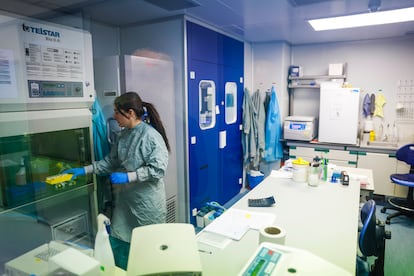
Carmina Gallardo coordinates the African swine fever laboratory at the Animal Health Research Centre, considered the leading center in the European Union. Her team participated in the same consortium as the Complutense University of Madrid — called Vacdiva — and has been unsuccessfully requesting state funding for two years to continue developing their best prototype. The failure of the vaccination program in Vietnam, she explains, halted research with live attenuated vaccines, which until now have been the only effective ones. Inactivated virus vaccines or those based on fragments do not appear to protect pigs and wild boar.
“In Vietnam, two things have happened: a reversion to virulence and, on the other hand, recombination of the live vaccine with viruses already circulating in the field. In other words, two viruses — the vaccine virus and the field virus — combine and create a monster, a mutant virus that again kills animals and is immune to the vaccine,” explains Gallardo, who is also an expert with the World Organization for Animal Health. This institution, the international authority on the matter, demanded in May that vaccines without proven safety not be used. “Currently, there is no effective and safe vaccine against African swine fever, nor is one expected in the immediate future,” the researcher laments.
Sign up for our weekly newsletter to get more English-language news coverage from EL PAÍS USA Edition
