
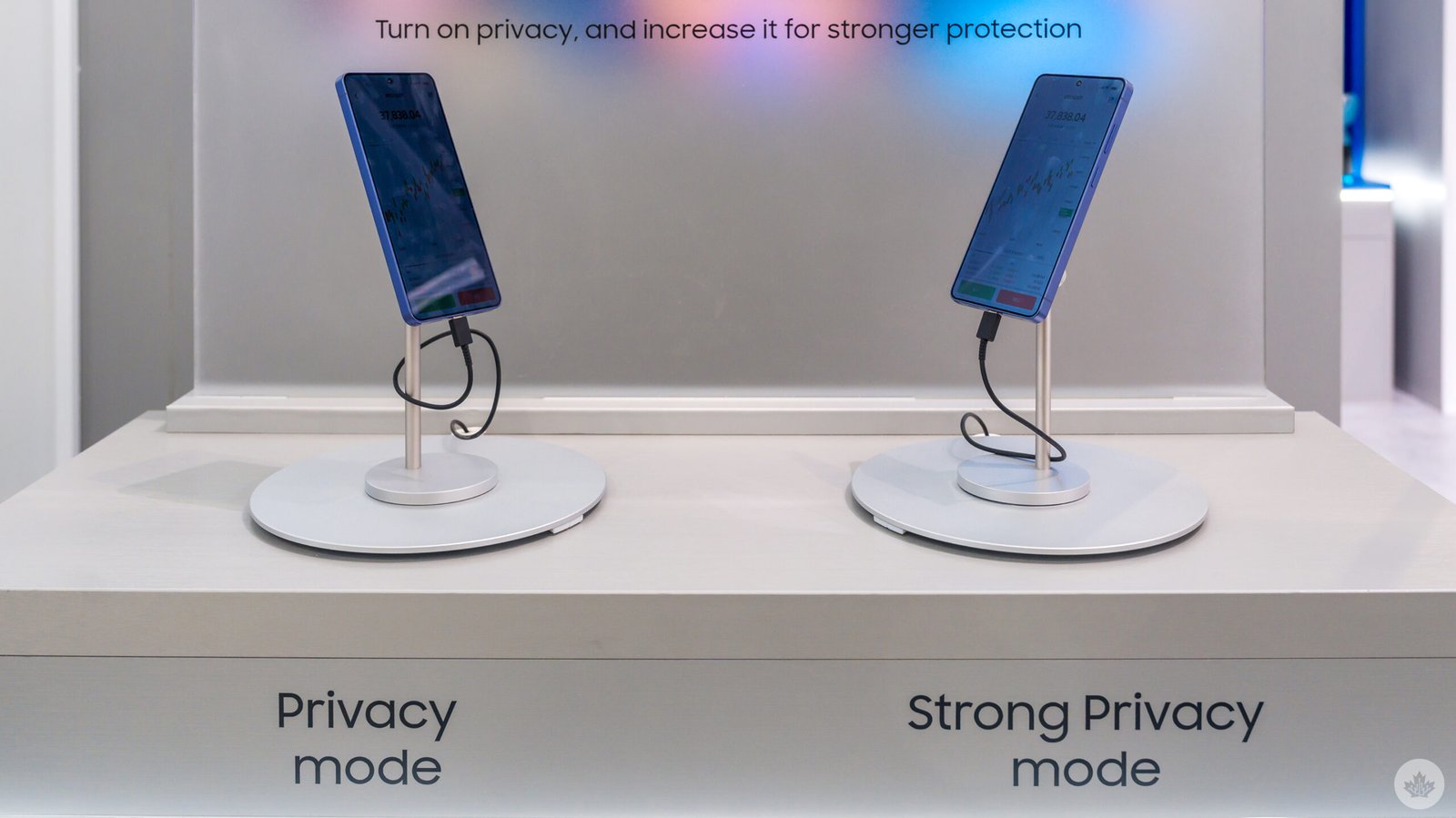
Walking into the Samsung Galaxy booth at Mobile World Congress (MWC) in Barcelona showed only standard and cursory examples of the company’s new Privacy Display featured on the Galaxy S26 Ultra. Meanwhile, a separate Samsung Display booth (in a different hall, no less) had a more interesting look at the technology and what may come next.
In an otherwise highly iterative update (yet again) for its flagship phone, Privacy Display feels like something fresh and easy to adopt. Anyone can identify with keeping some information away from prying eyes on the most personal of devices, and under its current iteration, there are options to do it piecemeal or by app.
But what if the adaptation could isolate further, be it a particular part of the screen or for a very specific instance?
Hiding in plain sight
Phone with privacy film (left) and the S26 Ultra with Privacy Display (right).
I won’t rehash how the Privacy Display technology works, but it’s essentially made up of two pixel types. The narrow pixels emit light directly ahead, while wide pixels spread light in all directions. Activate the narrow pixels only, and they become difficult to see from side angles.
As is, you have the option to either use it for everything you do on the phone or to limit it to specific apps and notifications. It also has two levels: Privacy mode, which offers standard reduced visibility, and Strong Privacy that makes it increasingly difficult to see anything from an acute angle.
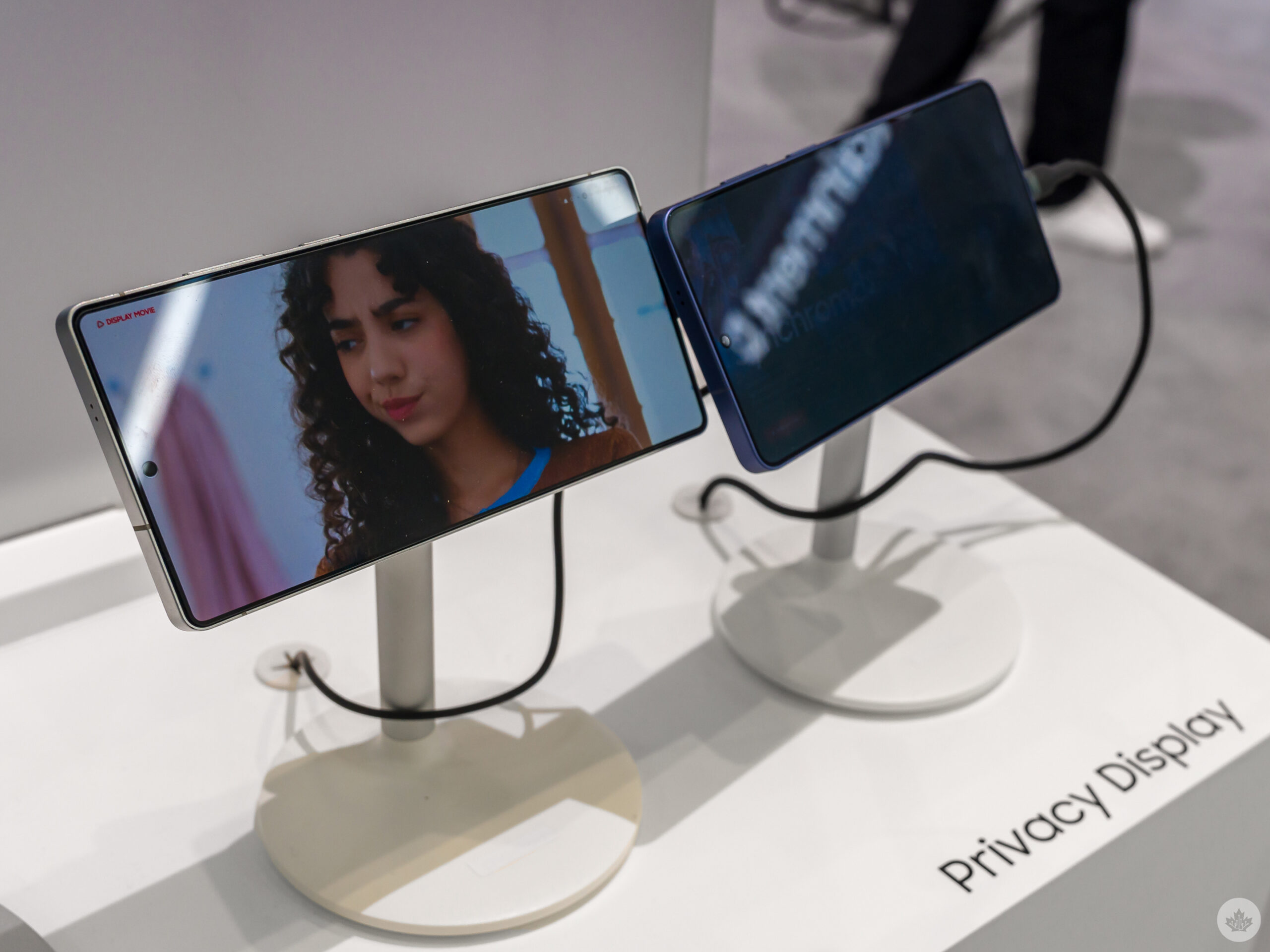
The most obvious comparison at the Samsung Display booth pitted a Galaxy S26 Ultra with Privacy Display enabled next to an S25 Ultra with a privacy screen protector. Along with introducing a dimmed shade at all times, one of the drawbacks of a third-party privacy filter is that it only works laterally when the phone is upright. Tilt it to landscape and the effect isn’t as pronounced, making the screen highly visible. Plus, overhead views are harder to hold off in portrait orientation, too.
Granted, these aren’t hard and fast rules for every single privacy filter on the market, but they’re not unusual circumstances. Moreover, Samsung is quick to point out that filters generally offer one polarity users must accept, no matter what they do on the device. Turning off Samsung’s Privacy Display when watching a show or doing a video call with friends and family sitting side by side are but two examples of how making this an elective feature can feel impactful for innocuous use cases.
Isolating parts of the screen
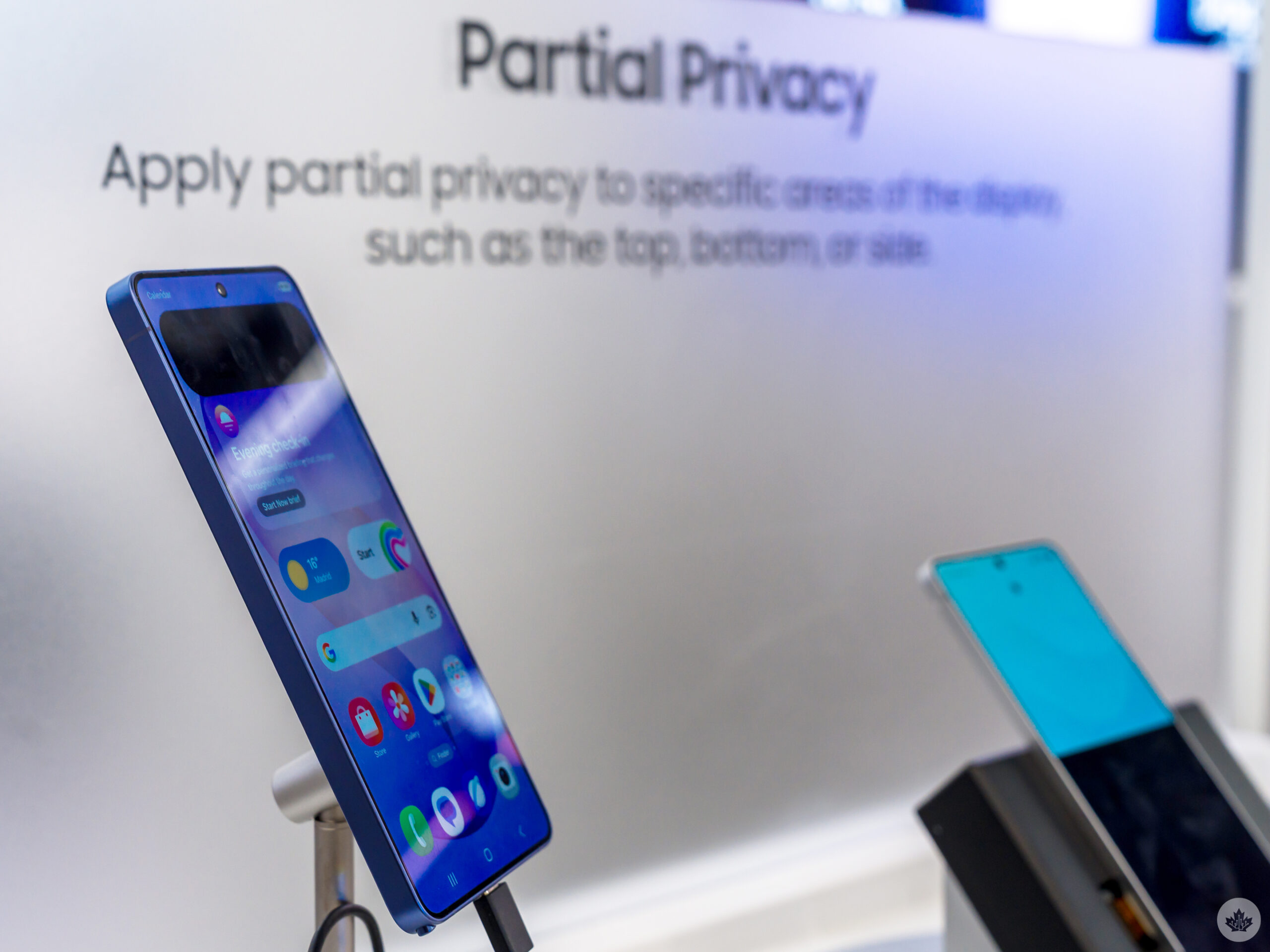
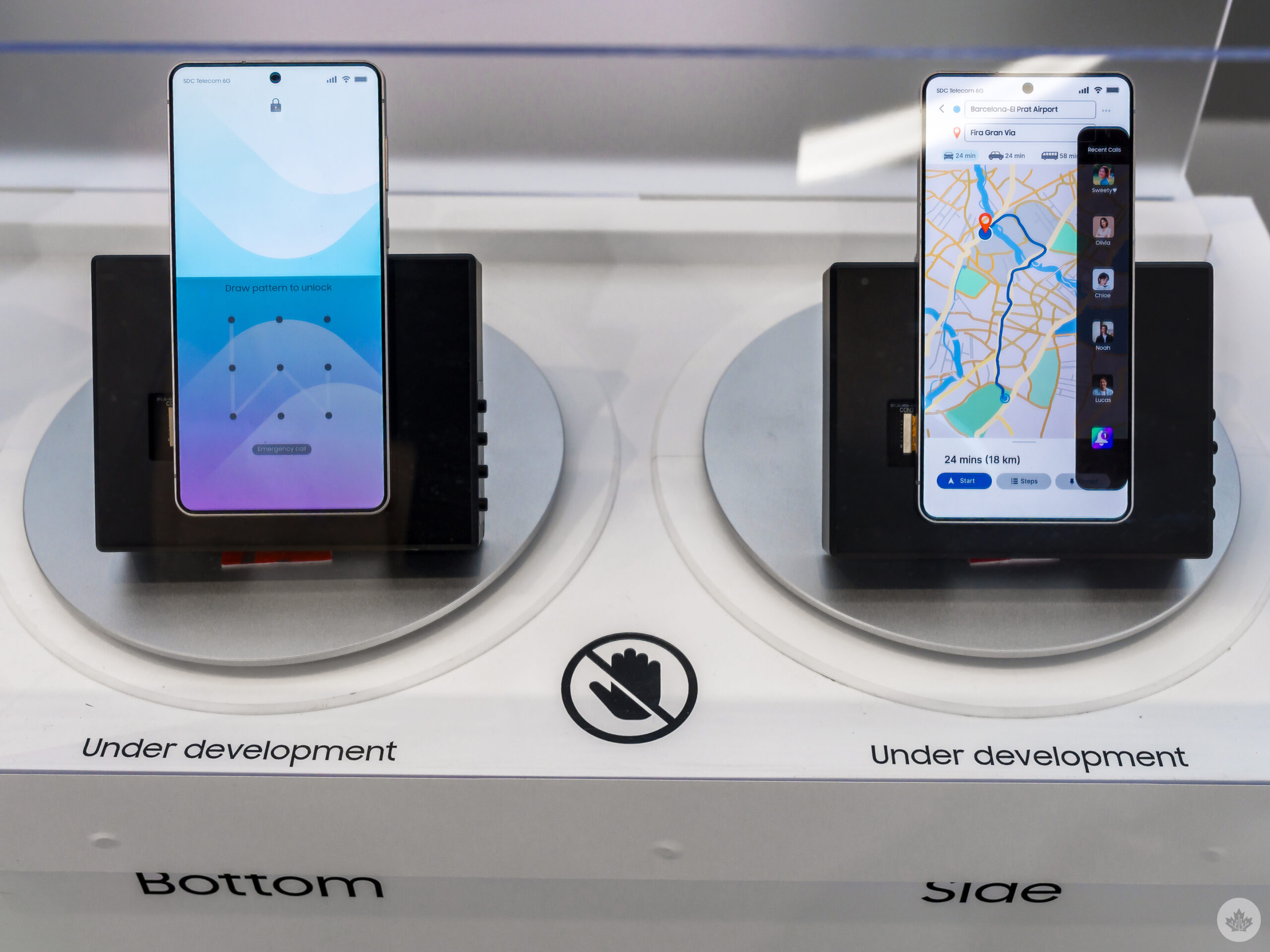
The booth also featured conceptual demos that portend a near future where the tech can be particular about what it actually dims onscreen. Samsung’s One UI is filled with elements that such a feature could theoretically isolate.
Here, too, it would be possible to apply this only to notifications from certain apps or even specific contacts. Business users, or even journalists like me, who deal with NDAs and sensitive information, might like that kind of granularity for peace of mind in warding off prying eyes.
Other examples include split-screen modes where one app is visible while the other isn’t. Indeed, by cutting the screen in half that way, it would also block peripheral views when inputting a PIN or pattern to unlock the device on the lower half of the display.
Yet another has the Edge panel blacked out when seeing the phone from an angle. I suspect we may even get to a point where editing a photo or video will keep the tools visible while leaving the image itself blocked out. Samsung Display didn’t present that, but I did ask, and they said they are working on all sorts of ideas. So, not a yes but not a no, either.
More to come for Privacy Display
What’s not clear from any of these examples is whether Samsung is considering making Privacy Display even more deliberate, meaning users can choose from a variety of potency settings. Not unlike active noise cancellation (ANC) on headphones and earbuds, as an analogy. Samsung’s Galaxy earbuds offer that kind of control, both manually and based on adaptive settings.
A screen that constantly brightens and darkens for privacy would have to work much like ambient sensors already do for screen brightness. Personally, I don’t always even notice the subtleties of when that comes into effect myself, so I imagine Samsung knows doing privacy that way would need to feel equally seamless for everyone.
There’s also no word on whether Samsung will integrate Privacy Display into other devices this year. The Galaxy Z Fold and Z Flip would seem to be ideal candidates, but given this only launched for the S26 Ultra, it’s hard to gauge what the near-term road map will look like.
