
Opinions expressed by Entrepreneur contributors are their own.
Key Takeaways
- Josh Kim documented the messy, unfiltered reality of opening Softies Burger, from construction delays to emotional stress.
- By sharing the journey on social media, the story itself became part of the brand, attracting new opportunities.
- The bigger things get, the easier it is to lose the plot. Stay close to why you started.
Josh Kim never planned to open a restaurant.
Softies Burger started as what Josh Kim later described as a joke. A side project. A way to make a little extra cash for what his business partner Sam Hong described as “diaper money.”
The two met while working in restaurant tech. Kim was at OpenTable, Hong had spent years opening coffee shops before moving into tech. Both loved hospitality, but both had chosen the safer path of steady salaries. Softies was supposed to be a low-risk outlet. A pop-up outside coffee shops and breweries around Orange County, California. Nothing serious.
“We dropped a few thousand dollars on a credit card to buy a couple of griddles,” Kim said. “It was always supposed to be a very low-risk, low-reward pop-up for friends and family.”
Their expectations were modest. For the first event, they planned to serve about 50 burgers — maybe a hundred if things went well. Thirty minutes before service, they noticed something strange: A line was forming.
“We saw a queue of like twenty or thirty people, none of whom we knew,” Kim said. “We thought they were at the wrong event.”
And they were not. That first pop-up sold 300 burgers in three hours. The night was chaotic. Two guys cooking together for the first time, suddenly buried under tickets.
“I’m crying and I don’t even know why,” Kim said. “I’m like, this was so hard.” Instead of rushing into a restaurant, they slowed down. One pop-up every few weeks. Just enough to test whether the first night had been a fluke.
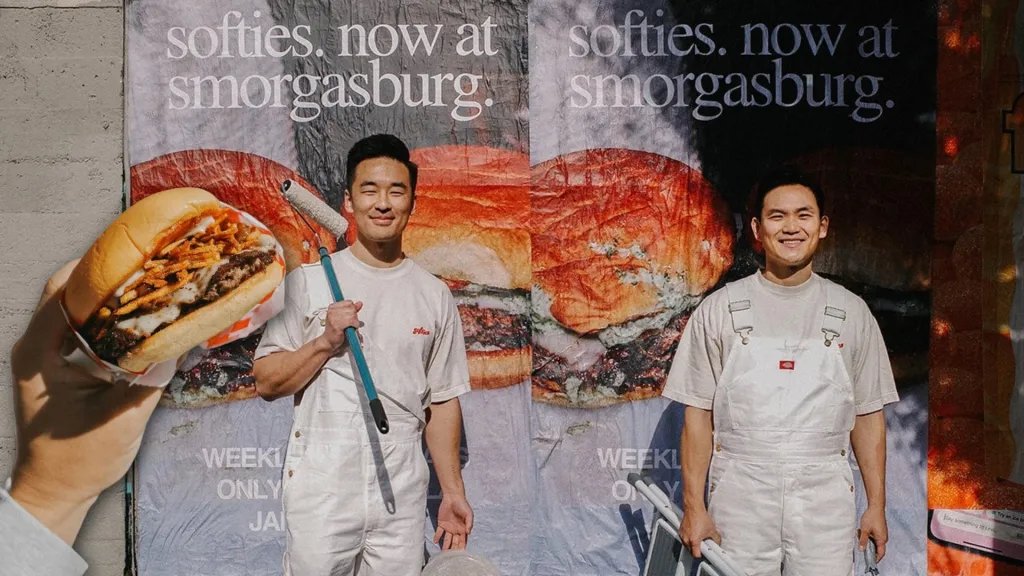
The crowds kept showing up. The joke kept growing. Soon Softies landed at Smorgasburg, Los Angeles’ massive outdoor food market, popping up every Sunday.
For Kim, the decision to go all in carried extra weight. The safer path had always been corporate life. But Softies kept pulling him back into the hospitality world he had tried to leave behind.
Eventually, the side project stopped feeling like a side project. “I would tell my younger self not to even consider drawing up a plan B,” Kim said. “Follow plan A, even if it looks really daunting.”
Building in public
What happened next was not just a restaurant opening. It became a story told in real time.
Before Softies Burger opened its doors at USC Village, Kim and his team decided they would document the process publicly. Not the polished version most brands share, but the messy reality of opening a restaurant.
The result was a vertical video series on Instagram that followed every step. This included lease negotiations, construction delays, stressful moments and the everyday exhaustion of being an entrepreneur. All this to say, Kim did not want another feed full of burger photos.
“No one cares about our burgers,” Kim said. “But people care when a story reminds them of their own.”
The episodes showed the moments that most operators hide — long nights, stress, doubt. The emotional weight of building a restaurant from scratch. At one point, Kim openly discussed the mental toll of restaurant ownership and the reality that success on the outside often comes with sacrifice behind the scenes. That honesty resonated with people online.
Operators from around the country began following the journey. Entrepreneurs saw pieces of their own struggles in the videos. What started as documentation slowly turned into something bigger: a brand built around transparency. That visibility also brought unexpected moments.
One of them came when chef Roy Choi, a pioneer of the Los Angeles food scene, joined Kim on the show. For Kim, the moment felt surreal.
“Roy Choi is a hero to us,” Kim said. “The fact that he would come on and share his story meant everything.”
By the time the conversation wrapped up, it was clear the pop-up experiment had grown into something much bigger. What started as a weekend hustle had become a full restaurant, a recognizable brand and a vehicle for the kind of storytelling most founders never get around to.
Today Softies Burger is projected to generate nearly $2 million in its first year. But Kim is careful not to frame growth in traditional restaurant terms. He says adding more locations is not the goal. Instead, it’s about keeping building honestly, sharing the process and showing what entrepreneurship actually looks like.
For Kim, that means continuing to build in public. Because the real story is still being written.
About Restaurant Influencers
Restaurant Influencers is brought to you by Toast, the powerful restaurant point-of-sale and management system that helps restaurants improve operations, increase sales and create a better guest experience.
Toast — Powering Successful Restaurants. Learn more about Toast.
Key Takeaways
- Josh Kim documented the messy, unfiltered reality of opening Softies Burger, from construction delays to emotional stress.
- By sharing the journey on social media, the story itself became part of the brand, attracting new opportunities.
- The bigger things get, the easier it is to lose the plot. Stay close to why you started.
Josh Kim never planned to open a restaurant.
Softies Burger started as what Josh Kim later described as a joke. A side project. A way to make a little extra cash for what his business partner Sam Hong described as “diaper money.”
The two met while working in restaurant tech. Kim was at OpenTable, Hong had spent years opening coffee shops before moving into tech. Both loved hospitality, but both had chosen the safer path of steady salaries. Softies was supposed to be a low-risk outlet. A pop-up outside coffee shops and breweries around Orange County, California. Nothing serious.
