
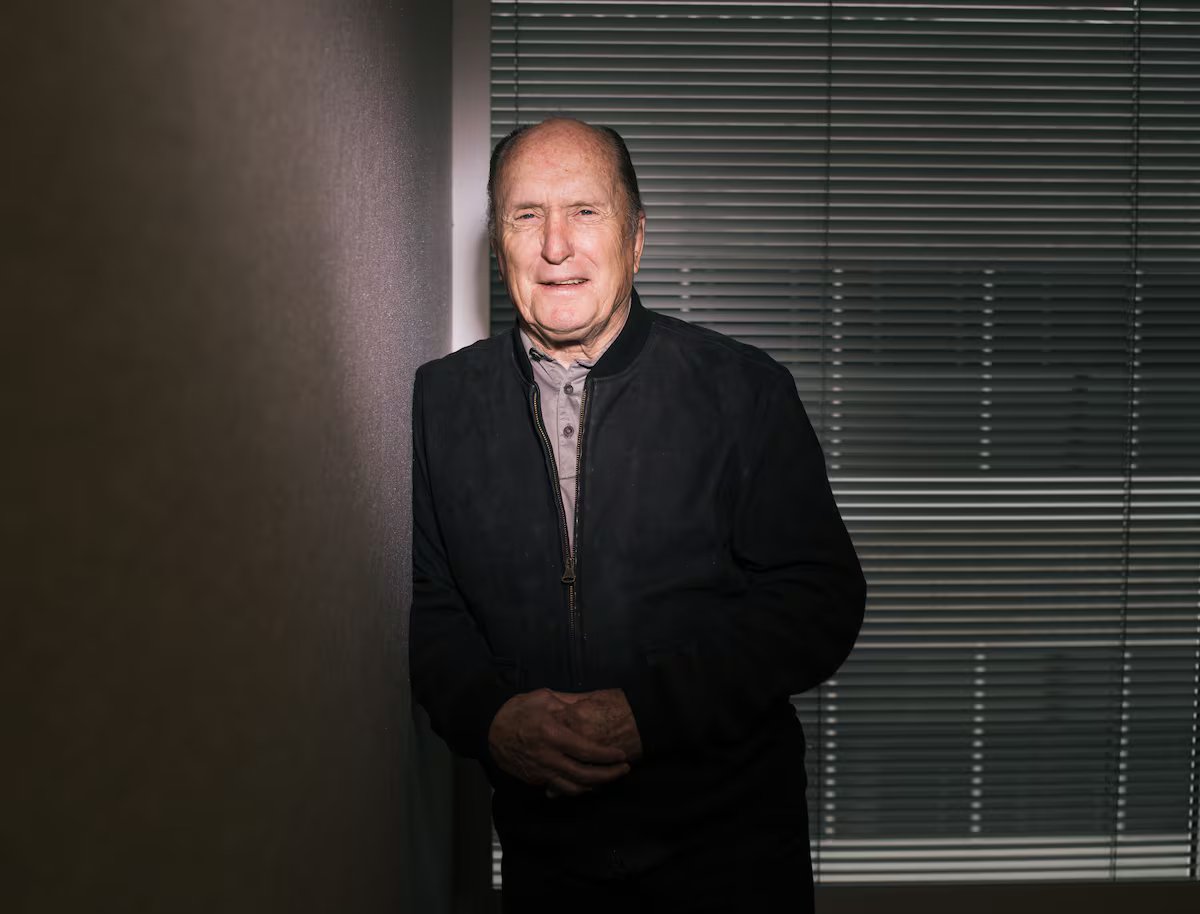
“To the world, he was an Academy Award-winning actor, a director, a storyteller. To me, he was simply everything.” With these words, Luciana Duvall announced on social media that her husband, acting legend Robert Duvall, had passed away on Sunday at the age of 95 at his ranch in Virginia.
Duvall will forever be remembered as Tom Hagen, the consigliere in The Godfather, in which he made offers people could not refuse as advisor to the crime family of Don Vito Corleone, and Colonel Kilgore, who loved the smell of napalm in the morning, in Apocalypse Now, both directed by Francis Ford Coppola. But thanks to his talent, he worked in cinema for seven decades. He won an Oscar for Tender Mercies, although he earned other nominations in the two films directed by Coppola as well as The Great Santini, The Apostle, A Civil Action, and The Judge. Not bad for someone who didn’t say a word in his first movie role (he played the quiet and lonely Boo Radley in To Kill a Mockingbird in 1962), although he already had experience in theater and television.
“His passion for his craft was matched only by his deep love for characters, a great meal, and holding court. For each of his many roles, Bob gave everything to his characters and to the truth of the human spirit they represented,” said his wife Luciana, an Argentine actress and director with whom he shared a passion for tango, in her statement.
Duvall was a workaholic actor, an expert horseman, and a talented singer, especially of country songs. On his ranch, he was able to enjoy all of these passions, to which he added his interest in history: over time, he collected numerous objects from the American Civil War that he found on his land. He ended his career on a high note in 2022 with two very interesting roles: The Pale Blue Eye, by Scott Cooper, with whom he had already worked on Out of the Furnace, and Hustle, a basketball movie starring Adam Sandler. During one of his visits to the San Sebastián Film Festival, where he received the Donostia Award, he said: “I’m open to surprises, to anything that might come around the corner, much better than things that are planned.” In acting and in life: he met his wife Luciana in 1996 in Buenos Aires, where he was shooting a film. Duvall went to buy flowers and, finding the florist’s closed, walked to a nearby bakery. There he ran into Luciana, who invited him — without knowing who he was — to the opening of a tango hall. Incidentally, at that 2009 festival, he said: “Today’s independent filmmakers would have held their own back then [in New Hollywood]. The problem is that independent cinema is withering away because of the economic situation, but what is clear is that in any country — anywhere there is someone with a camera in their hand wanting to tell a story — there will be material to make a film. What baffles me is the money involved in big productions. They’re all $100 million movies. I’d rather see ten $10 million movies made. It’s not hard to find good stories and roles; the hard part is getting the projects off the ground financially. We’re worse off than ever in that regard.” He said this as an actor of that New Hollywood and as the director of five feature films over four decades. An example of this struggle is The Apostle (1997), which he wrote, directed, starred in, sang in, and put up $5 million of his own money for when no studio wanted to back it financially.
There were two key creators in Duvall’s career: Coppola and screenwriter and playwright Horton Foote. He worked with the former on five occasions: The Rain People (1969), the first two Godfather films, The Conversation (1974), and Apocalypse Now. There could have been a sixth, but the actor asked for a salary to play Hagen for the third time in The Godfather Part III that Coppola considered excessive. That’s how the character died and a new consigliere, played by George Hamilton, appeared. All in all, they didn’t end up on bad terms. “Coppola launched us all; he was the catalyst for an entire generation of actors. We owe him a lot,” Duvall said. Regarding the famous helicopter sequence in Apocalypse Now, Duvall told Roger Ebert. “There wasn’t any time to think. I heard over the intercom that we only had the use of the jets for 20 minutes. One fly-by and that was it. I just got completely into the character, and if he wouldn’t flinch, I wouldn’t flinch” They shot it in a single take.
Colonel Kilgore, due to the brevity of the role, sums up how Duvall made the most of his screen time: “I’m a character actor, and I’ve never minded that. Sometimes actors like me can feel jealous of the leading actors. You often wonder if you could do certain types of roles that you’re never called for. But being a character actor has many advantages. You do great work and travel all over the world without having to carry the weight of the film. That’s pretty cool.”
Horton Foote, the other driving force behind his career, was the screenwriter for To Kill a Mockingbird. He saw Duvall in New York in the play The Midnight Caller, where he played a drunk, and it was Foote who suggested him for Robert Mulligan’s classic adaptation of Harper Lee’s novel. Furthermore, Foote wrote the screenplays for Tomorrow (1972) and Tender Mercies (1983), both major films in the actor’s career.
Robert Selden Duvall was born in San Diego on January 5, 1931. His father, a career military man, moved his family to the East Coast when his middle son was 10 years old. His mother was a descendant of General Robert E. Lee, a fact that Duvall liked to mention. After studying theater at university and spending two years in the army, he moved to New York in the late 1950s to continue his training and earn a living. He shared an apartment with Dustin Hoffman, and the two of them would scrounge food at Gene Hackman’s house, whose wife used to cook for them all.
Sign up for our weekly newsletter to get more English-language news coverage from EL PAÍS USA Edition
