
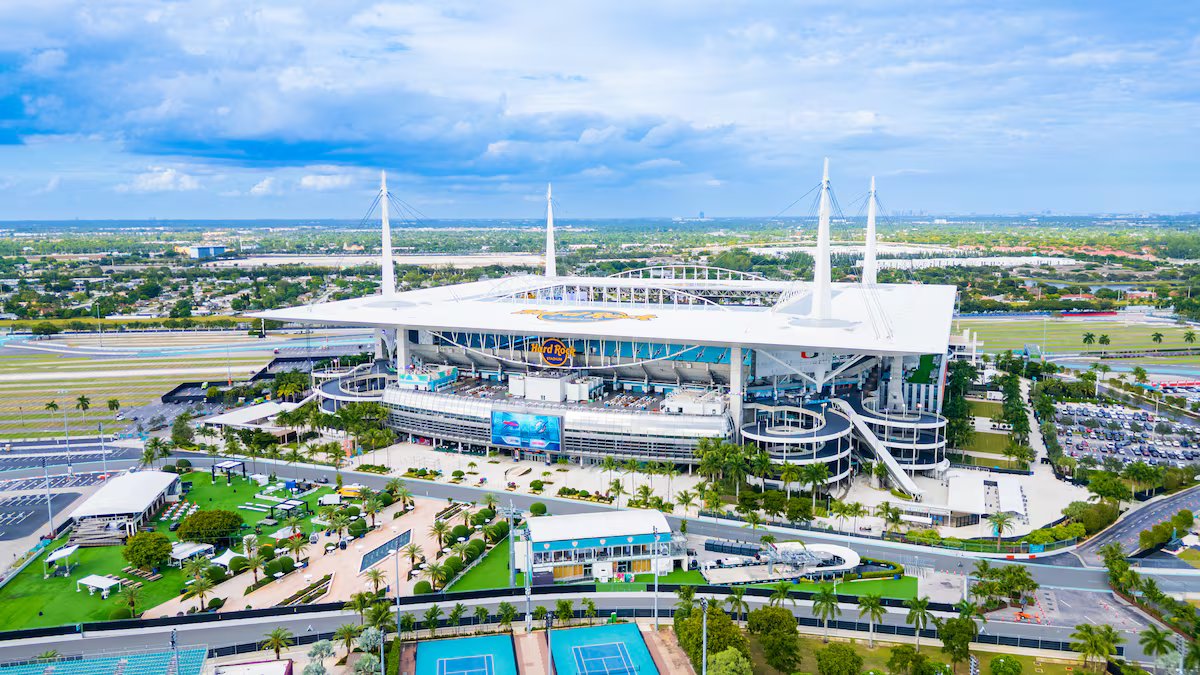
With just over 100 days until the start of the 2026 World Cup, officials from several host cities in the United States have warned that the partial shutdown of the Department of Homeland Security (DHS), which is exacerbating an already problematic lack of institutional coordination, is severely impacting security and logistical planning for the world’s largest sporting event.
Before the House Homeland Security Committee this week, local officials and experts warned that the situation is on track to create a “catastrophic” scenario for the tournament this summer. While they do not yet foresee direct disruptions to the match schedule, they do anticipate that it will significantly impact the vast array of festivals and side events planned.
The federal government had allocated, in its mega fiscal law passed last summer —known as the “Big Beautiful Bill”— $625 million through the DHS to strengthen security and preparedness at the 11 U.S. host venues (Mexico and Canada are also hosts, but the United States is by far the country that will host the most matches), as well as another $250 million specifically earmarked for improving drone threat detection and mitigation. However, due to the current budget freeze affecting the DHS, which shows no signs of being resolved soon in Congress, the Federal Emergency Management Agency (FEMA), which is responsible for distributing the funds, is unable to release them.
The current partial shutdown of the DHS — the third government stoppage in a year, including the longest in history last November — is also affecting agencies such as the Transportation Security Administration (TSA), which is responsible for airport security, as well as the Coast Guard and the Secret Service. But Democrats and Republicans cannot reach a budget agreement that would reopen the DHS . Reaching an agreement on limiting the number of federal immigration agents has proven impossible, a non-negotiable demand for Democrats, particularly after the killing of two U.S. citizens by immigration officers in Minneapolis in January.
Paradoxically, Immigration and Customs Enforcement (ICE) and the Border Patrol — the agencies that have led the large-scale migration operations — have not been affected, since their budgets were increased and secured to unprecedented levels in the same fiscal law passed in July of last year.
Nellie Pou, Democratic representative for New Jersey, was blunt. “This is completely unacceptable this close to kickoff. If DHS is going to play a role in this tournament, then DHS needs to be transparent, coordinated, and timely. The World Cup is a global stage. We need to act like we are ready for it. We’re running out of time.”
In Miami, one of the key venues, the situation is especially urgent, said Ray Martinez, the chief operating office for the Miami host committee. The city has requested some $70 million in federal aid that has yet to arrive as time ticks by.
“We are 107 days out from the tournament, but more importantly we are about 70-something days out from starting to build the fan fest,” he told the House committee on homeland security. “These decisions have to be made, generously, within in the next 30 days. Our local agencies are very anxious. Without receiving this money, it would be catastrophic for our planning and coordination.”
Martínez warned that the end of March would mark a point of no return, forcing the cancellation of parallel events due to the lack of security guarantees.
Meanwhile, Joseph Mabin, deputy police chief of Kansas City, described the release of funds as “critical” to hiring additional personnel in the city, which will host six matches and serve as a training base for four national teams. His department, he acknowledged, does not currently have enough officers to cover all anticipated threats. As a result, in Kansas City, both the side events surrounding the matches and the security plans for the teams staying in the city throughout the tournament are also on shaky ground.
The situation is also worrying in the town of Foxborough, about 50 kilometers (31 miles) south of Boston, which has 18,000 inhabitants. This town is home to Gillette Stadium — with a capacity of around 65,000 spectators — which will host seven matches, but local officials have said they have not received the $8 million in federal funding they requested to cover security costs; this amount is more than the town spends on public safety in an entire normal year. Faced with the uncertainty, they have threatened not to grant the license that FIFA requires to hold matches at Gillette Stadium, including one featuring England, another with France, and a quarterfinal.
According to local reports, the city has contacted the Kraft family — owners of Gillette Stadium, the NFL’s New England Patriots, and the MLS’s New England Revolution — to temporarily cover the deficit, though no agreement has yet been reached. City officials have set March 17 as the deadline to find a solution to the budget problem. According to these officials, after that date, the city will not have enough time to prepare for the seven games it is scheduled to host.
Another problem that has been highlighted is the lack of cooperation among agencies involved in planning, especially between federal and local entities. “If we’d been having this conversation two years ago, we’d be in better shape,” said Mike Sena, president of the National Fusion Center Associatio, which coordinates collaboration between national and local bodies. “But today, as we’re approaching these games, we’re nowhere near the capability we need.”
The concerns go beyond money and security. There are serious fears that transportation logistics to and from the stadiums — many of which are far from the urban areas where fans would be staying — could become chaotic; the chaos that preceded the 2024 Copa América final in Miami is an example of what organizers want to avoid. But there is so far no guarantee a similar situation won’t happen.
Meanwhile, up to five million visitors are expected to arrive in the United States for the World Cup, the biggest in history, with 48 teams competing for the first time. However, given the current immigration climate, there is uncertainty about the speed of the visa process, despite the announcement of an express system for those who have purchased official tickets. Meanwhile, amid rumors that ICE will be present at stadiums, as well as the cancellation of parallel events, the prospect of empty seats — at least for some matches — is growing.
Sign up for our weekly newsletter to get more English-language news coverage from EL PAÍS USA Edition
