
The historically long security lines currently snaking through U.S. airports are the painful result of extreme circumstances. Callouts, no-shows, and resignations by Transportation Security Administration workers fed up with a lack of pay during a partial government shutdown, combined with a bump in spring break travelers, have created unusually congested airport security checkpoints.
For the architects and airport authorities that work together to design these heavily regulated spaces, it’s the kind of convergence you can’t exactly plan for. But, according to some of the designers of these spaces, airports are increasingly incorporating design features that can help them manage extreme security lines in the future.
Flexible space allows for overflows
The lines, though currently caused by TSA worker shortages, are actually governed by the airports themselves and therefore are the airports’ problem. “There are regulations, but what the TSA is really interested in is the point from where you have your last document checked, called the TDC, to the actual [scanning] equipment,” says Ty Osbaugh, principal and global aviation leader at Gensler, a design and architecture firm. “That’s their land. How the queue works is purely up to an airport.”
How big that queue gets, though, is out of the airports’ and their designers’ hands.
Controlling the lines leading up to the security checkpoint takes a lot more than setting up a maze of stanchions. Osbaugh says airports carefully plan their pre-security, or landside, spaces to manage flows of passengers that can vary wildly during different times of the day and different days of the year. Building flexibility into this area, which can often share space with ticketing areas, allows for the lines to adapt to the crowds and circumstances.
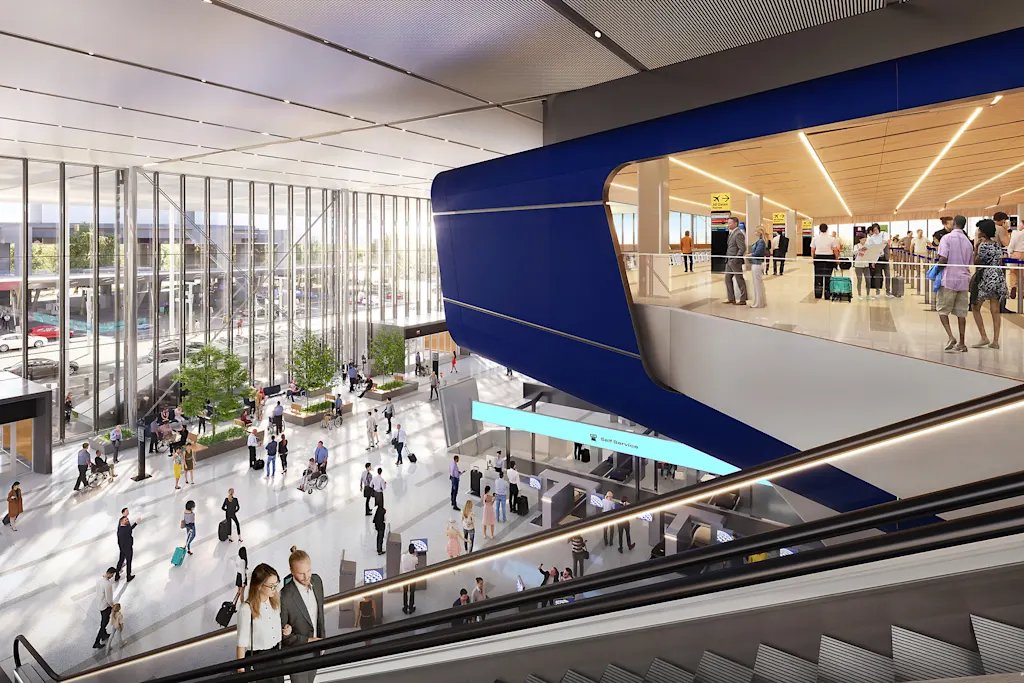
Gensler is currently working on a $9.5 billion redesign of Terminal 1 at John F. Kennedy International Airport in New York City, and Osbaugh says the landside space was designed with softer edges to be able to accommodate overflow. “We’ve got a garden that’s [adjacent], so if the queue starts to back up—God forbid that it does—now people have that extra space to be able to queue instead of backing into the ticketing areas and everything,” he says.
Other airports, including some currently experiencing incredibly long security lines, don’t have this kind of flexibility. “That’s the problem that we see in Hartsfield right now,” Osbaugh says, referring to the Hartsfield–Jackson International Airport in Atlanta, where travelers have been advised to expect four-hour wait times. “The checkpoints are boxed in by hard elements on both sides. So it’s just trying to figure out how do you have that pressure relief valve in the queue?”
Planning, but not building, for the worst
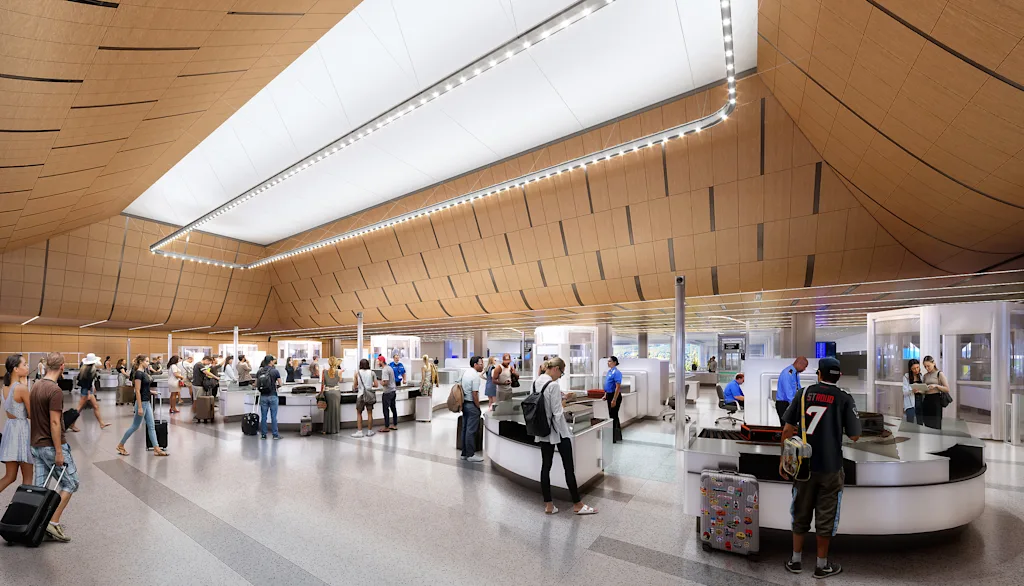
Airports are designed with epic security lines in mind, but that doesn’t mean they are built around the chance that they occur. Jonathan Massey, managing principal and aviation sector leader at the architecture firm Corgan, says his firm’s approach is to understand the existence of outlier events, but to design for more realistic peaks. “You always know something’s going to happen. There’s going to be a snowstorm somewhere, there’s going to be a strike, there’s going to be a terrorist event, there’s going to be a pandemic,” he says.
Airports rarely end up being large enough to handle abnormally high crowds that may only occur once every few years. Massey says airports are designed to accommodate predictable peak surges like spring break, the summer travel season, and Thanksgiving. “We’ll look at those as our planning baseline. Things like pandemics, strikes, government shutdowns, blizzards—those fall outside of that,” he says. “Typically, the industry just isn’t willing to spend $1,000 a square foot to make a building bigger for what might happen.”
Airports can also be hesitant to try to solve unpredictable crowding problems in facilities that will stand for decades, especially as new security technologies are rapidly changing the checkpoint process. Osbaugh, who’s been designing airport projects since before the September 11, 2001, terrorist attacks, recalls a time when the security screening was an agent waving a metal detecting wand. “The one thing that is constant, and will continue to be constant as it relates to security checkpoints, is they are going to evolve,” he says.
When it begins opening in phases later this year, the new Terminal 1 at JFK Airport will integrate biometric document-checking technology that could, one day, eliminate the need for human workers to manually check identification and boarding passes. “It’s taking the need of staffing for airlines down to next to none, but it’s also reduced the footprint of how much space is needed at a check-in hall,” Osbaugh says. The lines leading up to this checkpoint, he adds, can “accordion” in size depending on the size of a crowd at any given time.
Such flexibility has some architectural implications. Jeff Mechlem, airport sector leader at the architecture and engineering firm Stantec, says it’s become more important for airport designs to have wide open areas for the entire security pipeline. “[We’re] looking to make sure we can reduce the amount of columns and permanent walls and such that restrict not only the changing equipment and technologies, but also the configuration of our queues,” he says.
That approach is getting a test right now. One of the recent projects Stantec is involved in is the redevelopment of the international Terminal E in Houston’s George Bush Intercontinental Airport, one of the airports that has been hardest hit by the TSA worker shortage and partial government shutdown. The terminal, which is now only about half operational as more airlines get ready to move in, is currently seeing security checkpoint wait times of about two hours. (This kind of tech-enabled wait estimate is also on display in many newer airports, giving passengers at least some sense that they won’t—or definitely will—miss their flight.)
The project, and others currently rolling out in another Houston terminal and at Denver International Airport, was designed to ease this rare situation by making space in the central processing area for security lines to spread out without impacting bag-drop and check-in counters, according to Mechlem. Buffer space between each function provides the option for lines to spread past their usual footprint. Under normal circumstances, these areas simply blend into the landside space of the airport, like wide concourses. There are also restrooms located nearby and staff facilities that can be used to assist passengers. “We are looking at the planning of that space as not being just a buffer, but something that you then actually could use as operational for these extended queues,” Mechlem says.
The art of distraction
“It’s inevitable that you’re going to have some wait period and queue time here, and we’re looking at ways to use architecture to drive that experience and have it be a pleasant, stress-relieving experience,” Mechlem says.
But when lines stretch and wait times grow, there’s only so much a flexible floor plan or a column-free ceiling span can do. “Airport directors are looking for ways to distract the passenger,” Osbaugh says. Art is one option.
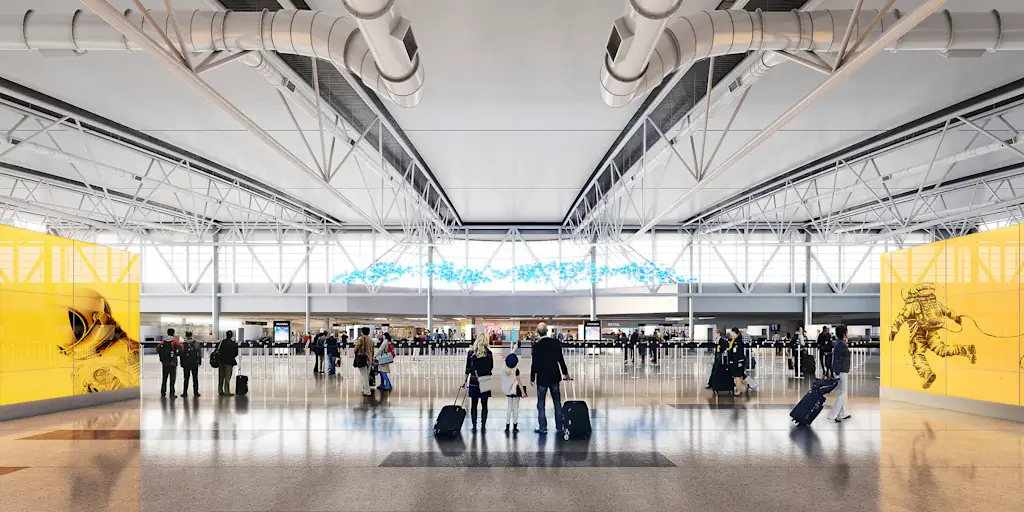
Along the wall bordering the security checkpoint at JFK’s Terminal 1, a massive split-flap display board designed by Pentagram and the engineering firm Arup will cycle through large lo-fi artworks of New York landmarks and scenery. In Houston’s Terminal E, there’s a large blown-glass artwork hanging above the checkpoint. At Dallas’s Love Field, a recent Corgan project, the line to the security checkpoint worms along a path directly beneath a huge tiled mosaic of a field of wildflowers.
The hope is these artworks offer at least some distraction from the tedium of standing in a line, whether for minutes or for hours. “If you stand in line and you’re only thinking about standing in line, it feels like you’re standing there a very long time,” Massey says.
Right now, with wait times hitting historic highs and unpaid TSA employees reportedly selling their own blood plasma to make ends meet, even the best distraction will only be temporary. Massey says there’s a limit to the crowds an airport facility’s design can solve for, and extreme security lines are less an architectural problem than a staffing and equipment problem.
“When all the machines are working and all of the staff shows up, then spring break will go fine because that’s what it’s designed for,” he says. “But when machines break down and people don’t show up, that’s when things don’t go fine. And that’s what we’re seeing now.”
