
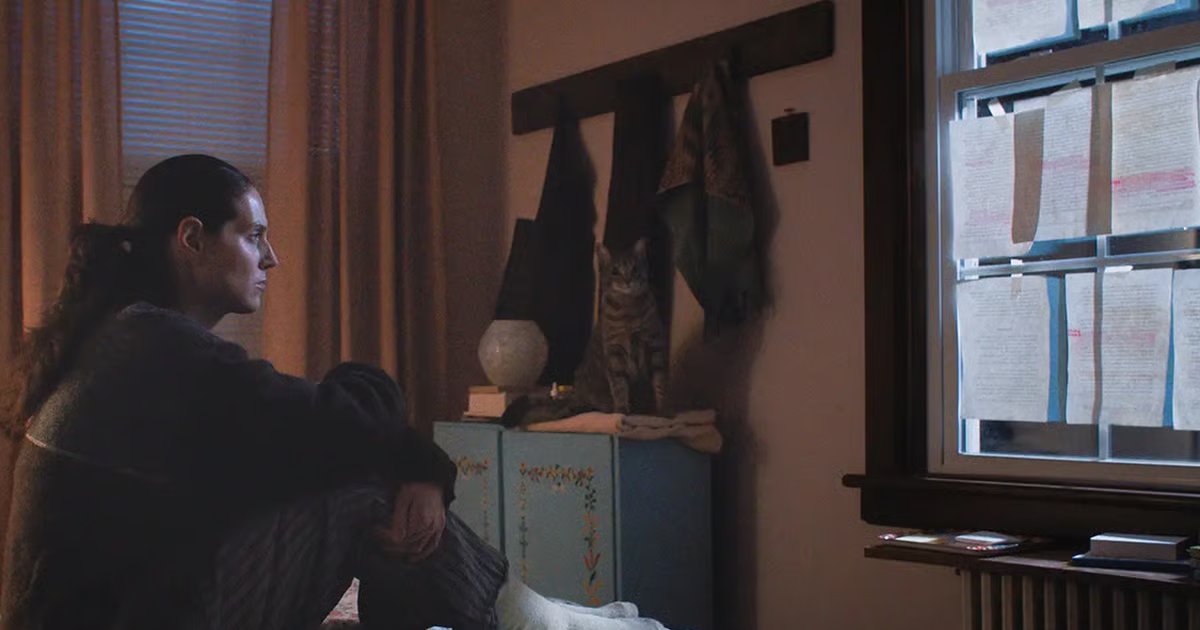
Leaving potentially traumatising sexual violence off the screen comes at no cost to the film’s impact. Over the course of one work day in Kitty Green’s The Assistant, we see how predatory behaviour poisons the environment. Working for a studio executive, Jane (Julia Garner) attempts to go about her duties like a ghost, unseen and unheard, but she cannot escape the overwhelming evidence of her employer’s treatment of women, coming in the form of vile comments from her boss and his soiled office couch which she must clean as thoroughly as a crime scene.
The intergenerational gothic Sound of Falling explores the lives of women on the same German farm across four time periods. Although misogynistic violence (including exploitation of domestic servants, sterilisation and incestual assault) haunts each generation it is never explicitly shown. Instead director Mascha Schilinski offers only one sexual image and it is notably positive. Christa (Luise Heyer), the mother and wife of the most recent generation to inhabit the farmhouse, holds her husband’s flaccid penis in a moment of odd intimacy, affectionately resting her head upon it. Her easy familiarity and lack of hesitation is silently empowering, breaking the cycle of misogynistic trauma that has followed this family.
There are now countless scenes that we can point to as examples of sexual assault and say irrefutably this is bad sexual conduct. When Molly Manning Walker’s How to Have Sex burst onto screens, the booze-soaked depictions of Brits abroad and sexual assault made such an impact that U.K. secondary schools planned to incorporate the film into secondary sex education. Although well intentioned, this demonstrates the limitations of current consent teachings, which are rooted in negative experiences and mainly teaching young boys not to rape and young girls to stay safe, while rarely educating young people on how to have positive sexual experiences.
This isn’t to say we should expect cinema to offer blueprints for best sexual practice, but we should afford space on screen for characters to return to their physicality, whether that be in the awkward manner befitting Agnes in Sorry, Baby, or Lidia (Imogen Poots) reckoning with her voracious and fraught sexual appetite while coming to terms with childhood abuse in The Chronology of Water. Sex is as nuanced and diverse as cinema itself and so its education should be just as rigorous about the grey areas as the hard lines.
At this point in film and wider society, we should know what sexual assault looks like, why it is wrong and the burden that can develop from graphically depicting it in media. By opting to avoid showing sexual assault entirely, perhaps the conversation can reach beyond the act itself and look at the restrictions of consent culture that teaches a binary of enthusiastic yeses and adamant nos. There’s value and power in exploring the rocky healing process and what obligation – if any – survivors have to tell their story.
