
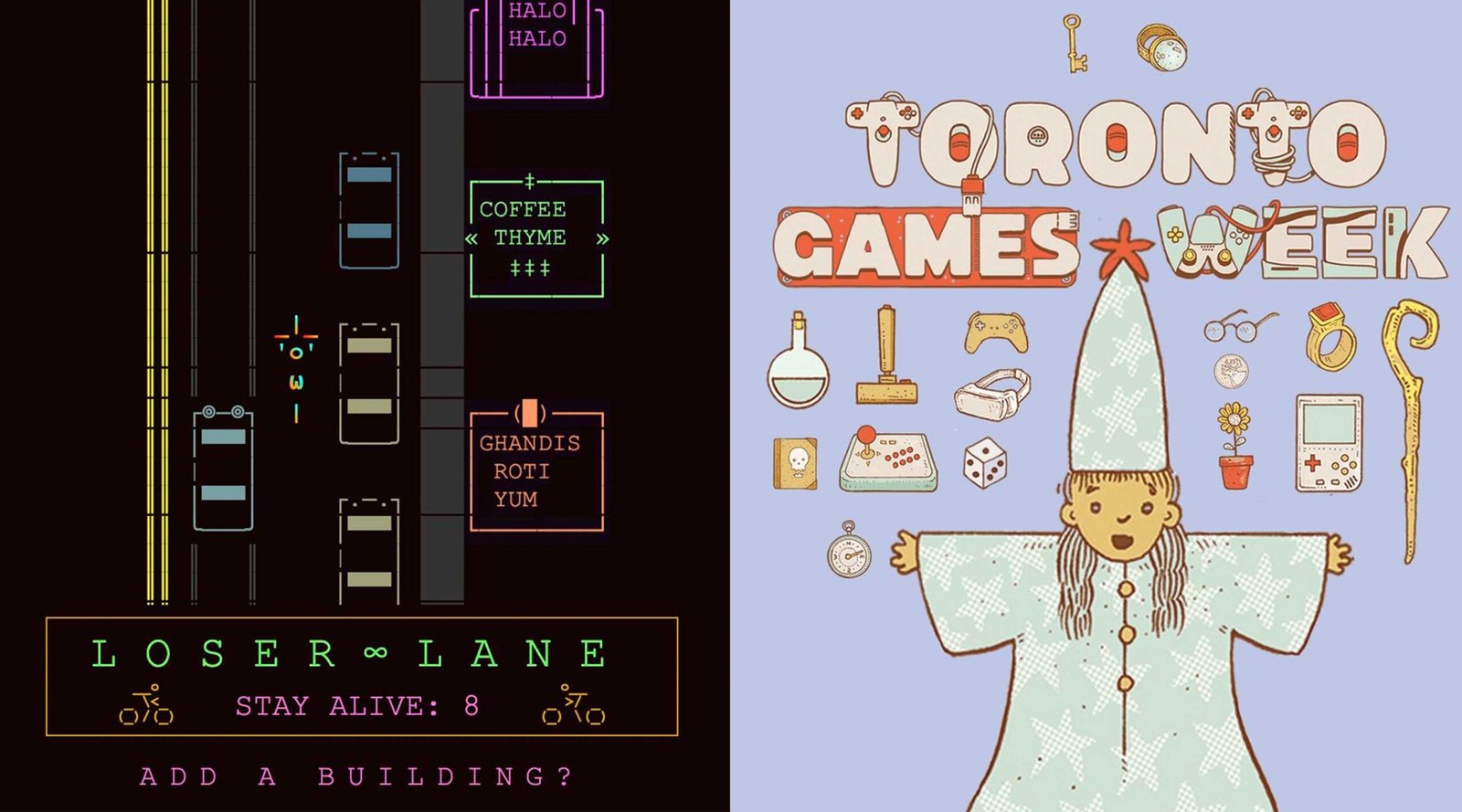
It’s safe to say most people have never played a game quite like Loser Lane. That’s because it’s not really a “game” in the traditional sense.
Playable within your browser, Loser Lane sees you trying to steer a cyclist through the streets of Toronto, avoiding obstacles like moving vehicles and parked cars along the way. The catch, however, is that you can’t actually win.
It’s like an endless runner, except you lose when you inevitably collide with any one of the aforementioned city hazards — hence the game’s title. And when you die, you’re met with a message that sarcastically reads, “Thanks Doug,” a clear reference to Ontario Premier Doug Ford, before linking you to a Cycle Toronto website to petition to keep bike lanes safe and passable.
Image credit: Marie LeBlanc Flanagan
Inspired by creator Marie LeBlanc Flanagan’s own experiences and family accidents related to cycling in Toronto, Loser Lane is a searing indictment of the Ford government’s controversial law restricting bike lanes in the city.
“I heard that Doug Ford was talking about ripping out the bike lanes, and I was immediately flooded with bad feelings — anger, sadness, frustration. Why are we moving backwards?” says Flanagan of what drove her to develop Loser Lane. “I was just overcome with feeling, and I started making something.”
Even before all of this, Flanagan said she regularly stressed about biking to work in the city.
“I lived on Queen West, and I found it terrifying. Every day I would bike, and every day I thought I would die, and I started calling it the ‘Loser Lane’ to my friends,” she says. “I was like, ‘Oh, I was in the Loser Lane,’ as in this space between the parked cars and the streetcar and the oncoming traffic with the pedestrians. So I saw it as a game before I even made games.”
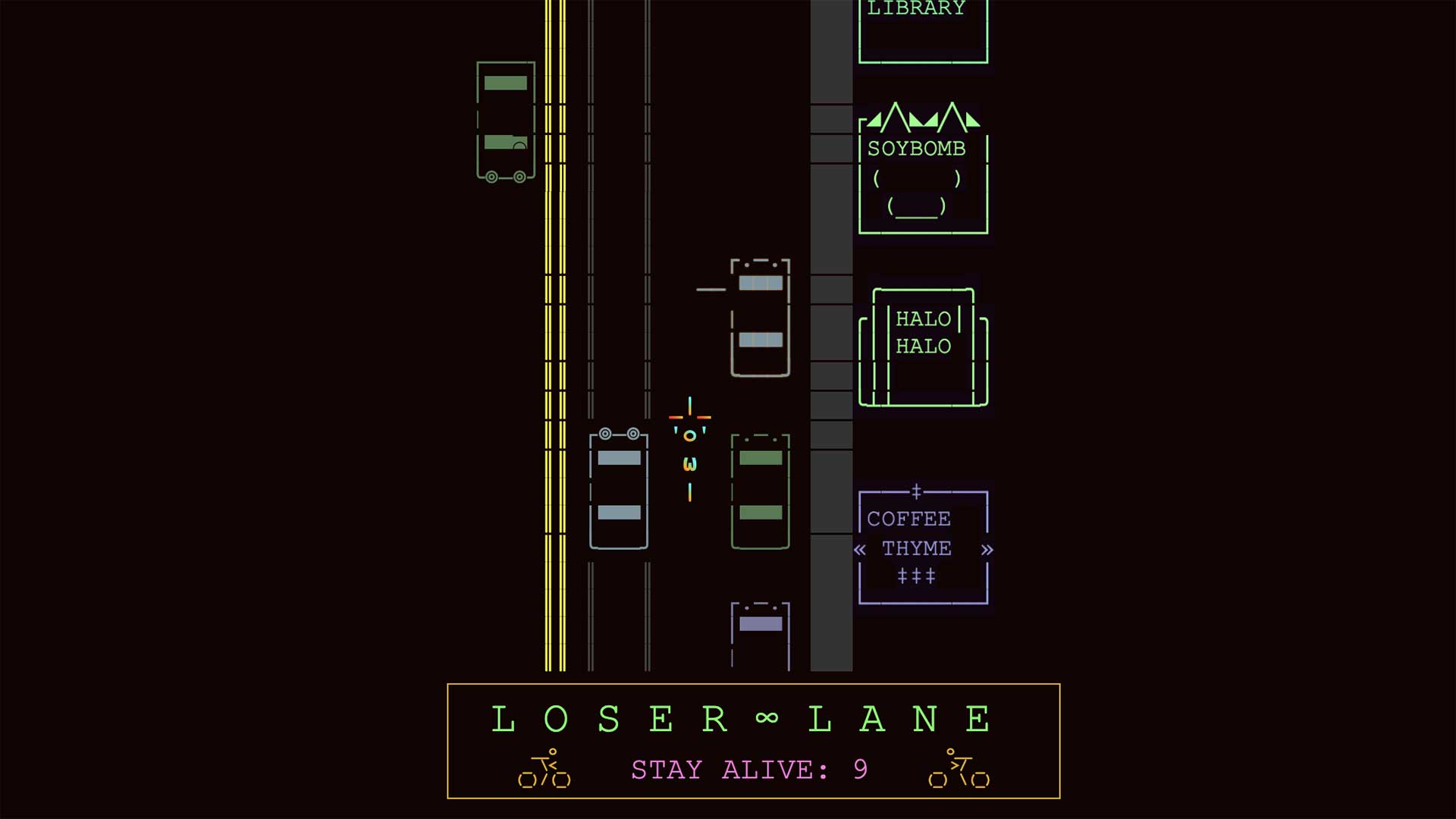
Image credit: Marie LeBlanc Flanagan
A key part of what makes Loser Lane so effective is its brevity. While so many games nowadays are glossy, big-budget affairs meticulously designed to eat away at your time, Loser Lane features rudimentary stick-based visuals and is intended to only be played for around 30 seconds to succinctly get its message across and point the audience towards actionable next steps.
“I wanted it to feel like something that was made by someone, in this way, out of a feeling — not something that takes months or even weeks to make, but something that someone could spin up as I did,” she says. To that point, Loser Lane even features an accessible tool that others can use to contribute buildings.
That simplicity has allowed her to make a Montreal offshoot of Loser Lane, where she now lives. Last year, a McGill study found that the city’s biking infrastructure isn’t matching demand. Flanagan also notes that the previous mayor, Aref Salem, showed support for creating bike infrastructure, but she hasn’t seen the same level of interest from his successor, Soraya Martinez Ferrada.
“She’s said that she’s going to review for bike paths, review the bike infrastructure. And this, to me, seems like a dog whistle that she would like to remove bike paths,” she says. “And there’s a lot of anger, especially from people outside of the city core, about there being a lot of bike lanes in the city core.”
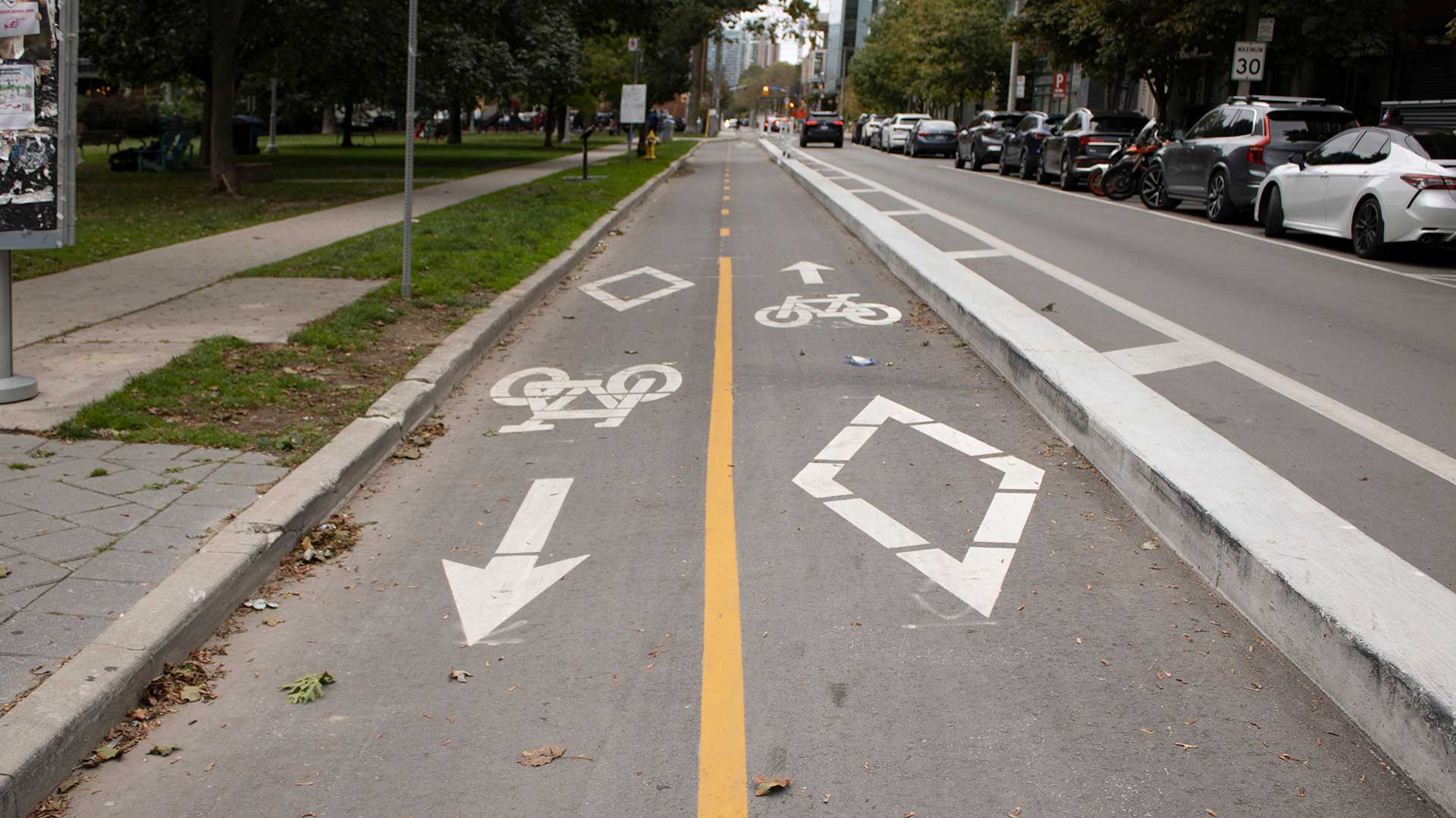
She says the bike lane discussions feed into “many important” broader political topics.
“We should all be aware at this point that we’re in the point of climate crisis that we have critical mass of energy moving in the wrong direction, and that we need to make changes in our lives environmentally,” she says. “I also feel with the rising rates of anxiety — [there’s] depression and loneliness that for many of us, some movement, some activity, some being in spaces with each other would be great. And so I hope that Toronto and all cities will prioritize more infrastructure for pedestrians and for cyclists.”
In December, Toronto Mayor Olivia Chow announced plans to install 20km of bike lanes in the city, although this is still working within the strict restrictions of the provincial government on cycling infrastructure. While Flanagan is aware that it would be a “reach” to expect Loser Lane to single-handedly get politicians to make sweeping changes to biking legislation, she says the response to the game has been “overpowering” so far.
“People were like, ‘Yes, this is me,’ this is how it feels,” she says. “I had someone approach me after I showed the game at the AGO, and they said that their father played the game, and said, after playing for the first time, ‘I understand why this is scary for cyclists. For the first time, I understand this from a cyclist perspective, and for the first time, I understand why we need bike lanes and why this is important.’ And that is the dream for me.”
Experimenting with games in all kinds of ways
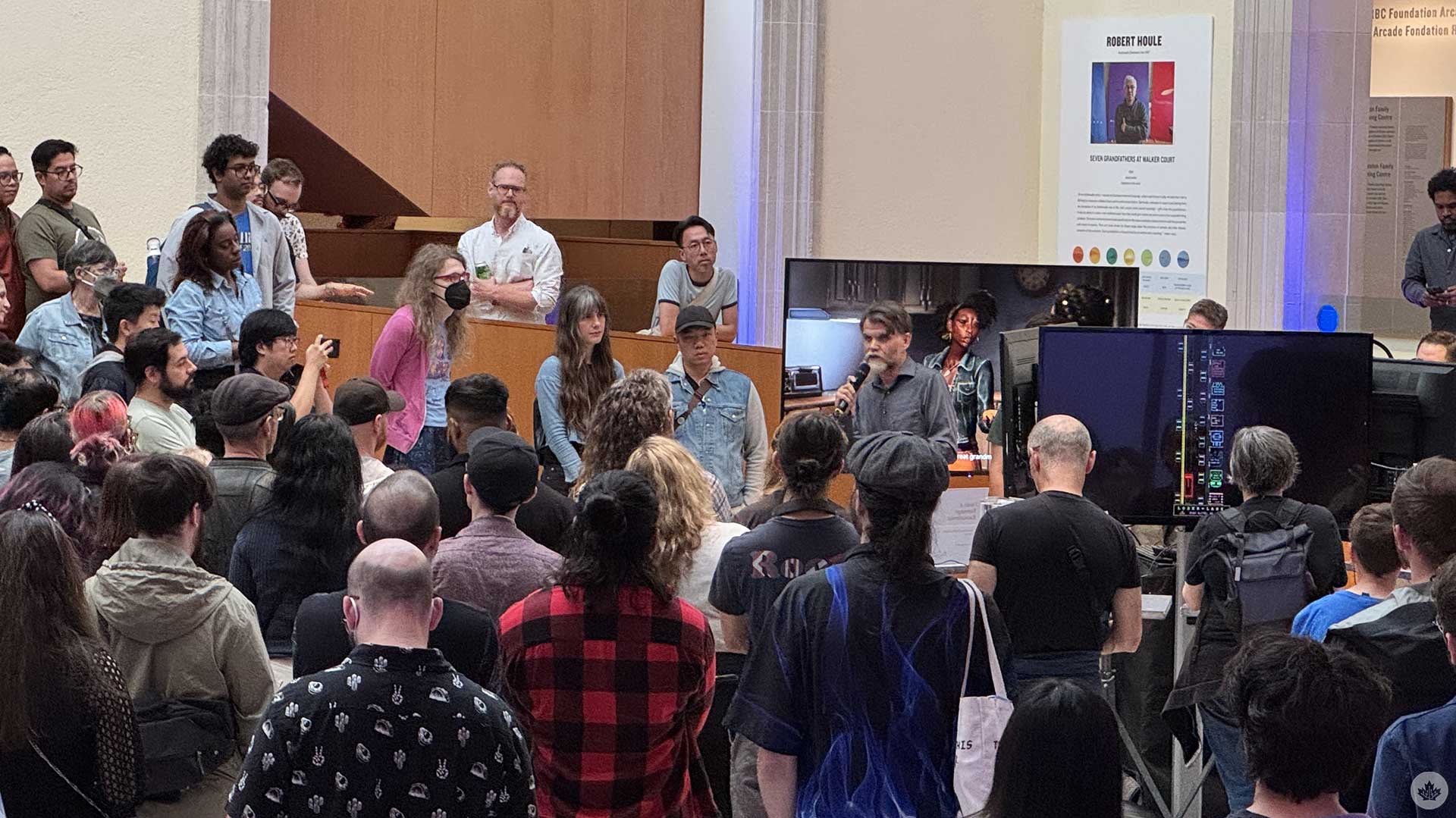
A Canadian video game showcase at the Art Gallery of Ontario in September 2025 featuring games like Loser Lane and South of Midnight.
Something else that’s notable about Loser Lane is how it speaks to Flanagan’s larger creative impulses. As a multi-disciplinary artist, she’s focused on what she says are “the playful spaces between people,” especially when it comes to community. Often, that manifests in what she refers to as “experimental game design” — thinking more outside of the box in terms of what a game can be and how it can be presented.
“It could be an alternative controller, like using your pulse or your facial expression or a mug as the game controller. It could be experimentation in what happens in a game. It can be experimentation with the sound,” she says. “Any kind of weird, unconventional tinkering and play is experimental game design.”
For her, this kind of exploration of different kinds of play “offers new pathways into exploring ideas and issues” that can better reach audiences. “It surprises people, it can delight people. It can also turn into a muddled mess of chaos. But I find that it just has more potential to reach people in a way that they don’t expect.”
With Loser Lane, we see those ideas manifested in an experience that is deliberately basic and short to better serve as a form of activism. But these ideas can also be seen across Flanagan’s other work, like Weird Canada, a blog that focuses on emerging creators in the Canadian arts scene, an annual drone show with events around the world, and the international think tank The Game Arts International Assembly (GAIA). Clearly, there’s an overarching theme of community connecting all of that.
“I feel like the one thread for me is bringing people together. In game design and in community, what does it mean for us to be in presence with each other, be in community with each other? What does it mean to cooperate and not in a soft and fuzzy way, but like in a real way? What does it mean to actually try and work and play with other people?” she says. “What does it mean for us to find equitable and good ways that empower us to be our best selves together? Because we are either moving forward together or not at all.”
All of those goals are perfectly encapsulated in one of Flanagan’s biggest and fastest-growing projects: Toronto Games Week (TGW), an initiative aimed at spotlighting the local game development scene. Flanagan co-organizes the annual June event with another multihyphenate, game developer, sci-fi author and cultural organizer Jim Munroe. It started a few years as just a small Toronto picnic and has since grown to include dozens of events, many of which are free and outdoors.
“It’s important to keep an open invitation and to just keep bringing in new voices and new communities, but also nurture what’s already there,” she says of working on TGW. “The work that Jim and I do is very specific, and a lot of the work that we do is just connecting this person to this venue, connecting these people who might like to work together, and trying to help people see the other people around them that are going to be excited about their ideas and want to collaborate and be in community — because ultimately, many people want to be.”
Some of last year’s TGW events included a focus on connecting diverse creators, a big game jam, a showcase of games from emerging talents and various talks from seasoned and up-and-coming developers. In keeping with Flanagan’s push for experimentation with the art form, a kickoff event featuring local indie studios even had big projections of the games on the wall of the Canada Malting Silos. Amid all of these efforts, the City of Toronto officially recognized June as Video Game Month, with Mayor Chow actually making an appearance at TGW’s Malting Silos kickoff event to meet developers and try out some games.
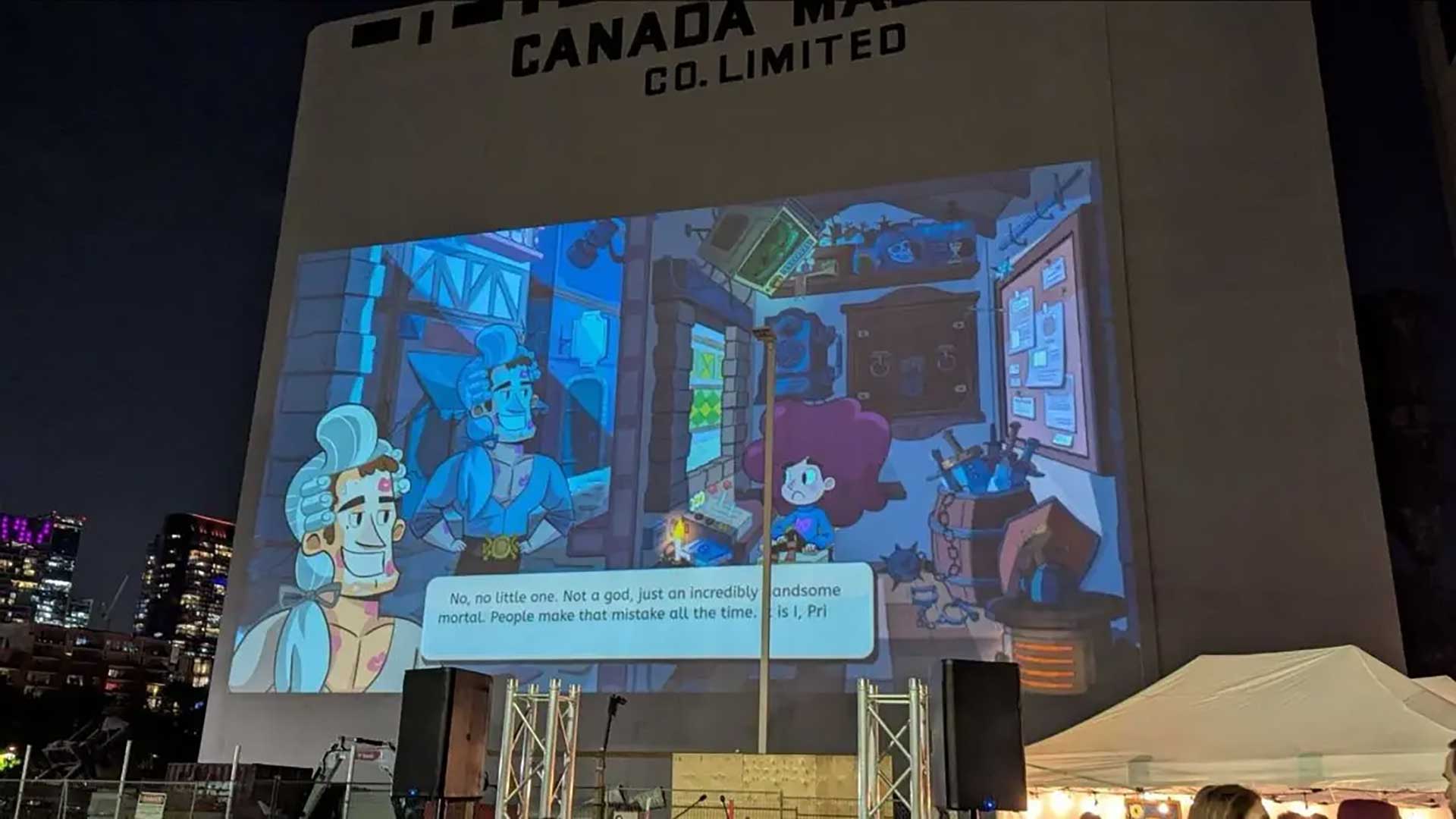
Lil’ Guardsman from Toronto indie developer Hilltop Studios being projected at Toronto Games Week. (Image credit: Interactive Ontario)
This year, Toronto Games Week runs from June 11 to 17, so Flanagan and Munroe are still diligently organizing it. Incidentally, that also overlaps with the first two Toronto games of the FIFA World Cup, which is expected to bring hundreds of thousands into the city. While Flanagan says she can’t talk about FIFA, she’s hopeful that having more people in town will only drive attendance to TGW.
“What I can say is that when there are people in the city who are excited about play in general, it’s a benefit for us. It’s a benefit for everyone. I am excited about it and I think that there’s room for a huge diversity of play,” she says. “It’s like this street party energy, even though some venues are inside, some are outside. We want everyone to have a seat at the table — anyone who’s excited about games and play is welcome to be part of Toronto Games Week.”
As the TGW organizers toil away at this year’s event, Flanagan says she has a lot of ideas on where she hopes to take it. For one, she says she wants to find a better way to unify and promote events, given that there are so many and they can come in different forms, like being indoor or outdoor or requiring registration versus simply being walk-in.
And of course, she wants to continue to partner with more developers and organizations, especially to help with fundraising efforts.
“There are so many people with incredible ideas, and then they need money to make it happen. So we’re always trying to find sponsors or partners or funds that we can connect with individual event organizers to make magic happen,” she says. “There’s an event called DEI or Die that’s a really fun event that happens because a single sponsor just throws them a little bit of money every year. And so this is something that we’re continuing to work on and try and make better — finding more funding.”
Ultimately, she says she’s just excited to see more people come together for TGW, as it creates a “feeling of togetherness” that’s especially important.
“As an event organizer, it can feel like people are indifferent, or like nobody’s trying to support you, but then when you get them all together, it’s like, ‘Oh no, people are just busy, and we do want to support each other,’” she says. “And there’s a lot of energy and enthusiasm in Toronto for games.”
The Toronto and Montreal versions of Loser Lane are available for free via Flanagan’s website. Those interested in getting involved with Toronto Games Week, be it through an event or sponsorship, can learn more on the official website.
Image credit: Marie LeBlanc Flanagan/Jim Munroe
