
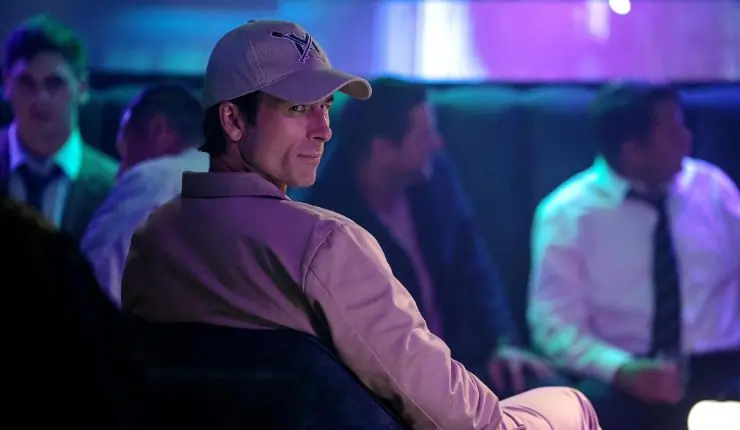
Following his breakout feature Emily the Criminal, writer-director John Patton Ford returns with How to Make a Killing. This witty crime comedy is twisted and entertaining in equal measure. Glen Powell leads as Becket Redfellow, the forgotten love child of the Redfellow dynasty. Raised to believe he would one day inherit the family fortune, Becket embarks on a wicked quest to kill his fellow Redfellows and reclaim his birthright. How to Make a Killing feels fresh and frantic in an era of Hollywood that’s rare on original IP, and the ensemble cast is not only talented but delightfully hateable in the best way possible.
If you weren’t sold on Glen Powell as a leading man after The Running Man, you will be now. Powell brings an energy and charm to Becket in How to Make a Killing that makes him not only likeable, but actively makes you root for his murderous endeavours. The plot utilises Becket as a narrator, which is an engaging choice that definitely helps the audience build sympathy for his plight. It also leads you to question the accuracy of his story and whether Powell’s charming performance is under- or overselling the wild events of the narrative. It’s a crowd-pleasing performance that is a little out of Powell’s usual lane, and one I’d like to see him engage with more often. Powell is the heart and soul of the film, and really carries the weight of its runtime on his shoulders.
The script and direction from Ford is a departure from Emily the Criminal, incorporating much more comedy than was present in his debut. The result is a black comedy thriller, with many of the jokes landing really well. A particular interchange between Becket and Margaret Qualley‘s Julia Steinway in his home got a lot of laughs out of me. The sharp wit in Ford’s writing is a highlight of How to Make A Killing, and helps the pace of the film feel fast and frantic. You’re never more than a minute away from a funny remark or cutting jab, and the ensemble as a whole delivers its lines with glee. The comedy is just one successful aspect of the film, however. The direction and action of the film are really engaging, and there is a particular setpiece between Powell and Ed Harris at the climax of the film that will have you on the edge of your seat.
As mentioned before, while Powell leads, the ensemble is a key aspect of How to Make a Killing. Jessica Henwick is sweet as Becket’s love interest, although the romance doesn’t necessarily land and falls a bit flat. While Powell and Henwick definitely have chemistry, the romantic angle feels little more than an attempt to give Becket a moral anchor, one that he regularly ignores. His relationship with Qualley’s Julia serves an alternative purpose, and does work better as a result. Julia represents the shallow life Becket is murdering his way into, and their childhood romance has clearly altered as their lives and differing social standings have evolved. Julia loves nothing more than money and is exactly the ‘lump of coal’ Becket describes her to be towards the film’s end.
The rest of the supporting cast are entertaining in how detestable they are. Zach Woods‘ hipster artist works so well, as we all have had the displeasure of interacting with a ‘creative’ like that, who is clearly living off of their family’s money. Topher Grace‘s megachurch rockstar pastor is incredibly annoying, especially in an age where those types of personalities are often getting far too much airtime. Raff Law‘s partyboy nepo baby is the stereotypical frat boy with more money than sense, and no purpose in life to make any good use of his money beyond drink and drugs.
Ford makes the strong choice to make almost every Redfellow an inflated caricature of the worst types of people we see in real life, because it makes it all the more satisfying to watch Becket find new and inventive ways to kill them. However, with such a tight runtime and so many characters to service, the Redfellow family doesn’t ever reach more than being caricatures. It may have served the plot and characters better if there were a couple fewer family members to off, as the one with the most interesting personalities, especially Topher Grace’s Steven Redfellow, could’ve been fleshed out stronger before their demise.
The choice to make Bill Camp’s Warren Redfellow sympathetic to Becket was a novel one. In an already unconventional narrative, his supportive role of Becket was a welcome choice and added necessary humanity to maintain a more even tone in the cast. A particular disappointment was Ed Harris‘s Whitelaw Redfellow. In the opening flashbacks detailing Becket’s birth, Whitelaw is swamped in shadow and looks an imposing figure. His role in Becket’s disownment should have been a driving force for the plot, but his presence often feels like an afterthought. The drive for revenge from Becket was so undercooked across the plot that the final confrontation didn’t feel like it had any buildup. The result is a fight that, while tense, lacks tangible stakes, especially considering how predictably easily Becket had been succeeding up to that point.
Overall, How to Make a Killing is a crowd-pleaser, often amusing and really makes the case that Glen Powell can lead a vehicle like this. However, the plot does feel a little undercooked, and the commentary it attempts to make on the corrupting power of wealth leaves a lot to be desired. A strong, detestable ensemble helps elevate the film, but some elements could’ve been fleshed out further or cut entirely, given its concise runtime. In all honesty, an extra 15 minutes could’ve helped the script to go further with some of the plot threads it was grasping at.
★★★
In UK cinemas March 11th / Glen Powell, Margaret Qualley, Jessica Henwick, Topher Grace, Zach Woods, Ed Harris, Bianca Amato, Nell Williams, Raff Law, James Frecheville, Adrian Lukis, Sean Cameron Micheal / Dir: John Patton Ford / StudioCanal
Related
Discover more from
Subscribe to get the latest posts sent to your email.
