
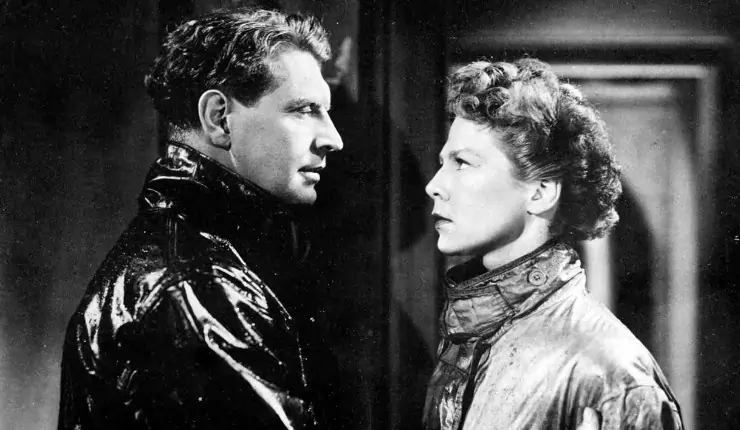
It’s odd that one of the most understated Powell & Pressburger films is also one of their most timeless. The directing partnership is responsible for some of British cinema’s most indelible, visually striking films, but while their most famous films like The Red Shoes and Black Narcissus have an operatic, almost mythic detached quality to them, I Know Where I’m Going! is more personal, more playful, and infinitely more relatable.
Wendy Hiller plays Joan Webster, a headstrong, driven young woman with a head for business, intent on marrying for money and security. Her wealthy, industrialist husband-to-be has rented the idyllic Scottish island of Kiloran for their wedding. But fate intervenes, and a fierce storm traps her in a little Scottish coastal town, with the Laird of Kiloran, Torquil (Roger Livesey) acting as her guide to the rural environment. As Joan waits for the weather to turn, her certainties begin to unravel. Initially aloof and slightly condescending toward the locals, her time with Torquil opens her eyes to an entirely different way of life. The result is a film that is a unique blend of romance, fish-out-of-water comedy, and a kind of spiritual fable that still resonates today.
Hiller is a great lead, bringing her characters ambition, materialism and drive to the forefront without ever feeling too snobbish. She’s clearly desperate to elevate herself to the next social echelon – so much so that even in her dreams she can’t remember her fiancé’s name, imagining her vows as “Do you take Consolidated Chemical Industries…?” – and yet she’s also self-aware enough not to appear a gold digger. Even in her most self-important moments, she’s too self-aware and awkward to really dislike. It’s quite telling that even at the halfway point, she is clearly more comfortable with the eccentric but cheery locals than her fiancé’s sniffy acquaintances. Her gentle demeanour is contrasted with their overt snobbery, and her gradual softening to the local customs feels entirely organic.
Similarly Livesey gives a wry, somewhat enigmatic performance as her love interest. Having previously played the much older Colonel Blimp, here he does the reverse – playing significantly younger than he really was as the youthful, good natured Torquil (losing something like twenty pounds for the part). He’s still perfect in the role, taking the various slights (intentional or not) directed his way with good humour and a kind eye. His chemistry with Hiller is effortless, and their romance feels authentic – but then Livesey is given a formidable wingman in the beautiful Scottish setting. It’s not just the man that Joan is falling in love with, but the whole way of life.
Scotland has never been as alluring as it is here. Powell and Pressburger pay tribute to the local culture and traditions, without it ever feeling too, quaint or patronising. The film is attentive to local culture and rituals – the celebratory Ceilidh is a beautifully observed scene – while also acknowledging the superstitions and peculiarities of island life with affection rather than mockery. The film does present a romanticised environment, but it crucially also feels real and vivid. The line “They’re not poor, they just haven’t got money” captures the ethos of the place and the filmmakers’ admiration for it.
Elsewhere the supporting cast is filled with memorable faces. Pamela Brown is the standout as Joan’s diametric opposite, playing the unruly, liberated Catriona, someone who has foregone the femininity Joan clings onto throughout, but still has an allure of her own. Her presence brings something tangible but ephemeral to the proceedings – she’s not a rival of Joan, but she’s also not quite a friend. She dismisses Joan’s preoccupation with material things with a single line, and remains a perceptive presence for the rest of the film, understanding the central couples feelings for each other long before they do. Brown is incredible, with big doleful eyes that say more than words can. The rest of the cast include Finlay Currie and John Laurie and an impossibly young Petula Clark, all bring character to the film and give it a real lived-in quality.
Though shot in stark, expressive black and white, this was made after the lush Technicolor of The Life And Death Of Colonel Blimp. It’s no less ambitious for this though, with beautiful cinematography and shot composition, making it one of Powell and Pressburger’s most visually controlled, ambitious films. Cinematographer Erwin Hillier evokes film noir and German Expressionism through the use of silhouetted figures on windswept causeways, dramatic shadows cast in the hotel, and atmospheric seafront compositions, giving the Hebrides an otherworldly feel. And that’s not even mentioning the Corryvreckan whirlpool, an awe-inspiring force of nature. The scene where the characters navigate the whirlpool is a stunningly crafted sequence – it’s intense and thrilling, and a startlingly effective example of early visual effects.
Yet this is film also represents Powell and Pressburger at their most playful, as evidenced from the opening titles alone – with the credits appearing as different parts of the set. The unsuitability of Joan’s future husband – along with her growing uncertainty about the marriage – is brilliantly and economically summed up in the scene where she first hears his pompous, brusque voice over the telephone. She asks if he has a cold because his pompous, distracted voice sounds so alien to her after days among softer Scottish accents. Torquil’s amused reactions give way to awkwardness as he overhears the fiance’s dismissive attitude to the locals – it’s a great way to engender sympathy for our central couple while making the unseen fiance instantly unlikeable. The script bubbles with cheeky wordplay throughout though: the local general shouting “Bullocks!” into the phone is a particularly risque detail.
Like Brief Encounter (released the same year!), the smallest gestures carry great significance due to the social mores of the time period. Joan’s insistence on leaving the island is more to preserve a sense of propriety than of a burning desire to get married to her cold future husband. Similarly, the scene in which Joan insists on the two sitting separately at lunch is described in the script as “the first love scene” in the film. There’s a beautiful, almost fourth wall breaking moment where she prays for the storm to break so she can just put some distance between her and Torquil, and the plaintive way she addresses the camera is quietly heartbreaking.
This is the second Criterion released romantic comedy in one month, and an interesting, if slightly apposite accompanying feature to His Girl Friday. If anything it shows the fundamental difference between classic Hollywood movies, and the British film industry. Both films are playful, and push boundaries in their own ways, but where Howard Hawks was anarchic and freewheeling, Powell and Pressburger are insanely disciplined, with beautifully constructed cinematography, and a plot that is meticulously structured. I Know Where I’m Going! may not have the lush colour palette or epic scale of their more famous films, but it remains an unassuming masterpiece; quiet, understated, and genuinely charming in a way that’s often claimed of old films but rarely earned. An essential text of British cinema.
Special Features
This release comes with an incisive, interesting academic commentary from film historian Ian Christie, a documentary on the film, a photo essay from Nancy Franklin, home movies from Michael Powell’s scottish vacations, narrated by his wife, Thelma Schoonmaker Powell, and stills, also narrated by Schoonmaker.
I Know Where I’m Going is out now from The Criterion Collection / Wendy Hiller, Roger Livesey, Pamela Brown, Finlay Currie / Dir: Michael Powell and Emeric Pressburger / General Film Distributors / PG
Related
Discover more from
Subscribe to get the latest posts sent to your email.
