

Too many years ago, I remember slotting a 3.5-inch disk into my PC. With my allowance, I’d bought $5 video game design software from a catalog. And as I looked at the terminal, lost without some familiar GUI . . . my coding efforts died.
Game design became an abstract concept even as I became a game journalist—a topic sketched in notebooks, theoretically discussed, critically observed. That was, until I loaded Moonlake AI. With $30 million in funding from investors including Nvidia, AIX, Google’s Chief Scientist Jeff Dean, and YouTube founder Steve Chen, the 15-person startup founded by two Stanford PhD students dreams of building complete games—from first person shooters to 2D puzzles—via a single, one-shot prompt.
Yes, vibe-coding apps like Claude Code and Replit make it possible to build games, too, but Moonlake is purpose-built for the task. It will never ask you to copy a snippet of code, offers templates to start with if you’d like, and has straightforward paths to bring in your own assets, too. It remembers your vision and constantly works to improve it alongside you.
For a $40/mo subscription (though you can technically try the platform for free), you type what you want to play, and presto, it’s coded, bug tested, and appears into existence.
Launching to the public in beta today, the Moonlake AI team knows they aren’t a one-shot game generator yet—while I was playtesting my first draft game in minutes, it took hours of going back and forth with the machine to polish it much further.
And in fact, the longer term goals for Moonlake AI stretch well beyond the lofty goal of vibe-coding video games. Their larger plan isn’t just to build Moonlake to be more capable, but to leverage the process of video game design itself to build a frontier AI model for the world.
Building my game in Moonlake AI
Am I the only one who, staring at the prompt, facing this machine that can do anything, suddenly can’t think of doing anything?
It was this lack of creativity that sunk me the first time I’d taken Moonlake for a test-drive. I couldn’t come up with anything unique, so I suggested a 3D dungeon crawler. Despite having no original ideas, I walked through my vision in a multi-paragraph, explicit prompt. It felt too taxing to the system, too grand in scope, and too out of touch with what I imagined. My prompt was realized as one big broken room filled with pill shaped characters and no simple way forward.
When I recount this story to Moonlake AI cofounder Sun Fun-Yun, he suggested starting smaller. Focusing on smaller interactions and building from there. (Even though he shared a few single-shot projects that he’d made in one day, including this Centipede clone and postapocalyptic simulator).
So I did the human work, and racked my brain for days before landing on a new concept: A miniature chef runs back and forth with a giant ice cream cone, catching falling scoops of ice cream. They stack and get harder and harder to balance. From here, I could pursue all sorts of game loops, depending on what felt fun about it (maybe you got points for each scoop, maybe some flavor combinations introduced bonuses, maybe ice cream scoops you didn’t catch got in the way). But for now, I focused on this simple introduction.
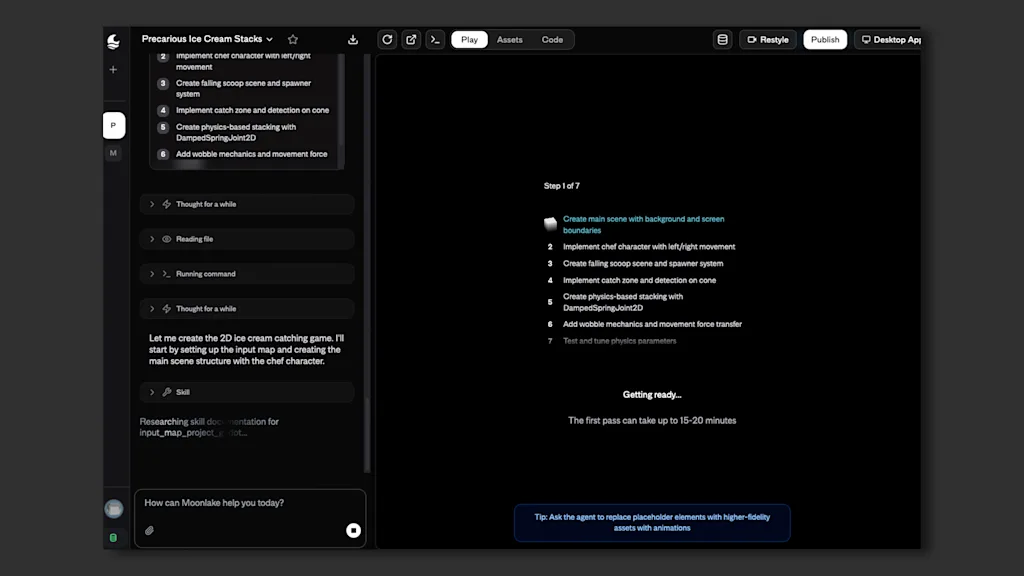
I typed this request into the prompt on the left side of the interface. And much like ChatGPT, Moonlake got to work, praising me for my brilliant creative idea, and then breaking down the tasks that would need to be taken to bringing it to life.
Moonlake offered me an estimate of 15–20 minutes to finish the job. Then it launched: Faster than I could possibly parse, the system created and worked through a checklist of to-dos. It needed to create graphic meshes, wobble mechanics, and sprites for my graphics. It researched topics it didn’t readily understand. A mix of plain language explanations, and then hundreds of lines of code, populated into the chatbox, expanding and then consolidating away from my eyes.
I was impressed by the decisions it made on its own, not just breaking down necessary tasks for a minimum viable product, but introducing a bouncy animation when the ice cream hit the cone (a detail I figured I’d add in a polishing pass later). The system even said it was loading the game, and testing it—spotting and squashing a few bugs—before that magical button appeared in the big center box making up most of the UI: Play Game.
The moment reminded me of the first time I tried gen AI; this actually worked! Sort of!
My first draft felt something out of the early PC gaming era. My chef was too big, cone was too small. And the ice creams wouldn’t stack.
But gosh, it got so much right about my simple pitch. The core vision was there. Ice cream fell at just the right pace from the sky. The scale of the entire scene felt right. The controls were all mapped without me needing to explain which key should do what. My chef . . . was something of a white blob stuck to a cone. He needed work. But Moonlake even did a decent job of creating a white tile kitchen background, with subtle sundaes printed upon it like murals.
From there, I began lecturing the machine to fix the ice cream so it stacked. That created other issues. Ice cream started stacking, but would fall with any movement. Negotiating the feel led me to try all sorts of new prompts, and even as it failed and failed again, I started recognizing how the AI was translating ideas like stickiness into its own annotated code. Hours of casual updates in a tab in my browser followed.
Fixing the physics of the scoops was vexing. I ended up in a loop of not quite solved problems.
But I also asked for a new chef, this one with a proper, giant hat, with little sweat marks poking out every time he changed directions. This entire idea, Moonlake nailed out of the gate. My exact preferred aesthetic? No. But it captured the vibe. I found myself pleased, but also realizing that polishing this experience into something that felt delightful would take a lot of work. Another day? A week? It was tough to tell.
The next morning, in a final ditch effort (I did have an article to file!), I decided to add a bunch of my lingering requests in one final push just to see what Moonlake could do. I wanted big multiplier scoring, a Kawaii graphic upgrade, and a few more fixes to my vexing scoop physics.
It was unfair to request all these updates at once, and almost sure to break something. Fifteen minutes of coding followed, while I grabbed a coffee. What I returned to? Largely my brief! A few new issues around ice cream slippage! A game over screen I didn’t ask for! But, at last, a true game—built for about 950 of my 1,500 monthly credits—and published for you to try with a button press.
(Moonlake is still determining pricing on extra credits.)
Creating the frontier model
Like a lot of AI companies, Moonlake is only charging customers its cost of computing—which is why the base subscription comes with a limited amount of credits to run the AI. Everyone believes that cost should go over time, which could either widen Moonlake’s margins on subscriptions, or simply be reinvested to make the platform more capable. But only when I ask how Moonlake trained its model do I really learn how it all works, and to some extent, why this video game generator even exists as a business.
Moonlake is an ever-growing AI model. However, it’s also really a video game building agent that takes your task and coordinates it with several specialized third party AI models that might handle anything from physics to asset generation. And it’s also growing into something even more ambitious as a result of sitting on top of so much existing AI power.
“Ours is an orchestrator that learns to fuse these modalities together,” says Fan-Yun. “And over time, our model can actually be more and more capable and incorporate other models’ capabilities into our own.”
But that’s only the start of the strategy. As you vibecode in Moonlake, you are creating your own video game. You are also training Moonlake’s own frontier model—what falls into a very hyped segment of “world models” or what Moonlake qualifies as “multimodal models”—that don’t just rearrange words and concepts LLMs, but have a deep understanding of what the world is, how it works, and how all of its surfaces and touchpoints respond to inputs across physical space.
That means when I correct Moonlake, saying an ice cream scoop should stack and stick atop another scoop of ice cream, it effectively learns that scoops of ice cream stick atop one another. Multiply that across millions of highly specific user requests, and as Moonlake AI cofounder Sharon Lee explains, game design could provide a perfect training loop to feed countless data points about how we expect the world to work into these world models.
No, many or even most games don’t operate on real world physics which would translate 1:1 in some simulation. But in some cases they do, and Moonlake could extract such real physics for their own simulations. Furthermore, the founders believe the aforementioned causal relationships it’s mapping will still add a clarity to world models that’s otherwise hard to pin down.
“There’s a gap between large language models today and semantics they understand, versus actually building [a] world out,” says Lee. And they believe that gap can be closed with more, intentional data.
Today, researchers are trying to get these world inputs by renting Airbnbs and scanning the rooms with lasers, but that is relatively static information that is hard to scale. AI can also analyze videos to draw conclusions, but those lack the sharpness of human contextualization. As for video games? “If you train a model on just a lot of Fortnite data, you know that you’re not going to really generalize to real world data,” says Lee. “[Our] data will just scale exponentially compared to hand curated data or collected data.”
Even Google’s Genie AI can generate a slew of amazing 3D worlds with some interactivity, but the interactions they afford are superficial at best.
“I think the difference is sort of observing the world as it is, versus observing and understanding the world with causality,” says Fan-Yun. And so causality is what Moonlake is after.
Gaming is a task for V1 of Moonlake’s model because the user feedback loop can teach it so much, but in the future, the team imagines applying a more mature version of this model to other fields. They see opportunities to train the next generation of robotics or improving driverless cars. Lee says they’ve even fielded calls from manufacturing companies, that imagine understanding the human side of the equation could help identify human factors issues in product design and assembly line production.
The challenge, of course, is building Moonlake well enough that it produces games up to the standards of gamers, and that it continues investing in the product, so that people can restyle the entire graphics package with a button press, or easily export these games to sell on PC, iOS, or any other platform they would like.
These ideas are all on the road map. But for now, Moonlake AI offers an accessible trip into the vibe-coding era, all through the lens of fun.
