
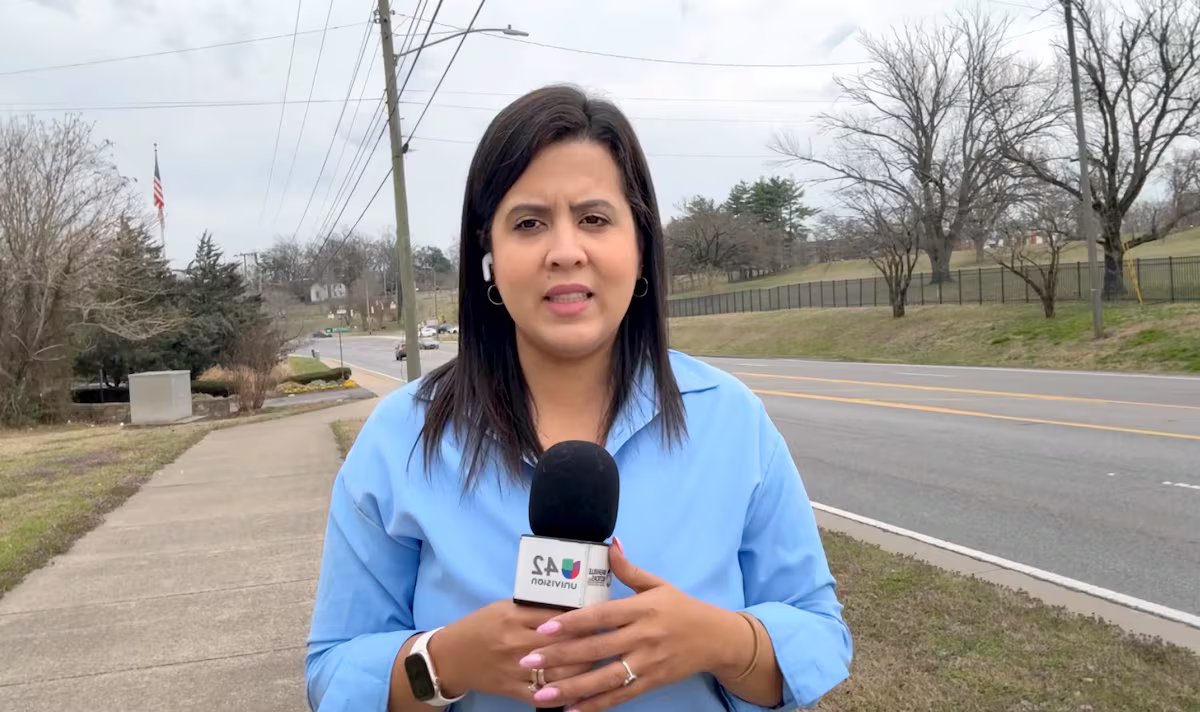
Colombian journalist Estefany Rodríguez remains in the custody of U.S. Immigration and Customs Enforcement (ICE) despite an immigration judge ordering her release on bail on Monday, after immigration authorities appealed the decision. Rodríguez, a reporter for the Spanish-language news outlet Nashville Noticias, was arrested on March 4 while she was with her husband in a vehicle bearing the outlet’s logo. According to testimony gathered by her defense team, immigration agents in unmarked vehicles surrounded and detained her in an operation that her lawyers describe as targeted and non-routine.
Although an immigration judge granted her $10,000 bail on March 16, immigration authorities decided to appeal the decision that same day, which has kept the journalist in custody at a detention center in Louisiana. The situation has complicated her legal defense, especially after days without communication with her team. “That’s a very difficult situation when you’re trying to, you know, defend her rights as a journalist,” her attorney Joel Coxander told the press.
The defense has also raised concerns about her detention conditions. Coxander told Nashville Noticias that his client has been subjected to “inhumane and difficult treatment,” while court documents state that she was held in solitary confinement for several days and subjected to procedures that may have affected her health.
The attorneys maintain that Rodríguez was detained without a valid warrant and that there are inconsistencies in the documents subsequently filed by the government. They also argue that the detention constitutes retaliation for her journalistic work, particularly her coverage of ICE operations.
“Estefany’s case is important not because it is unique but because it highlights the cruel and violent crackdown against our neighbors with the current mass deportation agenda we have been fighting against,” Coxander said.
Rodríguez arrived in the United States in 2021 after fleeing Colombia, where she received death threats related to her work as a journalist. Since then, she has applied for asylum and obtained a work permit valid through 2029. She also recently began the process of obtaining permanent residency after marrying a U.S. citizen. Her asylum case remains pending.
Immigration authorities, for their part, maintain that the journalist violated the terms of her immigration status by failing to attend scheduled appointments. However, her family and defense team assert that one of the appointments coincided with an ice storm that paralyzed Nashville and that it was subsequently rescheduled by the agency itself. “Our families belong together, and this broken immigration system has deeply harmed thousands upon thousands of families across the country,” her husband, Alejandro Medina, told the press.
Various international organizations have reacted to the case. The Committee to Protect Journalists (CPJ) called for her immediate release and expressed concern over the amount of the bail and the delay in executing it. “We are heartened to see that Estefany Rodríguez was ordered to be released from Immigration and Customs Enforcement custody at her bond hearing but are concerned that her bond is unusually high. Her team must be allowed to pay her bond immediately, and Rodríguez should be released without delay,” said Katherine Jacobsen, CPJ’s program coordinator for the United States, Canada, and the Caribbean, in a statement.
The organization went further by warning of a broader pattern: “The Department of Homeland Security and its affiliates are increasingly being used to police First Amendment rights, including freedom of the press. Rodríguez’s arrest is the latest example in a troubling pattern.”
Similarly, Reporters Without Borders (RSF) denounced the case as illustrating the risks faced by migrant journalists in the United States: “Once again, ICE agents have arrested a journalist who was covering their actions. Estefany Rodríguez’s arrest and detention are likely unlawful and a shocking illustration of the dangers journalists covering immigration in this country face.”
Rodríguez’s arrest comes amid an intensified deportation drive by the Trump administration, in which journalists covering these policies may be subject to scrutiny or reprisals. One of the most widely reported cases is that of Salvadoran journalist Mario Guevara, who was detained and subsequently deported after covering immigration protests.
Sign up for our weekly newsletter to get more English-language news coverage from EL PAÍS USA Edition
