
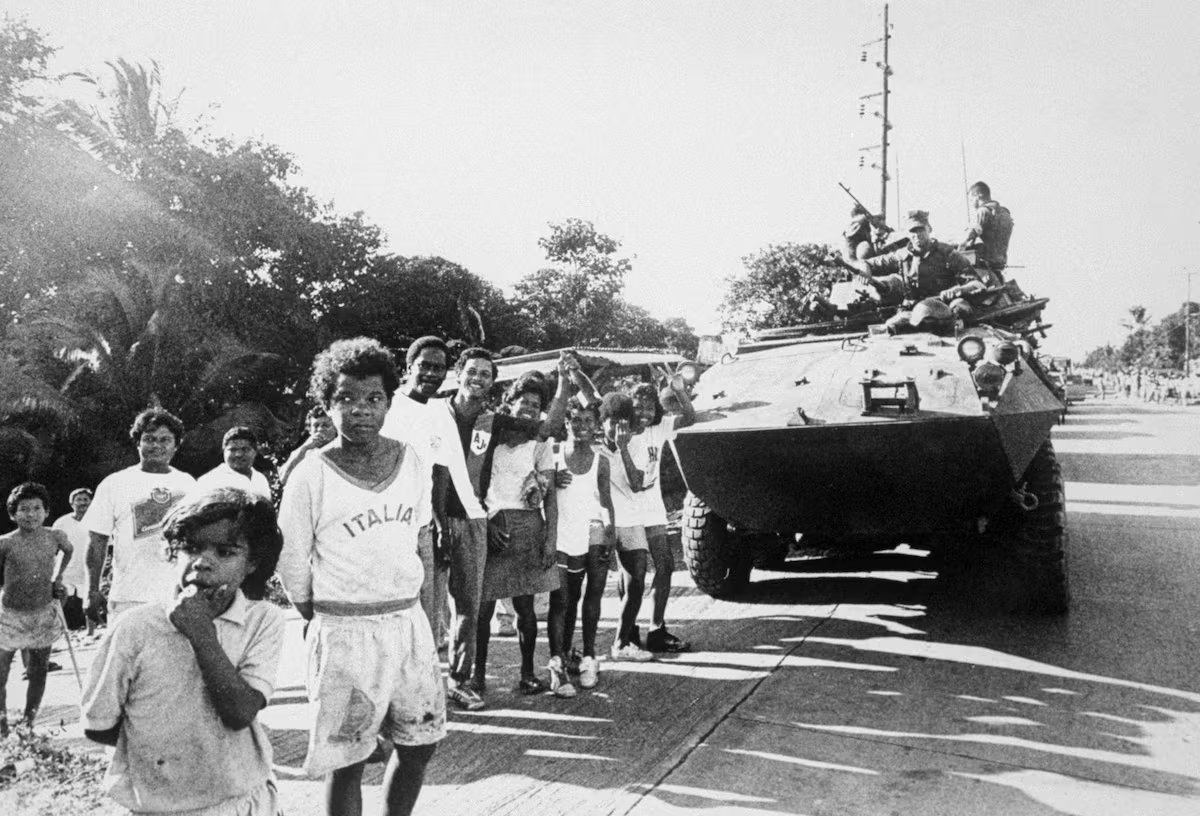
On January 3, Panama woke up with the strange sensation of looking in a mirror. During the early hours of the morning — while the world tried to process the details about the capture of Nicolás Maduro, as a result of a U.S. military operation — the country that is home to the Panama Canal once again delved into a wound that, 36 years later, remains open: the 1989 U.S. invasion.
The scene remains alive in the country’s memory. It returns, again and again, suspended between the past and contemporary debate. At midnight on December 20, 1989, the United States military offensive was deployed simultaneously, by land and by air. Helicopters, fighter jets and special forces took over strategic points in the capital and its surroundings, while entire neighborhoods woke up to the roar of explosions and gunshots. The objective was to put an end to the regime and capture the dictator, Manuel Antonio Noriega. He surrendered just days later, also on January 3, a coincidence that returns an unfinished story to the present.
For a nation without an army — one which manages a strategic sea lane for global trade — the operation in Venezuela brought up an uncomfortable question: what room to maneuver does Panama have when the United States decides to act in its own “backyard”?
Every so often, this question resurfaces. On January 20 — the one-year anniversary of Donald Trump’s return to the White House — the U.S. president avoided answering a question about whether his intention to “take back” the Panama Canal was still on the table. “I don’t want to tell you that.” He then paused, gave a tight smile and shrugged: “It’s sort of on the table.”
Although in Panama that response didn’t make major headlines — beyond social‑media comments like this one: “The Canal of 2026 is not the Canal of 1999; he has no idea how any of this works […]”— the comment evoked the bitter memory of January 20, 2025, when, during his inauguration speech, Trump set his sights on the Panama Canal. “China is operating the Panama Canal. And we didn’t give it to China. We gave it to Panama, and we’re taking it back,” he said at the time.
“He mentioned Panama six times [in his inauguration speech]; curiously, he didn’t mention Venezuela, but Venezuela suffered the consequences of a policy that, if I had to summarize it, is the end of multilateralism,” said former Panamanian Foreign Minister Jorge Eduardo Ritter on a local television channel.
The president of Panama, José Raúl Mulino, responded with a resounding “absolutely not” when asked in Davos, Switzerland, if — amidst the tension over Greenland, Venezuela and Canada — he feared a new escalation over the Canal. However, on the isthmus, the conversation is still alive, and it’s reinforced by the persistent echo of what happened in Caracas.
When history returns to the debate
An analysis by the consulting firm SHIFT Porter Novelli examined more than 2,500 comments on Panamanian social media between January 3 and 8, the days when Maduro’s capture dominated public conversation. It revealed that 44% of the mentions used geopolitical and historical language, with direct references to the 1989 invasion. Another significant percentage of social media users expressed fear that the action in Venezuela would set a precedent for future interventions in Latin America.
During the turbulent days of the first-half of 2025, the U.S. president was insistently talking about recovering the Panama Canal. In Washington, according to NBC News, the possibility of a military intervention — in order to ensure the operation of the interoceanic waterway — was even briefly mentioned. However, the Pentagon ended up ruling out this option.
“Panama lived through 2025 under the weight of concerns caused by Donald Trump’s expressions about the Canal,” recalls John Feeley, a former U.S. ambassador to Panama. Still, he rules out that there’s a risk of U.S. military action against the country, its government, or the Canal. What he does recognize is a deeper impact, which is linked to a historical perception that’s difficult to eradicate. “[General] Omar Torrijos, [who governed Panama from 1968 until 1981], said that the security of Panamanians was in the shadow of the eagle. That shadow is still there,” he says. In his view, many in Latin America still believe that if a country does something Trump dislikes, it could trigger an unwanted reaction.
This perception is reinforced by the strategic value of the Panama Canal, through which more than 14,000 ships transit per year. The infrastructure connects more than 170 countries through nearly 190 trade routes. For sociologist Danilo Toro, the Panamanian reaction to the fall of Maduro cannot be understood without considering the Canal’s central role in U.S. foreign policy. “It’s not that Panama wasn’t important before. It always was,” he maintains. “The difference is that, under the Trump administration, this value was expressed more explicitly and recurrently.”
Feeley rules out that the operation in Venezuela responds to a hemispheric security strategy or a commitment to Venezuelan democracy. “The United States did not act for democratic reasons, not even to remove a dictator,” he says. “It did it for other reasons: oil.” In his view, what unsettles much of the region is not whether Maduro did or did not deserve to be removed from power, but the fact that Washington chose to violate another state’s sovereignty.
That concern is reflected in public sentiment. According to a recent survey commissioned by the International Center for Political and Social Studies (CIEPS), seven out of 10 people believe Trump’s intention to regain control of the Canal is real.
Between caution and diplomacy
Domestically, Mulino has adopted a stance of support for the democratic path. He conveyed this directly to Venezuelan opposition leader María Corina Machado, urging her to remain firm in defending the popular will. Days after the military operation in Caracas, he reiterated that position and reminded the public that Panama safeguards the records that, according to the Venezuelan opposition, show that Edmundo González Urrutia won the July 2024 presidential election.
Panama’s Foreign Ministry echoed that stance in a statement calling on “the de facto authorities that still remain in Venezuela” to recognize the electoral results, and emphasized Panama’s role as custodian of the records.
This official position coexists with a Venezuelan presence that’s part of the Central American country’s daily landscape. The Venezuelan diaspora in Panama exceeds 58,000 people, according to the latest census.
For many of them, the news of Maduro’s capture came as a shock. The early hours of January 3 unfolded amid frantic messages, urgent phone calls, and the anxiety of those who felt something they believed buried in the past was suddenly resurfacing.
Ricardo Contreras, a member of the opposition collective ConVenezuela and a Panama resident for five years, recalls it this way: “We didn’t really know what was happening. News was coming and going until Trump announced he had Nicolás Maduro in custody.”
Not all reactions, however, followed that line. Four days after the military operation in Caracas, the National Police of Panama put down a demonstration by students from the country’s main public university: they were going to protest in front of the U.S. ambassador’s residence. The episode highlighted that — beyond the Venezuelan community — the event had struck a nerve within a segment of Panamanian society.
Two operations, two contexts
According to the Venezuelans interviewed for this report, the U.S. offensive hasn’t substantially altered their life plans. Regardless of what happens in their country of origin, Panama continues to be perceived as a haven of stability. However, the political dimension of the event opened a broader debate about the place that Panama occupies in the face of Washington’s actions in Latin America.
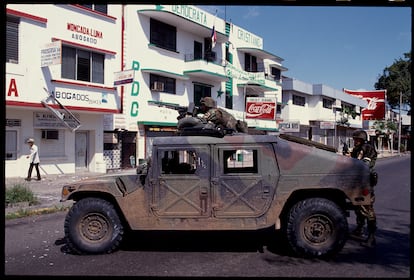
For Feeley, the parallel between the invasion of Panama in 1989 and the operation in Venezuela is tempting, but misleading. “They’re different cases,” he affirms. In Panama, for instance, there was institutional coordination, consultation with Congress and a democratic transition process. “In Venezuela, there wasn’t regime change, but rather a replacement of leadership within the same regime.”
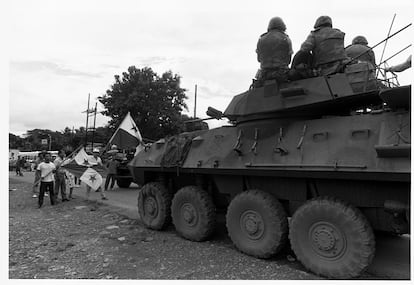
Political analyst Cristina Ramírez, a doctoral student at King’s College London, agrees that the comparison is forced. In 1989, she points out, the United States not only captured Noriega, but also dismantled the structure of the regime, enforced the electoral results from May of that year and kept troops in the country to guarantee a transition before withdrawing. A similar deployment in Venezuela, she adds, is practically unthinkable today, both due to its military cost and the lack of internal consensus within the United States.
Ramírez also highlights another key difference: the relationship between Panama and Washington was governed by treaties that protected the neutrality of the Canal and established a clear withdrawal schedule. “There were no demands or conditions made in exchange. Ten years later, the Canal passed into Panamanian hands as planned,” she recalls.
The gap isn’t only political, but also economic. After the invasion of Panama, the United States contributed to the institutional reconstruction of the country. In the Venezuelan case, Feeley maintains, there’s no comparable commitment. “[In this case, we’re not talking] about transition or reconstruction. We’re talking about profits,” he says, alluding to the control of oil resources.
Panama, once again, is seen from that blurry border that separates institutional memory from crude geopolitical interests.
Sign up for our weekly newsletter to get more English-language news coverage from EL PAÍS USA Edition
